
27 October 2026 · Astrummo
When Will I Get Married? How Vedic Astrology Reads Marriage Timing
Discover how Vedic astrology examines marriage timing through the 7th house, Navamsa (D9), Vimshottari Dasha and planetary transits.
Two people are born on the same day, under almost identical planetary skies. Yet their Vedic birth charts can tell very different stories. Discover how birth time, location, Lagna, Moon Nakshatra, and Vimshottari Dasha make each chart unique—with a real astronomical calculation.
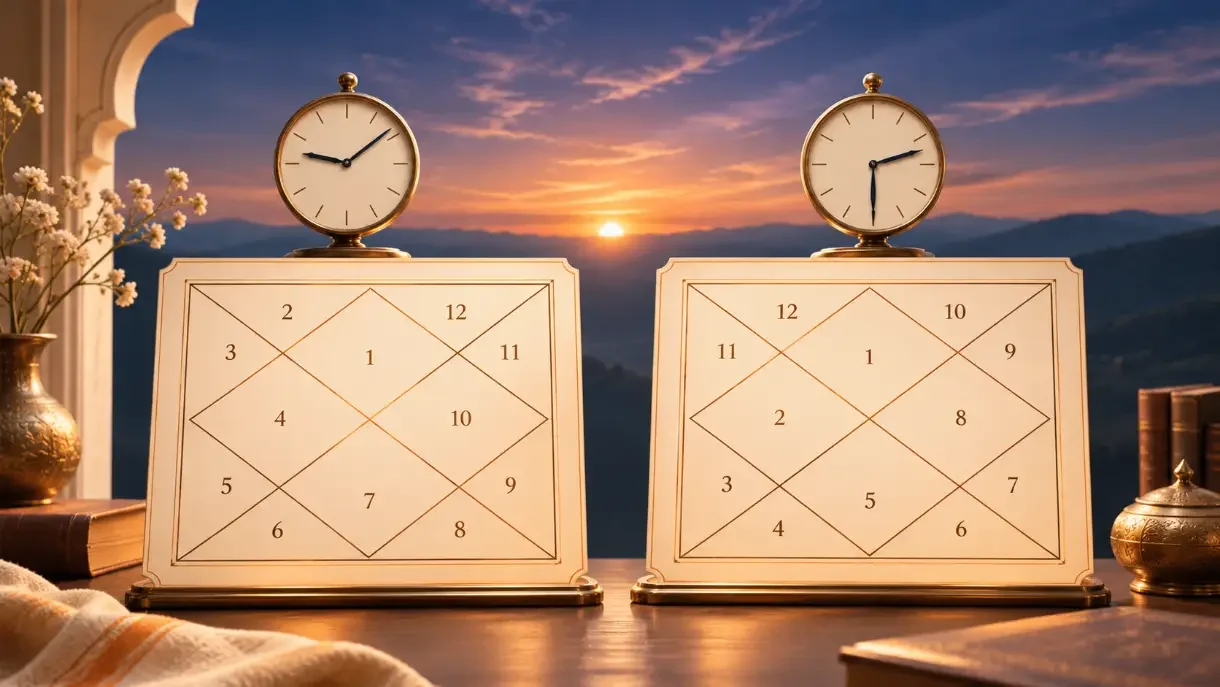
Two people share a birthday. Their Sun signs match, their Moon signs may be identical, and most planets occupy nearly the same positions. Yet their Vedic birth charts can tell remarkably different stories. The explanation lies in three details that ordinary horoscopes often overlook: birth time, location, and the mathematics of Jyotisha.
Imagine two babies born in the same city on the same day.
The first arrives at eight in the morning. The second is born twelve hours later, at eight in the evening.
Both enter the world under almost the same planetary sky. The Sun has barely changed position, and most of the planets remain in the same zodiac signs.
If you looked only at their birthdays, you might assume that their horoscopes would be practically identical.
But when an astrologer calculates their complete Vedic birth charts, something interesting happens.
The first child may have one Ascendant, while the second has a completely different one. Planets that occupy the tenth house in one chart may fall in the fourth house of the other.
Even their planetary-period calculations can begin at different points, despite the children sharing the same birth Nakshatra.
This is one of the reasons Jyotisha cannot be reduced to the familiar question, “What's your zodiac sign?”
A birth date tells us something about the sky. It does not tell us everything about the sky as it appeared from one particular place, at one particular moment.
And in Vedic astrology, that distinction changes the structure of the entire chart.
Most people encounter astrology through a Sun-sign horoscope.
You enter your birthday, discover your zodiac sign, and read a general description associated with it.
That approach is simple and accessible, but it leaves out most of the information used in a complete Vedic birth chart.
In Jyotisha, the natal chart, traditionally called a Janma Kundali, is calculated from three essential pieces of information: the date of birth, the time of birth, and the location.
Each serves a different purpose.
The date establishes the general positions of the planets. The time determines where those planets and the Ascendant fall at the moment of birth. The location establishes the observer's geographical perspective.
Together, these inputs make it possible to calculate the Lagna, the twelve houses, planetary degrees, Nakshatras, and other details used in traditional interpretation.
This is why two people born on the same day may share several planetary placements while still having distinctly different charts.
The most important difference often begins with the Lagna, also called the Ascendant.
The Ascendant is the point where the ecliptic meets the eastern horizon at a particular moment and location.
As Earth rotates, this point changes continuously.
Over the course of a day, all twelve zodiac signs can rise on the eastern horizon, although their rising durations vary with geographical latitude and time of year.
This creates an important distinction between the position of a planet and the position of that planet within the houses of a birth chart.
Consider the Sun.
Two people born twelve hours apart will generally have the Sun in almost the same zodiac position. The Sun moves by approximately one degree per day, so its position changes relatively little over half a day.
But if their Ascendants differ, the Sun can occupy entirely different houses.
In a traditional whole-sign Vedic chart, the Ascendant sign establishes the first house. The following signs then become the second, third, fourth, and remaining houses.
The house occupied by a planet is therefore not determined by its zodiac sign alone.
It also depends on where the chart begins.
For someone new to Jyotisha, Astrummo's beginner's guide to reading a Vedic birth chart explains how the Ascendant, twelve houses, and planetary rulerships work together.
Let's make this more concrete.
Imagine two births in New Delhi, India, on November 4, 2026.
One takes place at 8:00 a.m. The other occurs at 8:00 p.m.
Both times are in Indian Standard Time, and both charts use the same geographical coordinates and the Lahiri sidereal zodiac.
Using Swiss Ephemeris, their Ascendants are approximately:
Birth detail | Person A | Person B |
|---|---|---|
Date | Nov 4, 2026 | Nov 4, 2026 |
Local birth time | 8:00 a.m. IST | 8:00 p.m. IST |
Birthplace | New Delhi | New Delhi |
Sidereal Ascendant | Scorpio, 4°40′ | Taurus, 28°31′ |
Moon sign | Leo | Leo |
Birth Nakshatra | Purva Phalguni | Purva Phalguni |
The two children share the same sidereal Sun sign and Moon sign.
They even share the same birth Nakshatra.
Yet one has Scorpio rising, while the other has Taurus rising.
That single difference rearranges the entire house structure.
On this particular date, the Sun and Mercury occupy sidereal Libra.
For the person with Scorpio rising, Libra is the twelfth house.
For the person with Taurus rising, Libra is the sixth house.
The planets are in nearly the same zodiac positions, but the traditional house contexts differ.
The Moon provides an equally interesting example.
Both children have their natal Moon in Leo.
For Scorpio rising, Leo is the tenth house, traditionally associated with career, responsibilities, public life, and one's role in the world.
For Taurus rising, Leo is the fourth house, associated with home, family, emotional foundations, and domestic life.
One Moon sign. Two different house placements.
A traditional astrologer would not interpret those two configurations in exactly the same way.
And we have not yet considered the planets ruling those houses.
In Parashari Jyotisha, each zodiac sign has a planetary ruler.
That rulership becomes especially important when interpreting the houses.
For Scorpio Lagna, Mars rules the first house and the sixth house.
For Taurus Lagna, Venus rules the first house and the sixth house.
Both charts have a first house and a sixth house, but the planets responsible for those houses are different.
The remaining house rulerships change as well.
This is one reason the Ascendant is so central to a complete Vedic interpretation.
Knowing that someone has Jupiter in Leo, for example, is not enough to understand its full traditional role.
An astrologer also needs to know what Jupiter rules, where it is placed, which planets influence it, and how those factors relate to the rest of the chart.
That is why a personalized reading should begin with calculated placements rather than a generic description of a zodiac sign.
The Ascendant is not the only factor that changes with birth time.
The Moon moves much faster through the zodiac than the Sun or most planets.
It travels approximately 13 degrees per day on average, although its actual speed varies.
This makes the exact birth time particularly important when calculating the Moon's sidereal position.
In Jyotisha, the Moon occupies one of 27 Nakshatras, or lunar mansions.
Each Nakshatra spans exactly 13°20′ of the zodiac and is divided into four equal sections called padas.
A person born a few hours later may therefore have the Moon in a different part of the same Nakshatra — or, if the Moon crosses a boundary, in another Nakshatra altogether.
Let's return to the two hypothetical births in New Delhi.
At 8:00 a.m., the Moon is approximately 15°52′ sidereal Leo, within Purva Phalguni Nakshatra, first pada.
At 8:00 p.m., it has advanced to approximately 22°32′ Leo.
It is still in Purva Phalguni, but now in the third pada.
That is a change of roughly 6°40′ in just twelve hours.
The Nakshatra remains the same, yet its internal position changes considerably.
This matters because Nakshatra padas are connected with the Navamsa division of the zodiac, one of the additional chart frameworks used in Jyotisha.
The two children therefore share a birth Nakshatra but differ in the Moon's pada and its associated divisional placement.
The distinction is especially interesting because Purva Phalguni is ruled by Venus in the Vimshottari Dasha system.
And that brings us to a detail many beginners never encounter.
Vimshottari Dasha is one of the principal planetary-period systems used in Parashari Jyotisha.
It divides a complete 120-year cycle among nine planetary rulers.
The Moon's Nakshatra at birth determines which planetary Mahadasha begins the sequence.
But the exact position of the Moon within that Nakshatra determines how much of the starting period remains.
In our New Delhi example, both children are born with the Moon in Venus-ruled Purva Phalguni.
Both therefore begin with a Venus Mahadasha.
However, the Moon has traveled much farther through Purva Phalguni by the time the second child is born.
As a result, their starting Dasha balances are not the same.
Using the conventional proportional calculation:
Person A has approximately 16.2 nominal Dasha years remaining in the Venus Mahadasha.
Person B has approximately 6.2 nominal Dasha years remaining in the Venus Mahadasha.
That is a difference of almost ten Dasha years.
Both children begin in the same planetary period, but their subsequent period transitions occur at different points in life according to the traditional calculation.
The example illustrates why simply knowing someone's birth Nakshatra is not enough to reconstruct their full planetary-period timeline.
An accurate calculation requires the Moon's degree within that Nakshatra.
For a more detailed explanation, see What Is Vimshottari Dasha? How Planetary Periods Work in Vedic Astrology.
These period calculations are part of the traditional Jyotisha framework. They should not be mistaken for scientifically established predictions of life events.
Another important part of Vedic astrology is the system of divisional charts, known as Vargas.
One of the most widely used is the Navamsa, or D9.
The D9 divides each 30-degree zodiac sign into nine sections of 3°20′ each.
These divisions provide an additional traditional framework for examining planetary placements and their significance.
But because the Ascendant changes continuously as Earth rotates, an inaccurate birth time can lead to uncertainty in the calculated Navamsa Ascendant.
A difference of several minutes may be inconsequential in one chart and important in another, depending on how close the Ascendant is to a divisional boundary.
This is why accurate birth information matters so much when using divisional charts.
The Navamsa is not a separate horoscope that should replace the main birth chart. In traditional interpretation, it is examined alongside the Rashi chart and other supporting factors.
For readers comparing astrology software, our guide to why Vedic astrology apps sometimes show different birth charts explains how time zones, coordinates, ayanamsa settings, and divisional calculations can produce different results.
This leads to a fair question.
What about twins?
Or two babies born at the same instant in the same hospital?
If the birth time and geographical coordinates are effectively identical, and the same calculation settings are used, their astronomical birth charts will also be identical or extremely close.
A calculation cannot manufacture a difference that does not exist in its inputs.
And this reveals an important limitation of any astrological interpretation.
Two people may have very similar birth charts while growing up in different environments, making different choices, forming different relationships, and experiencing very different lives.
Jyotisha provides a traditional symbolic framework for interpreting planetary configurations. It does not establish that an individual's future is completely determined by the birth chart.
A careful astrologer should therefore avoid claiming that a chart can explain every difference between two human lives.
The same principle matters when discussing personality.
Even if two individuals share several astrological placements, it does not follow that they must have identical interests, personalities, or experiences.
Human lives are shaped by more than the positions of celestial bodies.
Geographical location introduces another essential consideration.
Imagine two births recorded as 9:00 a.m. on the same calendar date, one in London and the other in New Delhi.
Those local clock readings do not represent the same instant in Universal Time.
The applications must first convert each local birth time into a consistent astronomical time reference, accounting for the applicable time zone and historical daylight-saving rules.
Only then can the planetary positions be calculated appropriately.
Even if two births occur at exactly the same instant in UTC, different geographical locations can produce different Ascendants and house angles.
This happens because the horizon and local meridian depend on where the observer is located on Earth.
So a complete birth chart must account for both time and place.
The date is only the beginning.
Perhaps you have noticed something similar while comparing astrology readings.
You and a friend share a birthday, yet your daily readings seem completely different.
Or two people born under the same Moon sign receive guidance that focuses on different areas of life.
This does not necessarily mean either reading is inconsistent.
Within a personalized Jyotisha framework, the interpretation depends on more than the Moon or Sun sign.
Consider the difference between a transit and a natal chart.
The transiting Moon occupies the same calculated Nakshatra worldwide at a particular instant, assuming the same sidereal zodiac convention.
But it may fall in the seventh house of one natal chart and the tenth house of another.
Its traditional relationship with the individual's natal Moon, house rulers, and operating Dasha periods can also differ.
That is why one person's reading may emphasize relationships while another focuses on responsibilities or learning.
Both may be looking at the same planetary positions.
What changes is the natal framework through which those positions are interpreted.
Astrummo explores this distinction further in Why Does Your Vedic Astrology Reading Change Every Day?.
Not every minute changes your entire chart.
If your Ascendant is comfortably within a zodiac sign, a difference of several minutes may change its degree without changing the rising sign itself.
But if you were born close to a sign boundary, even a relatively small time correction could alter the Ascendant sign.
Divisional-chart positions may be more sensitive.
The Moon's Nakshatra or pada may also change if birth occurs close to a relevant boundary.
This is why software should never confuse numerical precision with certainty about the original birth record.
A calculated Ascendant displayed to several decimal places may look impressive, but those decimal places cannot compensate for a birth time that was only estimated.
If your recorded time is approximate, it is better to acknowledge that uncertainty than to assume every sensitive placement is established beyond doubt.
For readers trying to understand their lunar placements, Does Nakshatra Change Every Day? explains the difference between the fixed birth Nakshatra and the Moon's changing daily position.
There is something rather beautiful about the idea that two people can enter the world on the same day yet have different astronomical birth charts.
The planets may occupy almost the same places in the zodiac, but Earth has turned. The eastern horizon has changed. The Moon has moved farther along its orbit.
In a complete Vedic calculation, those differences matter.
The Lagna determines the arrangement of houses. The Moon's precise Nakshatra position establishes the starting balance of the Vimshottari Dasha sequence. Divisional charts add further mathematical detail.
A birth chart is therefore not simply a label attached to a birthday.
It is a calculated representation of the sky for a particular time and place, interpreted through a traditional system of astrological rules.
That does not make it a complete explanation of a human life.
But it does explain why a serious Jyotisha reading is considerably more involved than finding your zodiac sign in a daily horoscope.
And it raises a much better question than whether two people share the same sign.
What makes your own birth chart mathematically distinct?
That is where the exploration becomes personal.
Can two people born on the same day have different Vedic birth charts?
Yes. Different birth times or locations can produce different Ascendants, house placements, and other calculated chart details, even when most planets remain in the same zodiac signs.
Can two people have the same Moon sign but different Dashas?
Yes. They may have different birth Nakshatras within the same sign, or different positions within the same Nakshatra, resulting in different starting Dasha rulers or balances.
How quickly does the Ascendant change?
The Ascendant moves continuously as Earth rotates. A rising sign often lasts roughly two hours, but the actual duration varies by sign, latitude, and date.
Does a five-minute birth-time difference matter?
It can, particularly near an Ascendant or divisional-chart boundary. It does not automatically change the rising sign or every part of the chart.
Can twins have identical Vedic charts?
Twins born very close together in time and place can have identical or nearly identical calculated charts. A chart cannot establish every difference in their personalities or future experiences.
Why do Vedic astrology apps sometimes disagree?
Differences may arise from birth details, geographical coordinates, historical time-zone handling, ayanamsa settings, node calculation modes, house conventions, or divisional-chart methods.
Astrummo calculates personal Vedic birth charts using Swiss Ephemeris astronomical data, the Lahiri sidereal zodiac, and traditional Jyotisha frameworks.
Your birth date establishes the general planetary background. Your birth time and location help establish the Ascendant, houses, and other time-sensitive details.
From there, Astrummo connects the natal chart with planetary periods and current transits to support personalized astrological exploration.
If you want to understand your own chart more deeply, begin with a simple question in Ask Astrummo:
“What are the most time-sensitive placements in my Vedic birth chart, and how would my Ascendant, Navamsa, or Dasha balance change if my recorded birth time were slightly different?”
It is a useful way to explore why accurate calculations matter before drawing conclusions from an interpretation.
Your Sky. Your Story.
The two-birth example uses November 4, 2026, at 08:00 and 20:00 Indian Standard Time, New Delhi (approximately 28.6139° N, 77.2090° E).
Positions were calculated using Swiss Ephemeris 2.10.03, the Lahiri sidereal zodiac, geocentric planetary positions, and standard Ascendant calculations. The independent verification used the Moshier ephemeris fallback.
The illustrative charts give approximately:
08:00 IST: Scorpio Lagna 4°40′; Moon 15°52′ Leo, Purva Phalguni pada 1; approximately 16.19 nominal years of Venus Mahadasha remaining.
20:00 IST: Taurus Lagna 28°31′; Moon 22°32′ Leo, Purva Phalguni pada 3; approximately 6.21 nominal years of Venus Mahadasha remaining.
Dasha balances are proportional calculations within the traditional 120-year system. Translating them into exact calendar dates requires an explicitly chosen Dasha-year convention.
Further reading:
Brihat Parashara Hora Shastra — Lagna, planetary rulerships, Vargas, and Vimshottari Dasha
Astrology is a traditional interpretive system. It is not a scientifically established method of predicting personality or individual life outcomes.
27 October 2026 · Astrummo
Discover how Vedic astrology examines marriage timing through the 7th house, Navamsa (D9), Vimshottari Dasha and planetary transits.
25 October 2026 · Astrummo
Explore 7 major cosmic events in November 2026, from Mercury and Venus turning direct to the Full Moon, and discover their meaning in Vedic astrology.

24 October 2026 · Astrummo
Does Nakshatra change every day? Learn how often the Moon moves between Nakshatras, why your birth Nakshatra stays the same, and what it means for you.
23 October 2026 · Astrummo
Discover the 2027 Vedic astrology forecast: Jupiter and Saturn transits, Rahu-Ketu, retrogrades and eclipses explained using the Lahiri sidereal zodiac.
21 October 2026 · Astrummo
Your birth chart stays the same, but the planetary sky never stands still. Discover how Vedic astrology uses transits, lunar Nakshatras, Vimshottari Dasha and Panchanga to interpret each day—and why your personal reading may differ from someone else's.
19 October 2026 · Astrummo
What is Sade Sati in Vedic astrology? Explore Saturn's 7.5-year transit, its three phases, how it's calculated, and what it means for your birth chart.