22 October 2026 · Astrummo
How to Find the Best Days in Vedic Astrology: Nakshatras & Muhurta
Discover the best Nakshatras for starting projects, travel, learning and long-term plans. Learn how Vedic astrology evaluates auspicious timing.
Discover the 2027 Vedic astrology forecast: Jupiter and Saturn transits, Rahu-Ketu, retrogrades and eclipses explained using the Lahiri sidereal zodiac.

2027 brings an unusual sequence of planetary movements in Vedic astrology. Jupiter returns to its sign of exaltation, Saturn briefly enters Aries before retreating into Pisces, and five eclipses punctuate the year. Together, these events make 2027 particularly interesting for anyone following the ancient Indian tradition of Jyotish.
What makes this year distinctive is not simply the number of astrological events, but the way several major planetary movements overlap. Jupiter revisits Cancer while Rahu and Ketu remain on the Capricorn–Cancer axis. Saturn temporarily moves into Aries, then reverses course. Mars begins the year retrograde, adding another layer to the changing celestial calendar.
For astrologers, these movements create a complex combination of traditional themes: growth and restraint, ambition and responsibility, outward progress and inward reassessment.
But understanding 2027 requires more than reading generalized predictions for twelve zodiac signs.
This forecast examines the major planetary movements using the Lahiri sidereal zodiac, commonly employed in Vedic astrology. Dates are expressed in Coordinated Universal Time (UTC), and local calendar dates may differ. If you are unfamiliar with why Vedic and Western astrology use different zodiac references, our guide to Vedic vs Western Astrology explains the distinction.
The astronomical positions can be calculated in advance. Their meanings in Jyotish, however, belong to a traditional interpretive system rather than scientifically established predictions of future personal events.
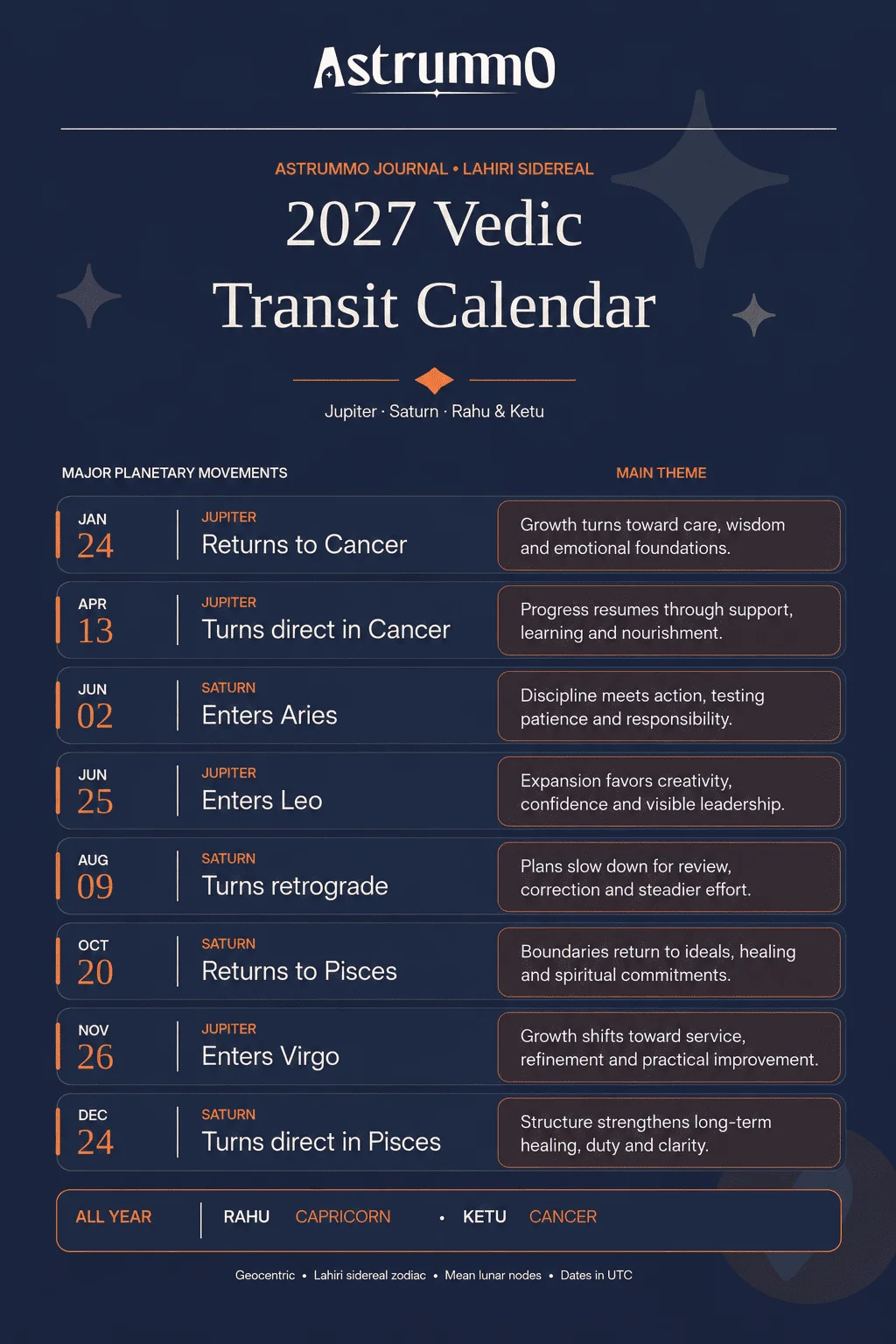
2027 Vedic planetary transit calendar. Dates use the Lahiri sidereal zodiac and UTC. Rahu and Ketu are calculated using mean lunar nodes.
Jupiter, known as Guru or Brihaspati in Vedic astrology, experiences three important sign transitions during 2027.
The planet begins the year retrograde in Leo before returning to Cancer on January 24 at approximately 20:01 UTC. Jupiter then turns direct on April 13, enters Leo again on June 25 at approximately 23:48 UTC, and moves into Virgo on November 26.
The return to Cancer is particularly significant within classical Jyotish because Cancer is traditionally considered Jupiter's sign of exaltation.
Planetary exaltation describes a condition in which a planet is understood to express certain traditional qualities strongly. Jupiter is associated with wisdom, knowledge, guidance, generosity, teaching and ethical development.
In Cancer, these qualities are often interpreted through themes of care, protection, emotional foundations and nourishment.
Yet there is an additional factor in 2027: Ketu also occupies Cancer.
Ketu, the south lunar node, is traditionally associated with detachment, introspection and the questioning of attachments. Jupiter's presence in the same zodiac sign therefore creates an interesting symbolic contrast.
One planet represents expansion, while the other is associated with release.
This does not mean Jupiter and Ketu form an exact conjunction throughout the period. Sharing a sign is not equivalent to occupying the same zodiac degree.
Nevertheless, within a sign-based traditional interpretation, the combination invites a question: can growth involve becoming more selective about what deserves attention, rather than simply accumulating more?
Jupiter's retrograde return to Cancer in January also means the first months of 2027 revisit a planetary configuration rather than introducing an entirely new one.
After Jupiter turns direct in April, it remains in Cancer until late June.
Its subsequent movement into Leo shifts traditional emphasis toward leadership, creativity, confidence, recognition and the expression of personal principles.
By November, Jupiter enters Virgo, a sign associated with discernment, analysis, service and practical improvement.
In broad terms, Jupiter's three sign transitions can be understood as different stages of one developing theme: strengthening foundations, expressing what has been learned, and translating ideas into useful results.
Exaltation alone, however, does not guarantee favorable outcomes. In an individual birth chart, Jupiter's house rulerships, placement, aspects and planetary periods remain essential.
Saturn, known as Shani, has an especially interesting transit pattern in 2027.
The planet begins the year in Pisces, where it has been moving through a sign traditionally associated with compassion, spirituality, ideals and emotional complexity.
On June 2, at approximately 23:58 UTC, Saturn enters Aries.
In classical Jyotish, Aries is Saturn's sign of debilitation.
That does not establish that the period will be universally difficult. Debilitation is a traditional assessment of planetary condition, not a scientific prediction of negative events.
The symbolism is nevertheless noteworthy.
Saturn represents patience, structure, discipline, boundaries and long-term responsibility. Aries, associated with Mars, emphasizes initiative, independence and decisive action.
The combination brings together two contrasting qualities: deliberate persistence and immediate action.
Traditional interpretations may therefore explore the tension between ambition and preparation, the desire for quick results and the responsibilities required to sustain them.
But Saturn does not remain in Aries.
It turns retrograde on August 9, returns to Pisces on October 20, and turns direct again on December 24.
This means Saturn's Aries passage lasts only from early June until October.
As Astrummo observed in its analysis of the year's transits:
"It is a temporary preview, not Saturn’s settled sign for the year."
This distinction is especially important for anyone following long-term Saturn cycles. A temporary entry followed by retrograde withdrawal should not be confused with an uninterrupted multi-year stay in the new sign.
The Jupiter–Saturn overlap in June
One particularly interesting period occurs between June 2 and June 25, when Saturn is in Aries and Jupiter remains in Cancer.
For approximately three weeks, Saturn occupies its traditional debilitation sign while Jupiter occupies its exaltation sign.
These are different planets in different signs, and their dignities cannot be reduced to a simple contest between favorable and unfavorable influences.
Nevertheless, the overlap provides an unusually clear contrast within the traditional symbolic framework: Jupiter's themes of support and growth coincide with Saturn's themes of restraint, effort and structural discipline.
Its significance for an individual still depends on the natal chart.
What about Sade Sati?
Saturn's movements also affect the traditional calculation of Sade Sati, the approximately seven-and-a-half-year transit period measured from the natal Moon sign.
During Saturn's passage through Pisces, the relevant Moon signs are Aquarius, Pisces and Aries.
While Saturn temporarily occupies Aries, they become Pisces, Aries and Taurus.
When Saturn returns to Pisces in October, the previous sign-based configuration returns.
Sade Sati is frequently described in unnecessarily alarming language. In practice, its traditional interpretation involves multiple chart factors and does not mean that everyone affected must experience hardship.
Our detailed guide, What Is Sade Sati?, explains the three phases, the calculation method and why retrograde sign changes matter.
Unlike Jupiter and Saturn, Rahu and Ketu do not change zodiac signs during 2027 under the mean lunar node convention used for this forecast.
Rahu remains in Capricorn, while Ketu stays in Cancer.
Astronomically, these are not physical planets. They represent opposite points where the Moon's orbital plane intersects the ecliptic.
Their positions are important to eclipse calculations, although the traditional Jyotish meanings assigned to them are separate from their astronomical definition.
In Vedic astrology, Rahu is commonly associated with desire, ambition, intensification and unconventional pursuits.
Ketu is associated with detachment, introspection, spiritual inquiry and the release of established attachments.
Capricorn and Cancer introduce another layer of contrasting symbolism.
Capricorn emphasizes structure, public responsibility, discipline and the pursuit of long-term goals. Cancer relates to private life, belonging, emotional security and care.
A general traditional interpretation of this nodal axis therefore explores the relationship between external achievement and internal stability.
With Jupiter also occupying Cancer during the first half of 2027, the contrast becomes more layered.
Jupiter's expansive symbolism interacts at the sign level with Ketu's association with detachment, while Rahu remains opposite in Capricorn.
This is not a prediction that everyone will face the same conflict between work and family, or that specific relationship or career events will occur.
It illustrates how Jyotish combines multiple planetary symbols to interpret broader patterns.
An important technical distinction also applies: astrologers may use either mean or true lunar nodes. Their calculated positions are not identical, particularly near sign boundaries. This article consistently uses mean nodes.
Mars begins 2027 with another important retrograde cycle.
It turns retrograde on January 10 while in sidereal Leo, moves backward into Cancer on March 9, and turns direct on April 1.
Mars returns to Leo on April 26.
Traditionally, Mars represents courage, initiative, energy, competition and the capacity for decisive action.
Its retrograde movement is often interpreted as a period of reconsidering existing efforts, strategies or conflicts rather than automatically pushing forward.
The return to Cancer is especially interesting because Cancer is traditionally Mars's sign of debilitation.
As with Saturn, this does not automatically imply unfavorable outcomes.
A responsible interpretation considers the planet's role in the full chart, not merely whether it occupies a sign of exaltation or debilitation.
Mercury also completes three retrograde periods during 2027, from February 9 to March 3, June 10 to July 4, and October 7 to October 28, based on UTC dates.
Mercury retrograde is widely associated with communication and planning in popular astrology, but sweeping claims that technology failures or personal misunderstandings must occur during these periods are unsupported.
Retrograde movement itself is an apparent change in direction as observed from Earth, not a reversal of a planet's physical orbit.
The 2027 eclipse calendar contains five events: two solar eclipses and three lunar eclipses.
According to NASA's official 2027 eclipse predictions, these are:
Date (UTC) | Eclipse type |
|---|---|
February 6 | Annular solar eclipse |
February 20 | Penumbral lunar eclipse |
July 18 | Penumbral lunar eclipse |
August 2 | Total solar eclipse |
August 17 | Penumbral lunar eclipse |
The August 2 total solar eclipse is particularly noteworthy.
Its path of totality crosses parts of southern Spain, North Africa and the Middle East, including Egypt and the Arabian Peninsula. For observers situated along the path, it offers a rare opportunity to experience a total solar eclipse.
The February 6 annular eclipse, meanwhile, is visible along a path extending across parts of South America and Africa.
The lunar eclipses deserve a separate distinction.
All three are penumbral, meaning the Moon passes through Earth's faint outer shadow rather than its darker central shadow.
The July 18 event is exceptionally slight. NASA lists a penumbral magnitude of approximately 0.0014, making it effectively imperceptible to casual observers.
In classical Jyotish, eclipses are linked symbolically to Rahu and Ketu and may be examined through their positions relative to an individual's natal chart.
But the geometry and visibility of an eclipse do not scientifically establish effects on human relationships, health, finances or future decisions.
Astronomical observation and traditional astrological interpretation should remain clearly distinguished.
How can these different planetary movements be understood together without reducing the year to a collection of disconnected predictions?
To explore that question, we asked Astrummo, a Vedic astrology app, to explain the most significant 2027 transits according to classical Jyotish.
The question explicitly requested a general interpretation, without reference to an individual birth chart or personal Dasha periods.
Astrummo's response began:
"Using sidereal Jyotish, 2027’s main story is a contrast between Jupiter’s promise of growth and Saturn’s insistence on restraint and responsibility."
The interpretation connected Jupiter's return to Cancer with Saturn's temporary entry into Aries and the continuing Rahu–Ketu axis.
Rather than treating exaltation or debilitation as a standalone prediction, it emphasized the interaction between planetary conditions and the broader rhythm of the year.
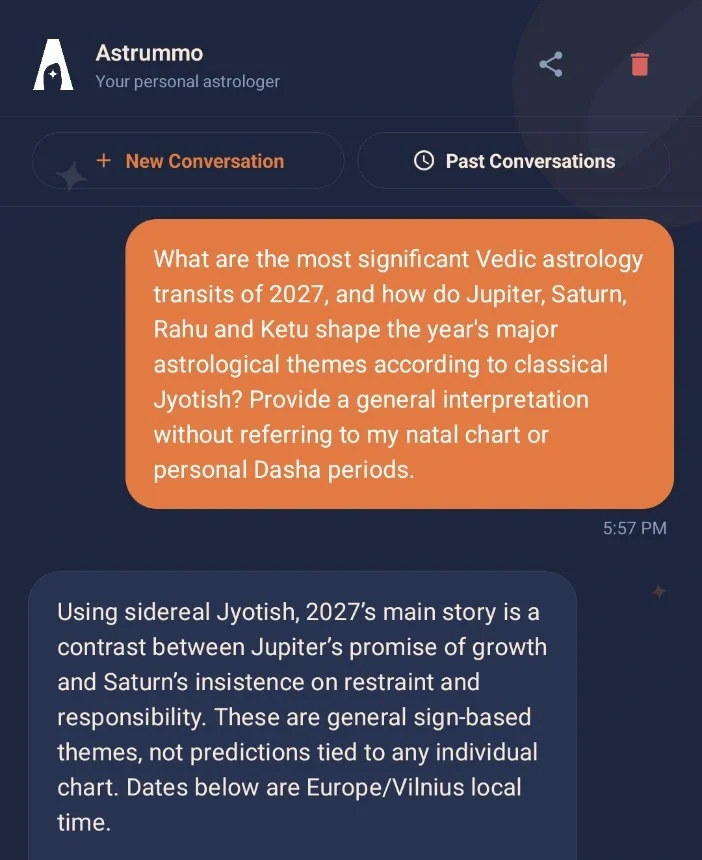
An actual Ask Astrummo exchange exploring the major planetary transits of 2027. The screenshot shows the original question and the beginning of Astrummo's response. Try Astrummo FREE for 7 Days! Download here: Astrummo.com
The analysis ended with another observation:
"Overall, the traditional reading is not simply “expansion” or “restriction”: it is growth that becomes more useful when grounded, and ambition that needs to remain in balance with care, limits and long-term responsibility."
This is one way to synthesize the year's planetary symbolism within Jyotish. It should be understood as an illustrative interpretation generated by Astrummo, not independent evidence that planetary movements determine personal outcomes.
Even a detailed annual transit calendar cannot determine how 2027 should be interpreted for an individual.
Consider Jupiter's return to Cancer.
For one birth chart, Cancer may occupy the 10th house, traditionally associated with career, responsibilities and public activity.
For another, Cancer may occupy the 4th house, associated with home, property, emotional foundations and domestic circumstances.
Although Jupiter's calculated astronomical position is identical at a given moment, the traditional interpretations can differ because the natal chart provides a different context.
Saturn's temporary move into Aries introduces another example.
Its importance depends not only on the Aries transit itself, but also on Saturn's natal condition, its relationship with the Moon, its house lordships and the timing systems active for that person.
One of the most widely used timing systems is Vimshottari Dasha, which derives planetary periods from the Moon's position in its birth Nakshatra.
A person running Jupiter Mahadasha may approach a Jupiter transit differently within traditional interpretation from someone running Saturn or Venus Mahadasha.
Antardasha periods add further context.
This is why a personalized Vedic reading traditionally involves several interacting layers: natal placements, houses, planetary strength, aspects, relevant divisional charts, Dasha periods and current transits.
General annual forecasts describe the changing sky. They do not replace that individual foundation.
This forecast uses geocentric planetary positions in the Lahiri sidereal zodiac.
The principal Jupiter, Saturn, Mars and Mercury transition dates were cross-checked using Swiss Ephemeris calculations. Rahu and Ketu use mean lunar nodes.
The Swiss Ephemeris technical documentation describes the astronomical calculation methods, sidereal reference systems and different lunar node conventions.
All planetary dates in this article are expressed in UTC. Some sign changes occur close to midnight, meaning an event listed on June 2 UTC may appear as June 3 in Asia or Europe.
Eclipse dates follow NASA's published predictions.
These conventions matter when comparing transit tables from different applications. Different ayanamsas, time zones or node calculations can produce different results, even when the underlying astronomical movement is the same.
The most distinctive feature of the 2027 Vedic astrology calendar is the repeated movement between planetary conditions that carry contrasting meanings in the traditional system.
Jupiter revisits exalted Cancer before continuing into Leo and Virgo. Saturn briefly enters debilitated Aries, then returns to Pisces. Rahu and Ketu maintain their Capricorn–Cancer axis throughout the year.
Together, they provide a rich calendar for studying planetary dignity, retrograde motion, sign transitions and the relationship between general transits and individual birth charts.
For anyone exploring these ideas personally, Astrummo offers a way to examine Vedic birth-chart placements, planetary timing and changing cosmic events within one application.
Ultimately, understanding the year is not about assuming that a particular planet guarantees success or difficulty. It is about studying how the moving sky is interpreted within the broader framework of Jyotish, while keeping personal decisions grounded in real-world judgment.
22 October 2026 · Astrummo
Discover the best Nakshatras for starting projects, travel, learning and long-term plans. Learn how Vedic astrology evaluates auspicious timing.
21 October 2026 · Astrummo
Your birth chart stays the same, but the planetary sky never stands still. Discover how Vedic astrology uses transits, lunar Nakshatras, Vimshottari Dasha and Panchanga to interpret each day—and why your personal reading may differ from someone else's.
19 October 2026 · Astrummo
What is Sade Sati in Vedic astrology? Explore Saturn's 7.5-year transit, its three phases, how it's calculated, and what it means for your birth chart.
15 October 2026 · Astrummo
Learn how Vimshottari Dasha works, why the Moon’s Nakshatra determines your planetary periods, and how Mahadasha, Antardasha and transits are used in Vedic astrology.
12 October 2026 · Astrummo
Discover all 27 Nakshatras in Vedic astrology, including their meanings, symbols, ruling planets, deities, zodiac degrees, and influence on your birth chart.

10 October 2026 · Astrummo
Learn how to read your Vedic birth chart, from your Ascendant and houses to planetary placements, nakshatras, and aspects—with a real chart example.
10 October 2026 · Astrummo
Understanding that distinction helps you compare your charts without treating one as a mistake.