24 October 2026 · Astrummo
Does Nakshatra Change Every Day? Here's How It Works
Does Nakshatra change every day? Learn how often the Moon moves between Nakshatras, why your birth Nakshatra stays the same, and what it means for you.
Explore 7 major cosmic events in November 2026, from Mercury and Venus turning direct to the Full Moon, and discover their meaning in Vedic astrology.
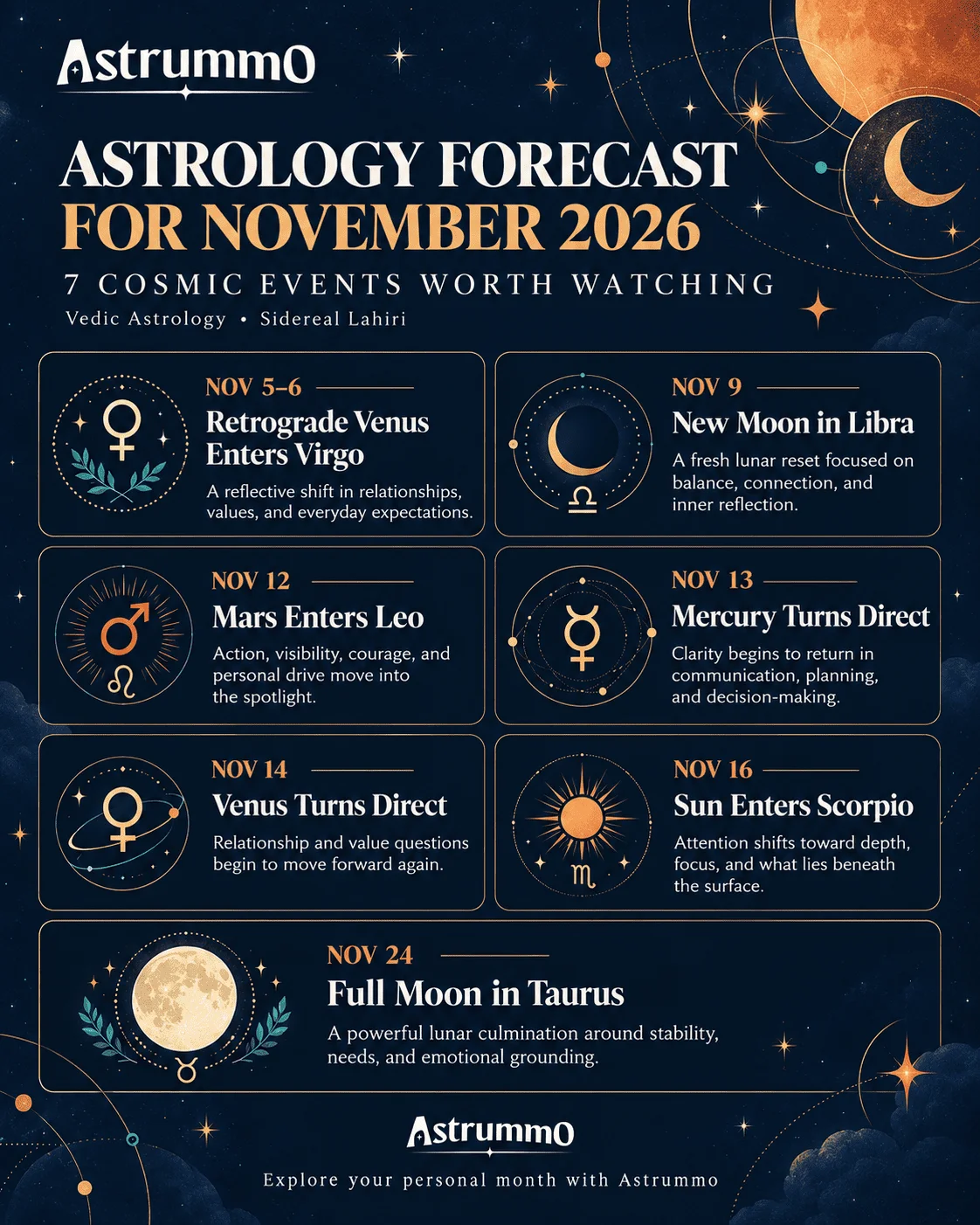
November 2026 brings a remarkable concentration of planetary changes in Vedic astrology. Mercury and Venus both end their retrograde motion, Mars enters Leo, Venus returns to its own sign, and the month's New Moon and Full Moon provide two important points in the lunar cycle.
Unlike a general horoscope that predicts the same experiences for everyone, Vedic astrology interprets these events through the individual birth chart. A planetary shift associated with relationships for one person might emphasize professional responsibilities, personal development, or family matters for another.
This November astrology forecast explores seven significant events, their traditional Jyotish interpretations, and what to consider when examining their relevance to your own chart.
The dates follow the sidereal zodiac and Lahiri ayanamsa used by Astrummo. Event dates are expressed in UTC unless otherwise specified, and local calendar dates may differ. The lunar phases are independently documented by the U.S. Naval Observatory.
The month begins with an interesting development for Venus, traditionally associated with relationships, affection, pleasure, beauty, and the things people value.
On November 5 in UTC, or November 6 in India, Venus moves backward into sidereal Virgo while remaining retrograde.
In classical Jyotish, Virgo is considered Venus's sign of debilitation. This does not automatically indicate relationship difficulties or financial losses. Instead, astrologers examine how Venus functions in the complete chart, including its strength, house placement, rulership, and any modifying planetary relationships.
Symbolically, Venus in Virgo can draw attention to the details of relationships and personal values.
Rather than asking whether something feels exciting, the traditional interpretation may emphasize whether it is sustainable, thoughtful, or genuinely fulfilling.
This period can serve as an opportunity to reflect on how expectations, habits, and practical responsibilities interact with emotional needs.
What to watch: The relationship between your ideals and everyday reality. In a personal chart, Venus's house position and active planetary periods determine which life areas receive greater emphasis.
The November New Moon occurs on November 9 at approximately 07:02 UTC.
In the traditional Vedic calendar, the New Moon is associated with Amavasya, the lunar phase when the Sun and Moon come together in geocentric longitude.
This particular New Moon takes place in sidereal Libra.
Amavasya holds an important place in several traditional Hindu observances, and its significance extends beyond the familiar modern idea of setting intentions at the beginning of a lunar cycle.
In Jyotish, the Moon represents the mind, emotional responsiveness, and subjective experience. Its conjunction with the Sun marks an important transition in the lunar cycle, but the exact meaning depends on the broader Panchanga and natal context.
Libra is traditionally associated with balance, agreements, and relationships. These themes may provide a useful symbolic starting point for reflection, although they do not establish universal predictions.
What to watch: The condition of your natal Moon, the house occupied by the New Moon, and the current lunar Nakshatra. A New Moon should not automatically be treated as the most favorable moment to begin every activity.
For a deeper understanding of lunar symbolism, explore our Complete Guide to All 27 Moon Nakshatras.
One of November's most interesting planetary configurations develops when Mars enters sidereal Leo on November 12.
Jupiter has already entered Leo on October 31, while Ketu also occupies the sign under the mean-node calculation convention used by Astrummo.
This creates a concentration of three important Jyotish factors in the same zodiac sign.
Mars is traditionally associated with action, courage, competition, and determination. Jupiter is associated with knowledge, growth, guidance, and principles. Ketu, the south lunar node, carries different symbolism connected with detachment, discernment, and the reconsideration of worldly attachments.
Their shared sign does not mean their influences simply add together to create more power or success.
In Vedic astrology, the significance of such a configuration depends on the planets' exact positions, their relationships, their dispositor, and the natal houses involved.
Leo is ruled by the Sun and is traditionally associated with leadership, visibility, self-expression, and responsibility.
The combination can therefore provide a symbolic context for examining ambition, confidence, personal authority, and the difference between purposeful action and unnecessary confrontation.
What to watch: Where Leo falls in your birth chart and whether Mars, Jupiter, or the relevant house rulers connect with your active Dasha periods.
Two planetary retrograde periods conclude within approximately nine hours of one another.
Mercury stations direct in sidereal Libra on November 13, followed by Venus turning direct in sidereal Virgo on November 14.
This makes the middle of November a particularly noteworthy period for astrology enthusiasts.
Retrograde motion is an apparent reversal of a planet's direction against the background stars as observed from Earth. The planet does not physically reverse its orbit around the Sun.
In traditional astrology, retrograde phases are interpreted through the changing apparent motion and condition of the planet.
Mercury is commonly associated with communication, analysis, learning, and exchange. Venus relates to relationships, aesthetics, values, and enjoyment.
Their nearly simultaneous return to direct motion may be interpreted as a shift in the symbolic emphasis of these themes.
However, a station is not an instant switch from difficulty to success.
The planets move especially slowly around their stationary points, and the broader astrological implications continue to depend on their chart relationships.
Someone experiencing a Mercury-related planetary period might interpret the station differently from someone whose current Dasha emphasizes Venus or Saturn.
What to watch: Matters represented by Mercury and Venus in your natal chart, especially where the two planets rule important houses or participate in relevant current planetary periods.
On November 16, the Sun enters sidereal Scorpio, an event traditionally known as Vrishchika Sankranti.
The Sun changes signs approximately once a month, forming one of the regular rhythms of the Vedic astrological calendar.
Scorpio is a Mars-ruled sign traditionally associated with intensity, investigation, persistence, and subjects that are not always immediately visible.
Its symbolism can provide an opportunity to examine motivations, longer-term commitments, and areas of life that require deeper attention.
Yet it would be misleading to announce that everyone should expect a dramatic transformation simply because the Sun changes signs.
For someone with Scorpio connected to the tenth house, the transit may be considered in relation to professional responsibilities. In another chart, Scorpio may occupy a house with entirely different significations.
The condition of the natal Sun, the transiting Sun's relationships, and the active Dasha all matter.
What to watch: The natal house receiving the Sun's transit and any relevant connections with your chart's Sun and Mars.
Following its retrograde station earlier in the month, Venus moves forward into sidereal Libra on November 22.
This is especially interesting because Libra is one of the two signs ruled by Venus, alongside Taurus.
In classical Jyotish, a planet occupying its own sign generally has an important form of essential dignity. However, sign dignity is only one part of planetary strength, and it does not guarantee uniformly favorable results.
Venus in Libra is traditionally connected with harmony, agreements, relationships, aesthetics, and the search for proportion.
Compared with the more analytical symbolism associated with Venus in Virgo, its return to Libra offers a different interpretive emphasis.
This may provide a useful moment to reflect on reciprocity, cooperation, and the role of personal values in important decisions.
For example, someone whose natal Venus governs partnership-related houses might pay attention to relational themes. Another person's Venus may primarily connect different areas of life, making a generic romance prediction inappropriate.
What to watch: The houses ruled by Venus, its natal dignity, and whether its transit activates relevant personal chart relationships.
November's Full Moon occurs on November 24 at approximately 14:53 UTC.
During a Full Moon, the Moon lies opposite the Sun in geocentric ecliptic longitude. In the Lahiri sidereal zodiac, this Full Moon occurs in Taurus, opposite the Sun in Scorpio.
Taurus is particularly significant in Jyotish because it is the Moon's traditional sign of exaltation, although the Moon's actual strength and interpretation require a more complete assessment.
The Full Moon is associated with Purnima, an important lunar phase in the Vedic calendar.
In traditional interpretation, the Sun–Moon opposition invites consideration of contrasting themes: outer responsibilities and inner needs, direction and receptivity, or the relationship between conscious intention and emotional experience.
However, these are symbolic themes rather than measurable effects on human behavior.
An astrologer would also examine the Full Moon's Nakshatra, house position, natal connections, and the wider planetary conditions before developing a personal interpretation.
What to watch: Whether the Taurus–Scorpio axis activates important houses or natal planets in your birth chart, and how the lunar conditions interact with your current planetary period.
The seven events above occur in the same astronomical sky for everyone, but their astrological interpretation is not identical for every person.
This distinction is central to Vedic astrology.
The first factor is your natal chart, especially the Ascendant, house structure, planetary rulers, and natal placements.
The second is your active Vimshottari Dasha, which provides a traditional framework for understanding longer periods of planetary emphasis.
The third is the relationship between current transits and those natal conditions.
For example, Mars entering Leo might occupy a house associated with career in one person's chart and a house connected with home and domestic responsibilities in another.
Even those house associations are only a starting point. A more detailed interpretation requires planetary strength, rulership, aspects, conjunctions, and supporting evidence.
This is also why recurring influences can remain meaningful without producing the same experience every day.
A Jupiter transit may provide a longer background theme, while the Moon's faster movement through signs and Nakshatras changes the more immediate astrological context.
For more background, read Why Does Your Vedic Astrology Reading Change Every Day? and What Is Vimshottari Dasha?.
Readers comparing different astrology calendars may notice disagreements about when planets enter signs.
The main reason is that Western tropical astrology and Vedic sidereal astrology use different zodiac reference systems.
For instance, a planetary position described as Scorpio in a tropical horoscope may still fall in sidereal Libra.
Station dates are generally closer across the two systems because they describe the reversal of apparent planetary motion, but reported times can still vary slightly according to astronomical and computational conventions.
Birth-chart interpretation may also differ depending on the chosen ayanamsa.
Astrummo uses the Lahiri sidereal framework, and this forecast follows that approach consistently.
Our guide, Vedic vs Western Astrology: Why Your Zodiac Sign May Change, explains the distinction in detail.
A monthly list of planetary events is useful for understanding the broader astrological calendar. But it cannot, by itself, tell you which event has the greatest significance for your individual birth chart.
That requires personal context.
Astrummo uses Swiss Ephemeris calculations, the Lahiri sidereal zodiac, and traditional Jyotish methods to help connect planetary positions with individual natal charts.
Features such as your Personal Daily Reading, Moon Today, Cosmic Events Feed, and Astrology Calendar help you explore the relationship between current celestial conditions and your own astrological foundation.
For a deeper interpretation, Ask Astrummo can examine questions about specific dates or longer periods in relation to your birth chart.
A useful question to ask is:
“Which planetary events in November 2026 are most significant for my birth chart, and why?”
A thoughtful answer should consider relevant natal placements, house rulerships, active planetary periods, and supported transits rather than assuming every event will affect everyone in the same way.
November offers a rich combination of changing planetary motions, sign transitions, and lunar conditions.
The value of following them lies not in predicting dramatic outcomes, but in understanding how traditional Vedic astrology brings together the changing sky and a lasting personal birth chart.
Astrological interpretations are traditional and symbolic. They are not scientifically established predictions of individual events or outcomes.
24 October 2026 · Astrummo
Does Nakshatra change every day? Learn how often the Moon moves between Nakshatras, why your birth Nakshatra stays the same, and what it means for you.
23 October 2026 · Astrummo
Discover the 2027 Vedic astrology forecast: Jupiter and Saturn transits, Rahu-Ketu, retrogrades and eclipses explained using the Lahiri sidereal zodiac.
22 October 2026 · Astrummo
Discover the best Nakshatras for starting projects, travel, learning and long-term plans. Learn how Vedic astrology evaluates auspicious timing.
21 October 2026 · Astrummo
Your birth chart stays the same, but the planetary sky never stands still. Discover how Vedic astrology uses transits, lunar Nakshatras, Vimshottari Dasha and Panchanga to interpret each day—and why your personal reading may differ from someone else's.
19 October 2026 · Astrummo
What is Sade Sati in Vedic astrology? Explore Saturn's 7.5-year transit, its three phases, how it's calculated, and what it means for your birth chart.
15 October 2026 · Astrummo
Learn how Vimshottari Dasha works, why the Moon’s Nakshatra determines your planetary periods, and how Mahadasha, Antardasha and transits are used in Vedic astrology.
12 October 2026 · Astrummo
Discover all 27 Nakshatras in Vedic astrology, including their meanings, symbols, ruling planets, deities, zodiac degrees, and influence on your birth chart.
10 October 2026 · Astrummo
Learn how to read your Vedic birth chart, from your Ascendant and houses to planetary placements, nakshatras, and aspects—with a real chart example.