12 October 2026 · Astrummo
The Complete Guide to All 27 Moon Nakshatras
Discover all 27 Nakshatras in Vedic astrology, including their meanings, symbols, ruling planets, deities, zodiac degrees, and influence on your birth chart.
Learn how Vimshottari Dasha works, why the Moon’s Nakshatra determines your planetary periods, and how Mahadasha, Antardasha and transits are used in Vedic astrology.
A birth chart can describe tendencies, strengths, tensions, and areas of life that may become especially important. But one of astrology's hardest questions isn't what a chart contains. It is when particular parts of that chart become more active.
Vedic astrology addresses this problem through Dasha systems—structured sequences of planetary periods. The best-known and most widely used of these is Vimshottari Dasha, a 120-year cycle in which the nine grahas rule successive periods of life.
Unlike a transit, which describes a planet's changing position in the sky right now, Vimshottari Dasha begins with the natal chart itself. Its starting point is determined by the Moon’s exact position in its birth Nakshatra.
This creates something very different from a generic horoscope. Two people born under the same zodiac sign can be moving through entirely different planetary periods, with different natal planets activated at the same moment.
Vimshottari Dasha is a Nakshatra-based planetary timing system used in the Parashari tradition of Jyotish.
The Brihat Parashara Hora Shastra, the major classical work traditionally attributed to Parashara, describes the system. Chapter 46 of the received text discusses numerous Dasha systems and presents Vimshottari as the principal Nakshatra-based sequence.
“Vimshottari” refers to the system’s full 120-year cycle. Those 120 years are distributed across nine planetary rulers in fixed proportions.
Planetary ruler | Mahadasha length |
|---|---|
Ketu | 7 years |
Venus | 20 years |
Sun | 6 years |
Moon | 10 years |
Mars | 7 years |
Rahu | 18 years |
Jupiter | 16 years |
Saturn | 19 years |
Mercury | 17 years |
Total | 120 years |
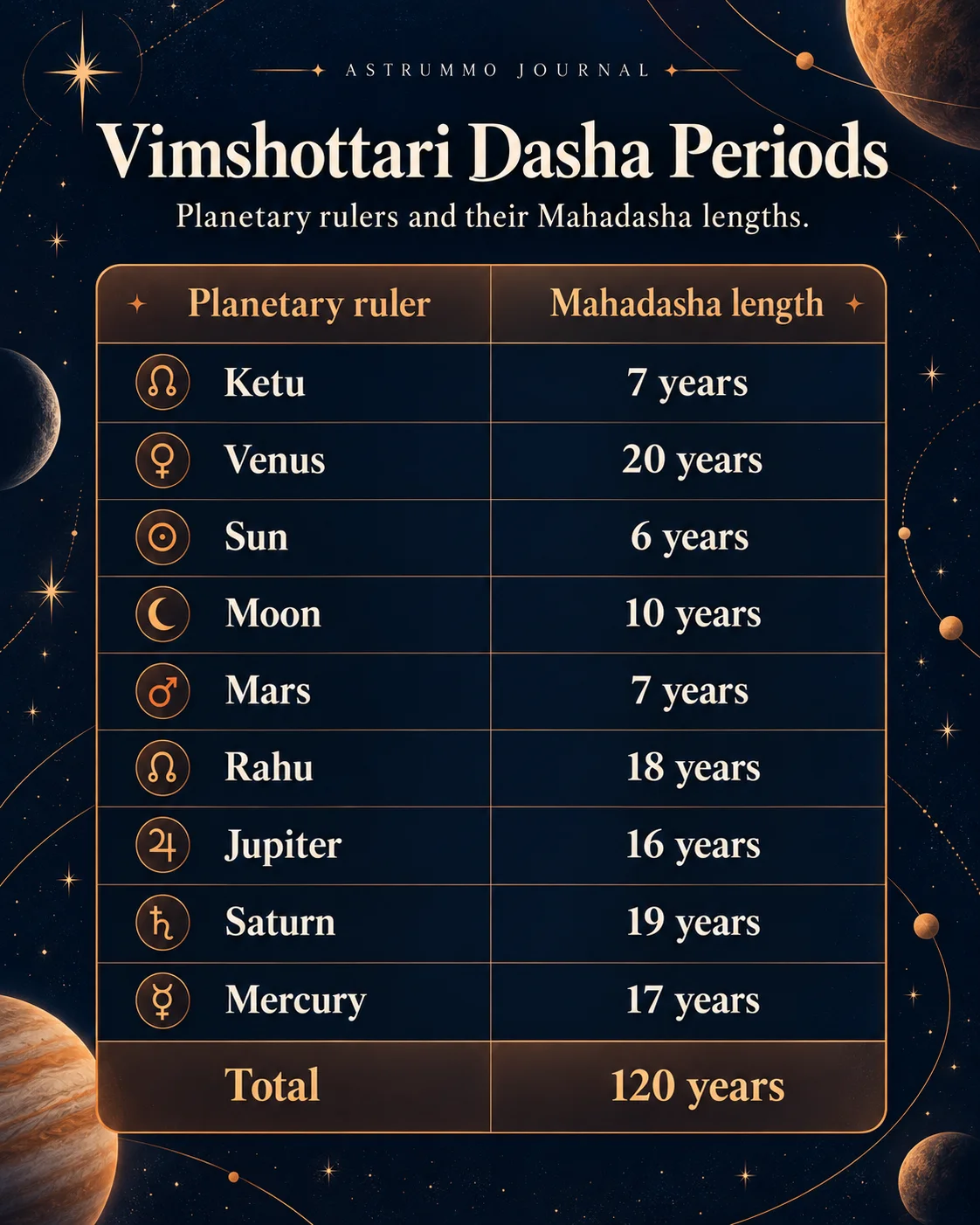
The order never changes:
Ketu → Venus → Sun → Moon → Mars → Rahu → Jupiter → Saturn → Mercury → Ketu
What changes from person to person is where in that cycle life begins.
That starting point comes from the Moon.
The sidereal zodiac used in Jyotish is divided not only into twelve Rashis, but also into 27 Nakshatras, or lunar mansions.
Each Nakshatra spans 13°20′ and belongs to one of the nine Vimshottari planetary rulers. The traditional 27-fold lunar division has deep roots in Indian astronomy and calendrical tradition.
Your birth Moon therefore answers two questions.
First, which Nakshatra contains the Moon? Its planetary ruler identifies the Mahadasha operating at birth.
Second, how far has the Moon already travelled through that Nakshatra? That determines how much of the first Mahadasha remains.
This second point is important. You do not normally begin life on the first day of a completely new Mahadasha.
Imagine that the Moon is born halfway through a Nakshatra ruled by Venus. Venus has a full Vimshottari period of 20 years. If half of that Nakshatra has already been traversed, roughly half of the corresponding starting period has also elapsed, leaving approximately ten years of Venus Mahadasha.
The classical method calculates the expired and remaining portions proportionally based on the Moon’s progress through its birth Nakshatra.
That is why exact birth data matters. A person born very close to a Nakshatra boundary can get a materially different starting Dasha balance if the Moon’s calculated longitude crosses that boundary.
A 20-year Venus Mahadasha obviously cannot be interpreted as twenty years of one unchanging experience.
Vimshottari therefore works in nested levels.
The broadest level is the Mahadasha, the major planetary period. Within each Mahadasha are nine Antardashas, or sub-periods. Those can be divided again into Pratyantardashas, creating increasingly precise layers of timing.
A person might therefore be running:
Saturn Mahadasha → Mercury Antardasha → Venus Pratyantardasha
All three planets matter simultaneously.
The Mahadasha establishes the broad period. The Antardasha modifies and focuses it. The Pratyantardasha can help narrow shorter developments within that larger sequence.
The subdivisions are proportional to the same 120-year planetary allocation rather than arbitrary calendar blocks. Classical Dasha literature extends the subdivision principle still further, although Mahadasha and Antardasha are generally the most useful levels for understanding longer life phases.
This is where simplified Dasha explanations often become misleading.
A Jupiter Mahadasha does not automatically mean sixteen years of luck. Saturn does not automatically mean nineteen years of suffering. Venus does not guarantee relationships or wealth. Rahu does not guarantee chaos.
The period tells the astrologer which natal planet has become especially important. What that planet can actually produce depends on the chart in which it exists.
A serious interpretation therefore asks questions such as: Which houses does the Dasha lord rule? Which house does it occupy? What is its dignity? Is it strong or weak? Which planets aspect or conjoin it? Which Yogas involve it? How does it operate in relevant divisional charts? And what does the Antardasha lord add to the picture?
This is why two people can enter Saturn Mahadasha and experience completely different lives.
For one chart, Saturn may be strongly placed and connected with career, responsibility, and durable achievement. In another, it may activate more difficult house themes or unresolved structural pressures. The word “Saturn” alone isn't enough.
The natal chart defines the promise; the Dasha helps define when that promise becomes active.
The safest way to understand the nine Mahadashas is not as nine prewritten predictions, but as nine periods in which different planetary structures in the natal chart move into the foreground.
During Sun Mahadasha, the condition of the natal Sun becomes particularly relevant, including its house, lordship, dignity, authority-related significations and connections with the rest of the chart.
During Moon Mahadasha, the Moon’s house, strength, Nakshatra, emotional and environmental significations, and its relationships with other planets deserve greater weight.
The same principle applies to Mars, Mercury, Jupiter, Venus and Saturn.
Rahu and Ketu require particularly contextual interpretation. They are lunar nodes rather than physical planets, and their results are normally read through their placement, sign and house context, dispositors, conjunctions and other relationships in the chart.
So instead of asking, “Is my next Mahadasha good or bad?”, a much better question is:
What does this planet represent and control in my specific birth chart, and how strongly is that potential supported?
Dashas and transits answer related but different timing questions.
A Dasha is natal. Its sequence starts at birth and unfolds according to the calculated planetary timeline.
A transit is current. It describes where planets are moving through the zodiac today, next month or several years from now.
In a detailed Jyotish reading, these systems are often read together.
Suppose a chart contains a strong career combination involving the 10th house. That combination exists from birth, but it doesn't mean career events must happen constantly.
A relevant Mahadasha or Antardasha may activate the planets connected with that part of the chart. A later transit may then provide a more specific trigger or intensification.
This distinction is extremely useful:
Natal chart: What potential exists?
Dasha: Which natal potential is activated now?
Transit: What is currently triggering or modifying it?
Good timing analysis therefore rarely comes from looking at only one of these layers.
Consider someone in a 19-year Saturn Mahadasha.
Nineteen years cover a large portion of adult life. It would make little sense for all nineteen years to feel identical.
A Saturn–Venus Antardasha combines the natal roles and relationships of Saturn and Venus. Saturn–Mars introduces a different interaction. Saturn–Mercury activates another.
The result isn't created by simply combining textbook keywords such as “Saturn = discipline” and “Venus = love.”
Instead, read both planets as actual chart factors.
If Venus rules important career houses in one person’s chart, Saturn–Venus may emphasize very different areas than it would in a chart where Venus is primarily connected with home, partnership or another domain.
That is one reason personalized Dasha interpretation requires the full chart rather than the period names alone.
No.
Do not treat Vimshottari Dasha as a deterministic event generator.
Entering Venus Mahadasha does not guarantee marriage. Jupiter Mahadasha does not guarantee children. Saturn Mahadasha does not guarantee loss. Rahu Mahadasha does not guarantee a dramatic relocation.
Those statements ignore the chart.
A useful prediction normally requires corroboration. Relevant houses, their lords, karakas, planetary strength, divisional charts, Dashas, and transits should point to a consistent conclusion before an astrologer assigns high confidence to a particular life theme.
This is also why the same Dasha may operate very differently at different ages. Natal potential, sub-periods and transits are interacting with an entirely different real-life context.
Dasha interpretation is therefore more useful as a structured timing framework than as a catalogue of predetermined events.
The sequence of planetary rulers is fixed, but your personal dates are calculated from astronomical birth data.
The Moon’s exact sidereal longitude determines its Nakshatra and its position within that Nakshatra. That position establishes the remaining balance of the opening Mahadasha, and every later Dasha boundary follows from it.
Different astrology programs can sometimes show slightly different dates because of calculation conventions such as the chosen ayanamsha, astronomical ephemeris and definition of the Dasha year.
A particularly important case is a birth Moon near a Nakshatra boundary. Even a relatively small difference in the calculated lunar position can affect the starting point of the entire timeline.
For this reason, meaningful comparison between two astrology programs requires comparing their calculation settings, not merely their displayed Dasha dates.
Astrummo does not treat a Dasha as a standalone prediction.
The calculated Dasha timeline is one layer in a broader Vedic chart analysis.
When interpreting a question, Astrummo first evaluates the natal foundation: the Ascendant, relevant houses and lords, planetary placement and dignity, aspects, and other chart relationships. Relevant divisional charts can then add context. Vimshottari periods show which of these natal factors are currently activated, while transits help identify current or approaching triggers.
This matters because a Dasha should answer more than:
“Which planet rules this year?”
The more useful questions are:
What does this planet actually signify in my chart? Why is it important now? Which life areas are activated? What supports or contradicts the interpretation? And when are the strongest windows within the larger period?
That is the difference between displaying a Dasha table and actually interpreting one.
Vimshottari Dasha adds a temporal dimension to the Vedic birth chart.
The natal chart does not disappear when a new Mahadasha begins. The chart remains the foundation. What changes is emphasis.
A planet that may have remained relatively quiet can become central because its period begins. Another planet can become especially important through an Antardasha. Transits then interact with those activated natal structures.
Seen this way, Vedic timing is not a collection of isolated predictions.
It is a hierarchy:
birth chart → planetary strength and relationships → divisional context → Dasha activation → transit timing
That's why knowing your current Mahadasha is useful—but knowing its name alone is only the beginning.
Brihat Parasara Hora Sastra, traditionally attributed to Parashara, modern R. Santhanam edition — bibliographic record via Google Books. Google Books — Brihat Parasara Hora Sastra
Brihat Parashara Hora Shastra, Chapter 46, digital Sanskrit/English text used to verify the Vimshottari sequence, durations and Dasha framework. BPHS Chapter 46 — Planetary Dasha Periods
Sanskrit Documents' Jyotisha archive, used as an independent textual repository/reference for classical Jyotisha works. Sanskrit Documents — Jyotisha texts
Divinity Atlas' textual-history entry, drawing on scholarship including David Pingree, used specifically for the caution about the received BPHS text's dating and attribution. Brihat Parashara Hora Shastra — textual history
Historical reference on the traditional 27-fold Nakshatra division of the zodiac. Encyclopaedia Britannica historical entry — Zodiac and Nakshatras
12 October 2026 · Astrummo
Discover all 27 Nakshatras in Vedic astrology, including their meanings, symbols, ruling planets, deities, zodiac degrees, and influence on your birth chart.
10 October 2026 · Astrummo
Learn how to read your Vedic birth chart, from your Ascendant and houses to planetary placements, nakshatras, and aspects—with a real chart example.

10 October 2026 · Astrummo
Set up your Daily Alignment reminder in Astrummo, allow phone notifications, and choose a time that fits your routine.
10 October 2026 · Astrummo
Understanding that distinction helps you compare your charts without treating one as a mistake.
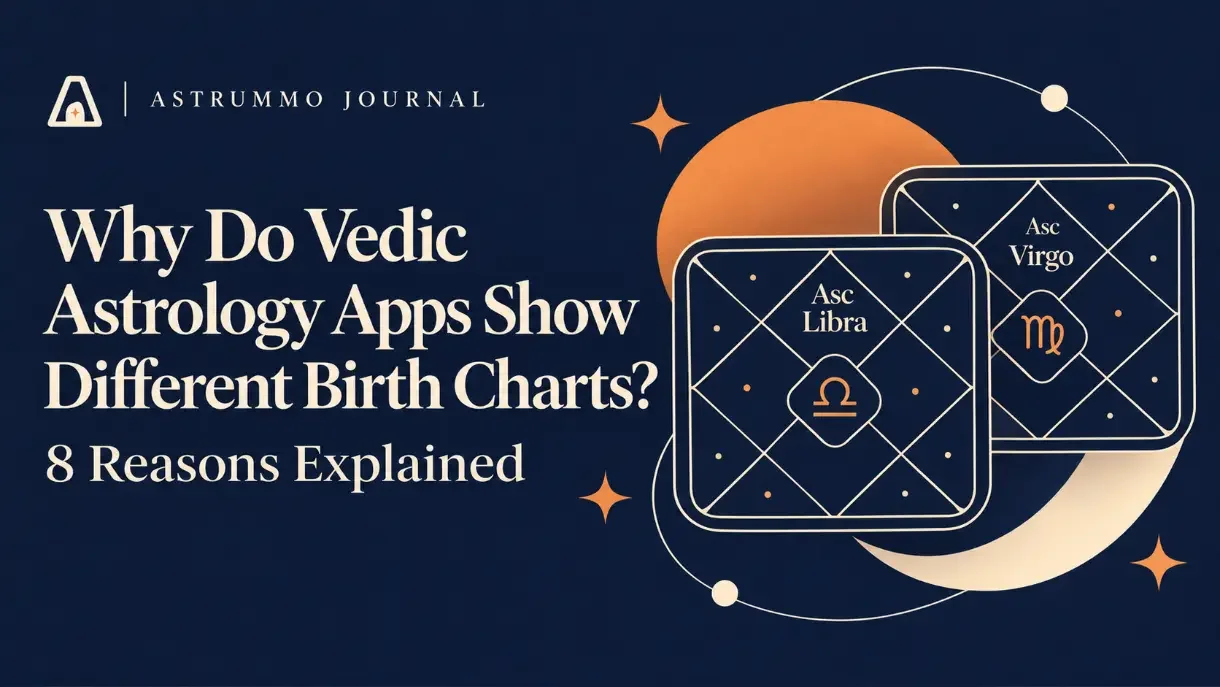
17 October 2026 · Astrummo
Why do Vedic astrology apps show different birth charts? Discover 8 reasons, from birth time and GPS coordinates to ayanamsa, Rahu, Ketu, and D9 charts.