10 October 2026 · Astrummo
How to Read Your Vedic Birth Chart: A Beginner’s Guide
Learn how to read your Vedic birth chart, from your Ascendant and houses to planetary placements, nakshatras, and aspects—with a real chart example.
Discover all 27 Nakshatras in Vedic astrology, including their meanings, symbols, ruling planets, deities, zodiac degrees, and influence on your birth chart.
In Vedic astrology, your zodiac sign is only the beginning of the story. Beneath the familiar twelve signs lies a much more detailed system: the 27 Nakshatras, or lunar mansions, that have shaped Indian astronomical and astrological traditions for thousands of years.
While zodiac signs describe broad planetary environments, Nakshatras offer a finer interpretive framework. They are traditionally used to examine emotional tendencies, motivation, relationships, planetary behavior, spiritual themes, and the timing of important life periods.
Your Moon Nakshatra is particularly significant. Its position at birth establishes the starting planetary period in the Vimshottari Dasha system, one of the principal timing methods in Jyotisha.
But Nakshatras are not limited to the Moon. Every planet and the Ascendant occupies a Nakshatra, creating another layer of meaning within a complete Vedic birth chart.
In this comprehensive guide, you will discover all 27 Nakshatras, their exact zodiac positions, planetary rulers, presiding deities, symbols, traditional interpretations, strengths, and challenges. You will also learn how Nakshatra padas work, how they connect with Navamsa and planetary periods, and why accurate astronomical calculations matter.
If you are new to Jyotisha, our beginner's guide to reading your Vedic birth chart provides an excellent starting point before exploring the deeper Nakshatra system.
The Sanskrit term Nakshatra has historically referred to stars, stellar groups, and divisions associated with the Moon's passage through the sky.
In modern Vedic astrology, Nakshatras are generally understood as 27 equal divisions of the sidereal zodiac, each occupying 13 degrees and 20 arcminutes.
Since the complete zodiac contains 360 degrees, the mathematical division is straightforward:
360° ÷ 27 = 13°20′
Each Nakshatra is further divided into four equal quarters, known as padas, measuring 3°20′ each.
This creates a system of 108 Nakshatra padas distributed across the zodiac.
The system has deep historical roots. The Taittiriya Samhita (4.4.10.1–3) preserves an early sequence of 27 Nakshatras and their associated deities. Ancient textual traditions also contain 28-member arrangements, reflecting the inclusion of Abhijit.
The historical distinction between stars as observational markers and equal mathematical divisions is important. Ancient Nakshatra traditions developed through astronomy, ritual practice, calendrical systems, and eventually the more elaborate interpretive methods of classical Jyotisha.
The Moon travels around Earth relative to the background stars in approximately 27.32 days.
This is known as the sidereal lunar period, which is different from the approximately 29.53-day cycle of lunar phases.
NASA explains this distinction in its educational resource on the Moon and astronomical calendars.
Because the Moon moves through the zodiac relatively quickly, it passes through approximately one Nakshatra each day, although the exact duration varies because its orbital speed is not constant.
This close relationship between the Moon's motion and the 27 lunar mansions helps explain why Nakshatras became so important in traditional Indian timekeeping and astrology.
In contemporary Jyotisha practice, each Nakshatra is associated with several interpretive components:
Planetary ruler: One of the nine rulers used in the Vimshottari Dasha system.
Presiding deity: A divine figure associated with the Nakshatra in traditional sources.
Symbol: An image representing its underlying symbolism.
Zodiac position: The precise sidereal longitude occupied by the Nakshatra.
Four padas: Subdivisions connecting Nakshatra positions to Navamsa.
Traditional qualities: Themes such as growth, protection, transformation, discipline, or creativity.
These attributes are interpreted together rather than independently.
Importantly, the astronomical positions can be mathematically calculated, while the personality descriptions and predictive meanings belong to traditional astrology and are not scientifically established psychological or predictive effects.
One of the most common questions in Vedic astrology is whether Nakshatras are more important than zodiac signs.
The two systems describe different levels of the same chart.
A zodiac sign, or Rashi, occupies 30 degrees. A Nakshatra occupies only 13°20′. Consequently, each sign includes portions of multiple Nakshatras.
This allows two planets in the same sign to occupy different lunar mansions.
Feature | Zodiac Sign (Rashi) | Nakshatra |
|---|---|---|
Total divisions | 12 | 27 |
Size of each division | 30° | 13°20′ |
Primary ruler system | Seven classical planets | Nine Vimshottari rulers |
Traditional emphasis | Broad planetary environment | Finer symbolism and timing |
Subdivisions | Numerous Vargas | Four padas |
Key applications | Natal interpretation | Natal interpretation, Dasha, matching, Muhurta |
Imagine two individuals whose Moon occupies sidereal Taurus.
The first has the Moon at 5° Taurus, within Krittika Nakshatra.
The second has the Moon at 15° Taurus, within Rohini Nakshatra.
Both have the Moon in the same sign, but their Nakshatras differ.
Krittika is associated with Agni, purification, discernment, and sharpness.
Rohini is associated with Prajapati, creation, growth, beauty, and nourishment.
Traditional astrologers may interpret the first placement through themes of clarity and transformation, while the second may emphasize stability, affection, and creativity.
However, neither interpretation should override the Moon's house placement, aspects, dignity, planetary associations, or the overall chart.
Vedic astrology commonly uses a sidereal zodiac, while mainstream Western natal astrology generally uses the tropical zodiac.
These systems have different reference points.
As a result, the same astronomical planetary position can receive different zodiac coordinates depending on the zodiac framework and ayanamsa being used.
The Swiss Ephemeris documentation explains sidereal calculations and the role of ayanamsa in converting between zodiac coordinate systems.
For a detailed explanation of why your zodiac sign may change between systems, read Vedic vs Western Astrology: Why Your Zodiac Sign May Change.
The following table uses the standard equal-division sidereal Nakshatra framework, beginning with Ashwini at 0° Aries.
# | Nakshatra | Sidereal Zodiac Span | Planetary Ruler | Presiding Deity |
|---|---|---|---|---|
1 | Ashwini | Aries 0°00′–13°20′ | Ketu | Ashwini Kumaras |
2 | Bharani | Aries 13°20′–26°40′ | Venus | Yama |
3 | Krittika | Aries 26°40′–Taurus 10°00′ | Sun | Agni |
4 | Rohini | Taurus 10°00′–23°20′ | Moon | Prajapati |
5 | Mrigashira | Taurus 23°20′–Gemini 6°40′ | Mars | Soma |
6 | Ardra | Gemini 6°40′–20°00′ | Rahu | Rudra |
7 | Punarvasu | Gemini 20°00′–Cancer 3°20′ | Jupiter | Aditi |
8 | Pushya | Cancer 3°20′–16°40′ | Saturn | Brihaspati |
9 | Ashlesha | Cancer 16°40′–30°00′ | Mercury | Nagas |
10 | Magha | Leo 0°00′–13°20′ | Ketu | Pitris |
11 | Purva Phalguni | Leo 13°20′–26°40′ | Venus | Bhaga |
12 | Uttara Phalguni | Leo 26°40′–Virgo 10°00′ | Sun | Aryaman |
13 | Hasta | Virgo 10°00′–23°20′ | Moon | Savitar |
14 | Chitra | Virgo 23°20′–Libra 6°40′ | Mars | Tvashtar |
15 | Swati | Libra 6°40′–20°00′ | Rahu | Vayu |
16 | Vishakha | Libra 20°00′–Scorpio 3°20′ | Jupiter | Indra-Agni |
17 | Anuradha | Scorpio 3°20′–16°40′ | Saturn | Mitra |
18 | Jyeshtha | Scorpio 16°40′–30°00′ | Mercury | Indra |
19 | Mula | Sagittarius 0°00′–13°20′ | Ketu | Nirriti |
20 | Purva Ashadha | Sagittarius 13°20′–26°40′ | Venus | Apas |
21 | Uttara Ashadha | Sagittarius 26°40′–Capricorn 10°00′ | Sun | Vishvadevas |
22 | Shravana | Capricorn 10°00′–23°20′ | Moon | Vishnu |
23 | Dhanishta | Capricorn 23°20′–Aquarius 6°40′ | Mars | Vasus |
24 | Shatabhisha | Aquarius 6°40′–20°00′ | Rahu | Varuna |
25 | Purva Bhadrapada | Aquarius 20°00′–Pisces 3°20′ | Jupiter | Aja Ekapada |
26 | Uttara Bhadrapada | Pisces 3°20′–16°40′ | Saturn | Ahir Budhnya |
27 | Revati | Pisces 16°40′–30°00′ | Mercury | Pushan |
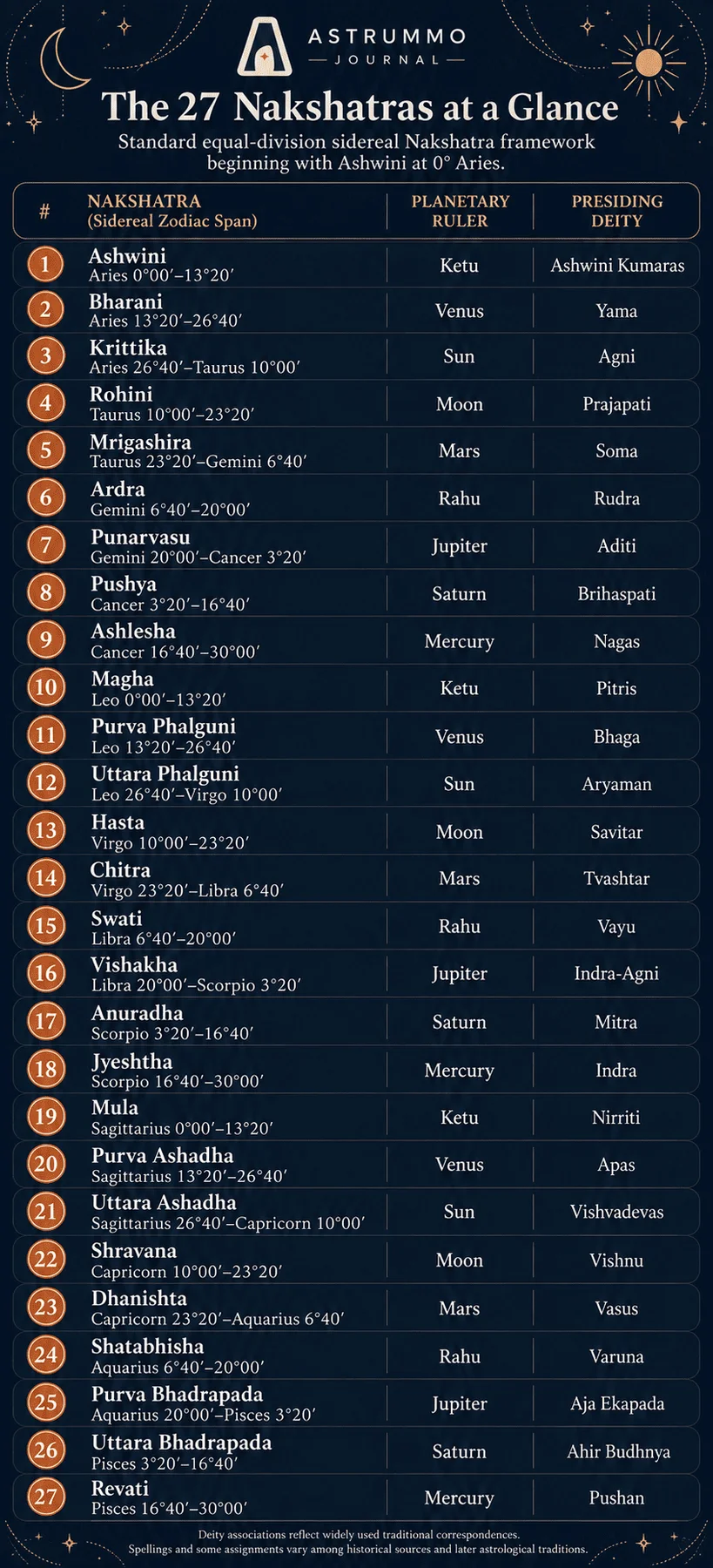
The deity associations reflect widely used traditional correspondences. Spellings and some assignments vary among historical sources and later astrological traditions. In particular, the Phalguni deity associations appear in differing orders across textual traditions.
For historical context, see the academic study Lunar Constellations (Nakṣatras) and Name Giving Tradition in Ancient India, which discusses early Nakshatra lists and their development.
The following descriptions summarize traditional and contemporary Jyotisha interpretations. They should be understood as symbolic tendencies rather than fixed personality diagnoses or guaranteed predictions.
Zodiac: Aries 0°00′–13°20′ Planetary Ruler: Ketu Deity: Ashwini Kumaras Symbol: Horse's head Core Themes: Initiative, healing, speed, vitality, independence
Ashwini begins the Nakshatra cycle, symbolizing movement, awakening, and new possibilities.
Its deity, the Ashwini Kumaras, represents the divine healers of Vedic tradition, linking this Nakshatra to restoration, vitality, and rapid intervention.
The horse symbolism conveys physical energy, instinct, freedom, and the capacity to move forward without hesitation.
In traditional interpretations, a prominent Ashwini influence may indicate someone who prefers immediate action to prolonged deliberation.
Strengths: Courage, initiative, adaptability, independence, quick decision-making, and restorative energy.
Challenges: Impatience, impulsivity, unfinished projects, and acting without sufficient preparation.
Moon in Ashwini: Traditionally associated with a quick emotional response, independence, and a preference for direct solutions.
The broader chart determines whether this energy appears as constructive initiative or excessive haste.
Zodiac: Aries 13°20′–26°40′ Planetary Ruler: Venus Deity: Yama Symbol: Yoni Core Themes: Creation, restraint, responsibility, endurance, transformation
Bharani symbolizes the ability to contain and carry powerful life processes.
Its association with Yama introduces themes of moral responsibility, restraint, consequences, and the natural boundaries of existence.
The yoni symbolizes creation, fertility, and the mysterious processes through which life emerges.
Bharani is traditionally described as passionate and capable of enduring difficult transitions.
Strengths: Endurance, creative power, determination, emotional depth, and resilience.
Challenges: Excess, possessiveness, stubbornness, emotional extremes, and resistance to limitations.
Moon in Bharani: May be interpreted as a strong emotional nature that learns through desire, responsibility, and the development of healthy boundaries.
Zodiac: Aries 26°40′–Taurus 10°00′ Planetary Ruler: Sun Deity: Agni Symbol: Blade, knife, or flame Core Themes: Purification, clarity, courage, discernment, refinement
Krittika represents the power to separate, refine, and purify.
Its deity, Agni, personifies fire and transformation within Vedic traditions.
The blade symbolizes precision and the willingness to cut away what is unnecessary.
Traditional interpretations associate Krittika with directness, honesty, protection, and the pursuit of clarity.
Strengths: Leadership, analytical ability, courage, discrimination, and principled action.
Challenges: Harsh criticism, impatience, anger, intolerance, and excessive rigidity.
Moon in Krittika: Traditionally associated with emotional directness, a strong sense of principle, and sensitivity to dishonesty.
Zodiac: Taurus 10°00′–23°20′ Planetary Ruler: Moon Deity: Prajapati Symbol: Chariot Core Themes: Fertility, beauty, creativity, nourishment, abundance
Rohini is strongly associated with creation, flourishing, and the development of material and emotional resources.
Its presiding deity, Prajapati, represents generative power and creation.
The Nakshatra's symbolism traditionally emphasizes beauty, stability, sensuality, and the nurturing of life.
A prominent Rohini placement may be interpreted as an appreciation for comfort, aesthetics, and enduring relationships.
Strengths: Creativity, patience, charm, artistic appreciation, and nurturing capacity.
Challenges: Attachment, possessiveness, indulgence, jealousy, and resistance to change.
Moon in Rohini: Traditionally associated with affection, emotional sensitivity, attachment to stability, and an appreciation for beauty.
Zodiac: Taurus 23°20′–Gemini 6°40′ Planetary Ruler: Mars Deity: Soma Symbol: Deer's head Core Themes: Curiosity, exploration, sensitivity, searching, discovery
Mrigashira represents inquiry and the desire to explore new experiences.
Its deer symbolism reflects curiosity, alertness, sensitivity, and movement.
The association with Soma introduces themes of nourishment, inspiration, and the search for fulfillment.
In traditional interpretations, Mrigashira emphasizes the process of seeking rather than simply reaching a destination.
Strengths: Curiosity, adaptability, intellectual interest, imagination, and research ability.
Challenges: Restlessness, uncertainty, indecision, anxiety, and difficulty committing.
Moon in Mrigashira: May be interpreted as a questioning emotional nature that seeks reassurance through understanding and exploration.
Zodiac: Gemini 6°40′–20°00′ Planetary Ruler: Rahu Deity: Rudra Symbol: Teardrop Core Themes: Intensity, disruption, renewal, confrontation, catharsis
Ardra represents the storm that breaks established patterns.
Its deity Rudra is associated with fierce transformative power.
The teardrop symbolizes emotional intensity, while the storm represents disruption followed by renewal.
In traditional astrology, Ardra can indicate the ability to confront difficult realities and investigate subjects others avoid.
Strengths: Resilience, research ability, courage, psychological insight, and persistence.
Challenges: Emotional turbulence, harsh speech, destructive impulses, and difficulty finding equilibrium.
Moon in Ardra: Traditionally associated with an intense questioning nature and the search for understanding through powerful experiences.
Zodiac: Gemini 20°00′–Cancer 3°20′ Planetary Ruler: Jupiter Deity: Aditi Symbol: Quiver of arrows Core Themes: Renewal, generosity, restoration, optimism, protection
Punarvasu symbolizes restoration after difficulty.
Its deity Aditi represents expansiveness, protection, and maternal abundance.
The quiver suggests resources that remain available for another attempt.
Traditional interpretations emphasize the ability to begin again, recover from setbacks, and return to meaningful values.
Strengths: Hope, generosity, resilience, adaptability, and philosophical understanding.
Challenges: Excessive optimism, repetitive patterns, unrealistic expectations, and difficulty accepting endings.
Moon in Punarvasu: May symbolize emotional renewal, faith in improvement, and a preference for familiar sources of comfort.
Zodiac: Cancer 3°20′–16°40′ Planetary Ruler: Saturn Deity: Brihaspati Symbol: Cow's udder Core Themes: Nourishment, wisdom, support, discipline, guidance
Pushya represents the conditions through which growth becomes sustainable.
Its association with Brihaspati, the divine teacher, emphasizes knowledge, responsibility, and ethical guidance.
The cow's udder symbolizes nourishment and the ability to sustain others.
Traditional Muhurta systems often regard Pushya favorably for certain activities, although its suitability depends on the wider electional configuration.
Strengths: Reliability, compassion, discipline, teaching ability, and long-term commitment.
Challenges: Over-responsibility, self-sacrifice, rigidity, and emotional suppression.
Moon in Pushya: Traditionally associated with emotional security through care, responsibility, and stable connections.
Zodiac: Cancer 16°40′–30°00′ Planetary Ruler: Mercury Deity: Nagas Symbol: Coiled serpent Core Themes: Intuition, strategy, attachment, subtlety, psychological depth
Ashlesha represents binding, concealment, and the complex relationships between instinct and intelligence.
Its serpent symbolism suggests awareness, protection, transformation, and hidden knowledge.
Traditional interpretations often emphasize psychological insight, strategy, and the ability to recognize subtle patterns.
Strengths: Perception, analytical ability, emotional intelligence, adaptability, and strategic thinking.
Challenges: Suspicion, manipulation, excessive attachment, secrecy, and emotional entanglement.
Moon in Ashlesha: May be interpreted as a private emotional nature with strong sensitivity to trust, attachment, and hidden motives.
Zodiac: Leo 0°00′–13°20′ Planetary Ruler: Ketu Deity: Pitris Symbol: Royal throne Core Themes: Ancestry, leadership, legacy, dignity, heritage
Magha connects the individual with inherited traditions and the responsibilities of leadership.
Its presiding deities, the Pitris, are associated with ancestral lineages.
The royal throne symbolizes authority, dignity, and the relationship between personal power and inherited position.
In traditional interpretations, Magha emphasizes respect for origins and the desire to establish a meaningful legacy.
Strengths: Leadership, loyalty, dignity, commitment to tradition, and organizational ability.
Challenges: Pride, entitlement, attachment to social status, and rigid hierarchy.
Moon in Magha: Traditionally associated with emotional identification with family, ancestry, recognition, and personal dignity.
Zodiac: Leo 13°20′–26°40′ Planetary Ruler: Venus Deity: Bhaga Symbol: Front legs of a bed or resting place Core Themes: Pleasure, creativity, affection, enjoyment, generosity
Purva Phalguni represents enjoyment, rest, beauty, and the experience of life's pleasures.
Its association with Bhaga emphasizes prosperity, favorable fortune, and the enjoyment of shared resources.
Traditional interpretations connect this Nakshatra with creativity, affection, social warmth, and artistic expression.
Strengths: Charm, creativity, generosity, sociability, and artistic talent.
Challenges: Excessive indulgence, vanity, laziness, and dependence on external appreciation.
Moon in Purva Phalguni: May symbolize a need for affection, pleasurable experiences, companionship, and opportunities for creative expression.
Zodiac: Leo 26°40′–Virgo 10°00′ Planetary Ruler: Sun Deity: Aryaman Symbol: Back legs of a bed Core Themes: Commitment, partnership, responsibility, generosity, stability
Uttara Phalguni emphasizes relationships that develop through responsibility and mutual support.
Its deity Aryaman is associated with social bonds, hospitality, agreements, and honorable relationships.
Where Purva Phalguni emphasizes enjoyment, Uttara Phalguni emphasizes the commitments that sustain meaningful connections.
Strengths: Reliability, cooperation, generosity, leadership, and loyalty.
Challenges: Excessive obligation, inflexibility, controlling behavior, and transactional relationships.
Moon in Uttara Phalguni: Traditionally associated with emotional security through reliable partnerships and long-term commitments.
Zodiac: Virgo 10°00′–23°20′ Planetary Ruler: Moon Deity: Savitar Symbol: Hand Core Themes: Skill, craftsmanship, dexterity, intelligence, manifestation
Hasta symbolizes the ability to transform intention into practical action.
Its hand symbolism emphasizes craftsmanship, coordination, and the ability to shape material reality.
Savitar, its presiding deity, is associated with inspiration and vitalizing power.
Traditional interpretations often connect Hasta with practical intelligence, communication, and skilled work.
Strengths: Dexterity, craftsmanship, communication, ingenuity, and adaptability.
Challenges: Perfectionism, anxiety, control issues, excessive cleverness, and difficulty delegating.
Moon in Hasta: May be interpreted as an emotional need to organize, create, improve, and maintain practical control over circumstances.
Zodiac: Virgo 23°20′–Libra 6°40′ Planetary Ruler: Mars Deity: Tvashtar Symbol: Bright jewel Core Themes: Beauty, design, construction, brilliance, creativity
Chitra represents the creation of beauty through structure and skill.
Its deity Tvashtar is associated with divine craftsmanship and the shaping of forms.
The bright jewel symbolizes refinement, individuality, and visual brilliance.
Traditional interpretations often connect Chitra with architecture, design, technical creativity, and an appreciation of form.
Strengths: Artistic ability, technical skill, visual imagination, precision, and creative ambition.
Challenges: Vanity, perfectionism, excessive concern with image, and competitiveness.
Moon in Chitra: Traditionally associated with an appreciation for design, beauty, recognition, and personal expression.
Zodiac: Libra 6°40′–20°00′ Planetary Ruler: Rahu Deity: Vayu Symbol: Young shoot moving in the wind Core Themes: Independence, movement, flexibility, trade, self-development
Swati represents growth through movement and adaptation.
Its deity Vayu personifies wind and movement.
The young shoot symbolizes flexibility and the capacity to survive changing conditions.
Traditional interpretations emphasize independence, personal freedom, and unconventional development.
Strengths: Adaptability, entrepreneurship, curiosity, diplomacy, and independent thinking.
Challenges: Instability, isolation, inconsistency, and reluctance to accept commitments.
Moon in Swati: May symbolize emotional independence, flexibility, and a strong need for personal space.
Zodiac: Libra 20°00′–Scorpio 3°20′ Planetary Ruler: Jupiter Deity: Indra-Agni Symbol: Triumphal arch or branching fork Core Themes: Ambition, persistence, achievement, discipline, purpose
Vishakha represents focused effort directed toward a chosen objective.
Its association with Indra and Agni combines themes of power, initiative, and transformation.
Traditional interpretations connect Vishakha with ambition, determination, and the capacity to pursue long-term goals.
Strengths: Persistence, leadership, strategic planning, ambition, and resilience.
Challenges: Obsession, rivalry, inflexibility, and excessive attachment to results.
Moon in Vishakha: Traditionally associated with emotional investment in achievement, purpose, and personal progress.
Zodiac: Scorpio 3°20′–16°40′ Planetary Ruler: Saturn Deity: Mitra Symbol: Lotus Core Themes: Loyalty, friendship, devotion, cooperation, discipline
Anuradha combines emotional depth with the discipline needed to sustain relationships.
Its deity Mitra is associated with friendship, alliances, and social harmony.
The lotus symbolizes growth and beauty emerging from challenging conditions.
Traditional interpretations emphasize loyalty, meaningful connections, and disciplined devotion.
Strengths: Cooperation, loyalty, emotional resilience, persistence, and diplomatic ability.
Challenges: Emotional dependency, fear of betrayal, excessive attachment, and suppressed feelings.
Moon in Anuradha: May be interpreted as a deep emotional need for loyalty, trust, and lasting relationships.
Zodiac: Scorpio 16°40′–30°00′ Planetary Ruler: Mercury Deity: Indra Symbol: Earring or protective umbrella Core Themes: Authority, protection, seniority, intelligence, responsibility
Jyeshtha symbolizes seniority and the responsibilities associated with power.
Its deity Indra represents authority and leadership within Vedic mythology.
The protective umbrella symbolizes guardianship, status, and responsibility.
Traditional interpretations often connect Jyeshtha with strategic intelligence, protective instincts, and leadership under pressure.
Strengths: Resourcefulness, courage, leadership, intelligence, and protective ability.
Challenges: Suspicion, competitiveness, defensiveness, arrogance, and emotional burden.
Moon in Jyeshtha: Traditionally associated with emotional sensitivity to power, responsibility, trust, and recognition.
Zodiac: Sagittarius 0°00′–13°20′ Planetary Ruler: Ketu Deity: Nirriti Symbol: Bundle of roots Core Themes: Investigation, transformation, origins, truth-seeking, detachment
Mula represents the desire to discover what lies beneath appearances.
Its root symbolism suggests investigation, foundational knowledge, and the removal of superficial structures.
The association with Nirriti introduces themes of dissolution, disorder, and transformation.
Traditional interpretations connect Mula with questioning established beliefs and seeking fundamental truth.
Strengths: Research, philosophical inquiry, resilience, honesty, and willingness to investigate difficult subjects.
Challenges: Excessive skepticism, instability, destructive tendencies, and difficulty accepting uncertainty.
Moon in Mula: May symbolize an emotional need to understand causes, investigate hidden truths, and question conventional explanations.
Zodiac: Sagittarius 13°20′–26°40′ Planetary Ruler: Venus Deity: Apas Symbol: Winnowing basket or fan Core Themes: Conviction, purification, enthusiasm, persuasion, vitality
Purva Ashadha represents confidence, inspiration, and the power of strongly held beliefs.
Its association with the waters, Apas, introduces themes of purification, vitality, and renewal.
Traditional interpretations emphasize persuasive ability, idealism, and commitment to personal convictions.
Strengths: Enthusiasm, determination, creativity, persuasive communication, and resilience.
Challenges: Stubbornness, overconfidence, dogmatism, and resistance to criticism.
Moon in Purva Ashadha: Traditionally associated with emotional investment in ideals, principles, and a sense of personal purpose.
Zodiac: Sagittarius 26°40′–Capricorn 10°00′ Planetary Ruler: Sun Deity: Vishvadevas Symbol: Elephant tusk Core Themes: Integrity, responsibility, endurance, achievement, leadership
Uttara Ashadha represents achievement through patience, responsibility, and consistent effort.
Its presiding deities, the Vishvadevas, are associated with universal principles and moral order.
The Nakshatra traditionally emphasizes success that develops through sustained commitment rather than immediate reward.
Strengths: Discipline, leadership, integrity, persistence, and long-term planning.
Challenges: Rigidity, excessive responsibility, perfectionism, and difficulty adapting.
Moon in Uttara Ashadha: May symbolize emotional security through meaningful accomplishments and adherence to personal principles.
Zodiac: Capricorn 10°00′–23°20′ Planetary Ruler: Moon Deity: Vishnu Symbol: Ear Core Themes: Learning, listening, communication, preservation, knowledge
Shravana represents the transmission and reception of knowledge.
Its ear symbolism emphasizes listening, observation, and the capacity to understand through careful attention.
The association with Vishnu introduces themes of preservation, continuity, and maintaining order.
Traditional interpretations frequently connect Shravana with education, language, communication, and cultural knowledge.
Strengths: Listening ability, memory, communication, teaching, and patience.
Challenges: Overdependence on external opinions, gossip, excessive caution, and difficulty asserting independence.
Moon in Shravana: Traditionally associated with emotional learning through observation, communication, and meaningful social connections.
Zodiac: Capricorn 23°20′–Aquarius 6°40′ Planetary Ruler: Mars Deity: Vasus Symbol: Drum Core Themes: Rhythm, prosperity, coordination, achievement, performance
Dhanishta symbolizes rhythm, timing, and coordinated action.
Its association with the Vasus introduces themes of resources, abundance, and elemental powers.
The drum represents rhythm and the ability to act in coordination with broader social patterns.
Traditional interpretations connect Dhanishta with productivity, ambition, performance, and material development.
Strengths: Organization, leadership, adaptability, creativity, and resourcefulness.
Challenges: Excessive ambition, status-seeking, restlessness, and emotional distance.
Moon in Dhanishta: May symbolize emotional fulfillment through achievement, group activity, and productive engagement.
Zodiac: Aquarius 6°40′–20°00′ Planetary Ruler: Rahu Deity: Varuna Symbol: Empty circle Core Themes: Healing, investigation, mystery, boundaries, independence
Shatabhisha is traditionally connected with healing, concealment, and the investigation of hidden processes.
Its deity Varuna is associated with cosmic order, waters, and binding moral principles.
The circular symbolism may represent containment, protection, and separation.
Traditional interpretations often connect Shatabhisha with analytical thinking, investigation, independence, and unconventional interests.
Strengths: Research ability, independence, persistence, analytical reasoning, and originality.
Challenges: Isolation, secrecy, emotional detachment, and difficulty trusting others.
Moon in Shatabhisha: May symbolize an emotional preference for privacy, self-reliance, and intellectual exploration.
Zodiac: Aquarius 20°00′–Pisces 3°20′ Planetary Ruler: Jupiter Deity: Aja Ekapada Symbol: Front legs of a funeral cot Core Themes: Intensity, idealism, spiritual inquiry, transformation, conviction
Purva Bhadrapada symbolizes the intensity of spiritual and philosophical transformation.
Its deity Aja Ekapada is associated with mysterious and powerful forces in Vedic tradition.
Traditional interpretations emphasize conviction, austerity, and the willingness to explore difficult existential questions.
Strengths: Philosophical depth, commitment, determination, insight, and resilience.
Challenges: Extremism, emotional intensity, rigidity, and excessive idealism.
Moon in Purva Bhadrapada: Traditionally associated with a strong emotional connection to beliefs, existential questions, and spiritual ideals.
Zodiac: Pisces 3°20′–16°40′ Planetary Ruler: Saturn Deity: Ahir Budhnya Symbol: Back legs of a funeral cot Core Themes: Depth, patience, endurance, maturity, contemplation
Uttara Bhadrapada represents stillness, reflection, and the capacity to remain grounded amid uncertainty.
Its deity Ahir Budhnya is associated with the serpent of the depths.
Traditional interpretations connect this Nakshatra with contemplation, psychological depth, maturity, and endurance.
Strengths: Patience, compassion, emotional stability, introspection, and reliability.
Challenges: Passivity, withdrawal, pessimism, and difficulty expressing emotions.
Moon in Uttara Bhadrapada: May symbolize emotional depth, privacy, contemplation, and a preference for stable inner foundations.
Zodiac: Pisces 16°40′–30°00′ Planetary Ruler: Mercury Deity: Pushan Symbol: Fish Core Themes: Protection, guidance, compassion, completion, transition
Revati is the final Nakshatra in the standard 27-part sequence.
Its presiding deity Pushan is associated with nourishment, guidance, travelers, and safe passage.
Revati symbolizes the completion of one cycle and preparation for the next.
Traditional interpretations emphasize compassion, imagination, sensitivity, and protective care.
Strengths: Empathy, creativity, generosity, adaptability, and supportive guidance.
Challenges: Escapism, excessive idealism, unclear boundaries, and over-giving.
Moon in Revati: Traditionally associated with sensitivity, imagination, compassion, and a desire for emotional harmony.
Understanding the 27 Nakshatras is only the beginning.
Each Nakshatra is divided into four padas, producing a total of 108 subdivisions across the zodiac.
Because each Nakshatra occupies 13°20′, every pada covers precisely 3°20′.
This is also the size of a Navamsa division in the D9 chart.
The mathematical correspondence is significant:
27 Nakshatras × 4 padas = 108 padas.
12 zodiac signs × 9 Navamsa divisions = 108 Navamsa segments.
The two systems therefore align through the same 108-part division of the complete zodiac.
Pada | Position Within Nakshatra | Angular Width |
|---|---|---|
1 | 0°00′–3°20′ | 3°20′ |
2 | 3°20′–6°40′ | 3°20′ |
3 | 6°40′–10°00′ | 3°20′ |
4 | 10°00′–13°20′ | 3°20′ |
Every planetary position occupies one of these four quarters.
Ashwini occupies the first 13°20′ of Aries.
Because Aries is a movable sign, its first Navamsa begins in Aries itself.
Consequently, Ashwini's four padas correspond to:
Ashwini Pada | Sidereal Position | Navamsa Sign |
|---|---|---|
1 | Aries 0°00′–3°20′ | Aries |
2 | Aries 3°20′–6°40′ | Taurus |
3 | Aries 6°40′–10°00′ | Gemini |
4 | Aries 10°00′–13°20′ | Cancer |
A person with the Moon at 2° Aries occupies Ashwini Pada 1.
A person with the Moon at 11° Aries occupies Ashwini Pada 4.
Both share the same Nakshatra, but their Navamsa positions differ.
This provides a further layer of interpretation.
Padas help connect the symbolism of a Nakshatra with the Navamsa framework.
However, the pada alone should not determine the interpretation.
An advanced reading should also examine:
The planet's sign and house placement
Planetary strength and dignity
The Nakshatra ruler and its condition
Relevant aspects and conjunctions
The associated Navamsa position
Operating Dashas and other timing factors
For a broader explanation of how these layers fit together, explore How to Read Your Vedic Birth Chart.
One of the most important applications of Nakshatras is the Vimshottari Dasha system.
Vimshottari Dasha organizes planetary periods into a complete sequence totaling 120 nominal years.
The system uses nine planetary rulers, each assigned a fixed duration.
The sequence is:
Planetary Ruler | Mahadasha Duration |
|---|---|
Ketu | 7 years |
Venus | 20 years |
Sun | 6 years |
Moon | 10 years |
Mars | 7 years |
Rahu | 18 years |
Jupiter | 16 years |
Saturn | 19 years |
Mercury | 17 years |
Total | 120 years |
The Nakshatra occupied by the Moon at birth identifies the starting Mahadasha ruler.
The Moon's exact position within that Nakshatra determines how much of the first Mahadasha remains.
This method is associated with the Brihat Parashara Hora Shastra. A discussion of its traditional textual basis and calculation principles can be found in Vimshottari Dasha: Nakshatra Origin and the 120-Year Cycle.
Suppose a person's Moon occupies Ashwini Nakshatra.
Ashwini is ruled by Ketu, so the person begins life within Ketu Mahadasha.
However, this does not mean the person necessarily experiences all seven years of the Ketu period after birth.
The remaining period depends on how far the Moon has progressed through Ashwini.
If the Moon is exactly halfway through Ashwini, approximately half of the Ketu Mahadasha remains.
The basic calculation is:
Remaining Mahadasha = Remaining fraction of the birth Nakshatra × Full Mahadasha duration
If 50% of Ashwini remains:
0.50 × 7 years = 3.5 nominal Dasha years.
This is a simplified example. Precise calendar dates depend on the adopted Dasha year convention and the calculation method.
Because the starting Dasha depends directly on the Moon's precise sidereal position, small positional differences can affect the calculated balance of the first Mahadasha.
Differences in ayanamsa settings, birth-time accuracy, computational conventions, or the underlying planetary longitude can therefore produce different results.
This is one reason professional astronomical calculation systems are valuable.
The Swiss Ephemeris technical documentation describes astronomical position calculations, sidereal modes, and related coordinate conventions.
Accurate astronomical data provides the foundation for consistent chart calculations, although it does not scientifically validate astrological predictions.
To determine a Nakshatra, you need the sidereal longitude of the Moon or whichever planetary body you want to examine.
The calculation follows a straightforward mathematical principle.
Every Nakshatra occupies 13°20′, equivalent to 13⅓ degrees.
The zodiac begins with Ashwini at sidereal longitude 0°.
A planetary longitude is assigned to its Nakshatra according to its position within the 360-degree circle.
Start with an accurate birth date, time, and location.
A professional astronomical calculation engine determines the planetary position.
If calculations begin with tropical longitude, an appropriate sidereal conversion must be applied.
The Swiss Ephemeris documentation describes the relationship between tropical and sidereal coordinates and the use of ayanamsa.
Divide the planet's sidereal longitude by 13⅓ degrees.
The whole-number portion identifies the zero-based Nakshatra position in the sequence.
For example, a planet at 45° sidereal longitude occupies the fourth Nakshatra, Rohini, because 45° lies between 40° and 53°20′.
Find how far the planet has progressed from the beginning of its Nakshatra.
Each pada covers 3⅓ degrees.
The position within the Nakshatra identifies Pada 1, 2, 3, or 4.
The Nakshatra is only one part of the analysis.
A complete interpretation considers the relevant planet, sign, house, lordships, strength, aspects, conjunctions, divisional charts, and timing systems.
Interpreting the Nakshatra without these surrounding factors can produce misleading conclusions.
Although the Moon Nakshatra is often the primary starting point, other placements also matter.
The Moon is associated in traditional Jyotisha with the mind, emotional responses, habits, and subjective experience.
Its Nakshatra is especially significant because of its role in Vimshottari Dasha calculations.
The Ascendant describes the rising point of the zodiac at birth.
Its Nakshatra adds another interpretive layer to the individual's overall life orientation and outward expression.
Accurate birth time is especially important here because the Ascendant changes relatively quickly.
The Sun's Nakshatra may be examined for themes involving identity, authority, purpose, and self-expression.
Venus is associated with relationships, pleasure, beauty, values, and attraction.
Its Nakshatra can add nuance to these traditional significations.
Mars is associated with initiative, courage, conflict, drive, and action.
Its Nakshatra may refine how these tendencies are interpreted.
Mercury is associated with reasoning, learning, communication, and commerce.
Its Nakshatra may provide additional symbolic information about intellectual and communicative tendencies.
Jupiter is associated with knowledge, ethics, education, growth, and guidance.
Its Nakshatra adds detail to these themes.
Saturn is associated with responsibility, limits, discipline, endurance, and long-term development.
Its Nakshatra can refine the traditional interpretation of these subjects.
Rahu and Ketu are lunar nodes, not physical planets.
They represent mathematically defined points associated with the Moon's orbital plane and the ecliptic.
In Jyotisha, their Nakshatra positions contribute to the interpretation of nodal themes, although their meaning depends heavily on the larger chart.
Nakshatras play an important role in traditional Indian compatibility systems.
One of the best-known frameworks is Ashtakoot matching, also called Guna Milan.
This system compares the birth Nakshatras and Moon signs of two individuals across eight categories.
The conventional maximum score is 36 points.
Koota | Maximum Points | Traditional Focus |
|---|---|---|
Varna | 1 | Temperamental classification |
Vashya | 2 | Mutual influence |
Tara | 3 | Nakshatra compatibility |
Yoni | 4 | Instinctive compatibility |
Graha Maitri | 5 | Planetary friendship |
Gana | 6 | Temperamental grouping |
Bhakoot | 7 | Moon sign relationship |
Nadi | 8 | Traditional constitutional classification |
Total | 36 |
However, a numerical compatibility score should not be treated as a guarantee of relationship success.
Traditional Jyotisha interpretations may also examine Venus, Jupiter, the seventh house, seventh-house ruler, Navamsa, planetary strength, and relevant Dasha periods.
Real-world relationship compatibility also depends on communication, values, consent, mutual respect, and behavior — none of which can be reliably determined from an astrological score.
Nakshatras are also used in Muhurta, the traditional practice of selecting astrologically favorable times for particular activities.
Within this system, different Nakshatras are associated with different qualities of action.
Some are traditionally considered more suitable for activities involving growth, stability, movement, learning, or completion.
Others are associated with intensity, separation, confrontation, or transformation.
However, a Nakshatra alone does not determine whether a particular moment is favorable.
A full Muhurta assessment may also consider:
Tithi, the lunar day
Vara, the weekday
Yoga and Karana
The Moon's condition
Relevant transits
Local time and location
The nature of the intended activity
Therefore, simplified lists of universally favorable or unfavorable Nakshatras should be treated cautiously.
The appropriate interpretation depends on the complete electional framework.
One of the most interesting historical questions concerns the number of Nakshatras.
The standard modern Jyotisha calculation system uses 27 equal divisions.
However, some ancient traditions also recognize a 28th Nakshatra known as Abhijit.
Abhijit is traditionally associated with a region between Uttara Ashadha and Shravana.
It does not operate as an additional equal 13°20′ segment in the standard 27-part Vimshottari system.
The distinction is historical as well as mathematical.
Different ancient textual traditions preserved lists containing 27 or 28 lunar mansions, and scholars continue to examine how these arrangements developed.
The study Lunar Constellations (Nakṣatras) and Name Giving Tradition in Ancient India discusses early textual evidence, including the Taittiriya Samhita and other Vedic sources.
For ordinary modern birth-chart calculations and Vimshottari Dasha, the standard 27-Nakshatra framework remains the usual reference.
It is tempting to read a description of your Moon Nakshatra and treat it as a complete explanation of your personality or life.
But professional Jyotisha interpretation requires considerably more context.
Consider two people with the Moon in the same Nakshatra.
Their experiences may differ because their Moon occupies different houses, receives different aspects, has a different dispositor, or interacts differently with the rest of the chart.
Their Navamsa placements and operating Dashas may also differ.
A more rigorous traditional approach follows a layered interpretation:
Examine the natal chart foundation.
Identify the relevant houses and planetary significators.
Evaluate dignity, strength, conjunctions, and aspects.
Examine the Nakshatra and its planetary ruler.
Consider relevant divisional charts, including D9.
Assess operating Dashas and transits.
Form a balanced judgment from corroborating and conflicting indications.
This approach avoids reducing a complex birth chart to a single Nakshatra label.
For a fuller explanation of chart structure, planetary houses, and interpretation, see our complete beginner's guide to reading a Vedic birth chart.
Your birth Nakshatra generally refers to the Nakshatra occupied by the Moon at the moment of your birth.
To determine it accurately, you need your birth date, time, location, and a consistent sidereal calculation method.
Neither is universally more important.
The zodiac sign describes a broader planetary context, while the Nakshatra provides a finer symbolic subdivision.
Traditional interpretations consider both together.
There is no universally strongest Nakshatra.
Different Nakshatras have different traditional qualities and applications.
Their significance depends on the planet occupying them and the broader horoscope.
No single Nakshatra guarantees a successful marriage.
Traditional matching evaluates relationships between two birth charts rather than selecting one universally superior lunar mansion.
Historically, Nakshatras were associated with identifiable stars and stellar groups.
The standard modern astrological system uses 27 equal divisions of sidereal longitude, rather than defining each Nakshatra solely by the physical boundaries of a star cluster.
Yes.
Because each zodiac sign covers 30 degrees and each Nakshatra covers 13°20′, multiple Nakshatra regions can fall within a single sign.
A Nakshatra occupies 13°20′.
A pada is one of its four equal subdivisions, each measuring 3°20′.
Every Nakshatra therefore contains four padas.
Possible explanations include different ayanamsa settings, birth-time interpretation, time-zone conversion, or calculation conventions.
Differences are particularly noticeable when a planetary position lies close to a Nakshatra boundary.
In the standard Moon-based Vimshottari Dasha system, yes.
The birth Moon's Nakshatra determines the starting planetary ruler, and the Moon's position within that Nakshatra determines the remaining portion of the first period.
Nakshatras form part of traditional astrological predictive methods, particularly through Dasha and transit interpretation.
However, astrology has not been scientifically demonstrated to predict individual life events reliably.
Traditional interpretations are best understood as a symbolic framework rather than guaranteed forecasts.
Nakshatras are among the most intricate and historically significant components of Jyotisha.
Their importance extends beyond personality descriptions.
They connect ancient observations of the Moon's movement with ritual traditions, astronomical coordinate systems, planetary-period calculations, compatibility practices, and detailed natal interpretation.
The 27 Nakshatras create a framework through which traditional astrologers explore the finer distinctions within the twelve zodiac signs.
Yet their real interpretive value comes from context.
A Nakshatra does not operate independently of the planet occupying it, the house involved, planetary strength, divisional charts, or timing factors.
A careful reading brings these elements together rather than treating any single placement as a complete explanation.
If you are beginning your journey into Vedic astrology, learning the Nakshatras is an important step toward understanding how its different systems connect.
For further exploration, read How to Read Your Vedic Birth Chart: A Beginner's Guide and Vedic vs Western Astrology: Why Your Zodiac Sign May Change.
Together, these guides provide a foundation for understanding the sidereal zodiac, planetary positions, and the deeper interpretive structure of traditional Jyotisha.
10 October 2026 · Astrummo
Learn how to read your Vedic birth chart, from your Ascendant and houses to planetary placements, nakshatras, and aspects—with a real chart example.

10 October 2026 · Astrummo
Set up your Daily Alignment reminder in Astrummo, allow phone notifications, and choose a time that fits your routine.
10 October 2026 · Astrummo
Understanding that distinction helps you compare your charts without treating one as a mistake.
15 October 2026 · Astrummo
Learn how Vimshottari Dasha works, why the Moon’s Nakshatra determines your planetary periods, and how Mahadasha, Antardasha and transits are used in Vedic astrology.
17 October 2026 · Astrummo
Why do Vedic astrology apps show different birth charts? Discover 8 reasons, from birth time and GPS coordinates to ayanamsa, Rahu, Ketu, and D9 charts.