10 October 2026 · Astrummo
Vedic vs Western Astrology: Why Your Zodiac Sign May Change
Understanding that distinction helps you compare your charts without treating one as a mistake.
Why do Vedic astrology apps show different birth charts? Discover 8 reasons, from birth time and GPS coordinates to ayanamsa, Rahu, Ketu, and D9 charts.
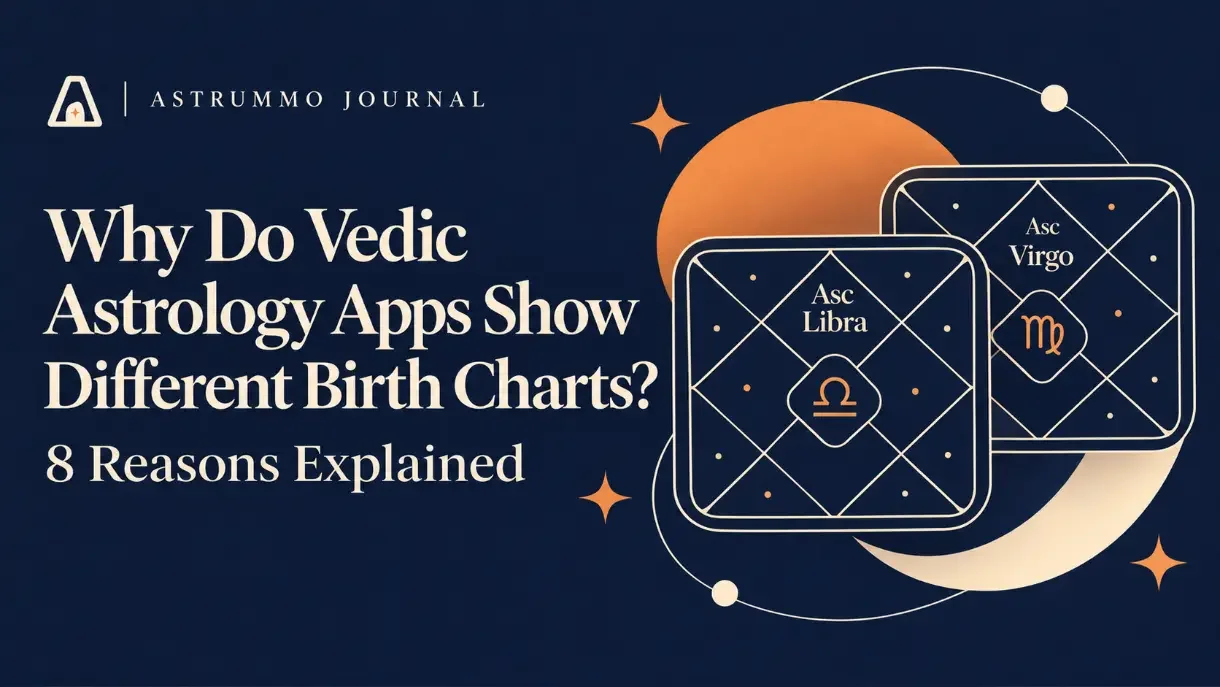
You enter your birth date, time, and location into two Vedic astrology apps. Both calculate your birth chart, yet the results do not match.
One app places your Ascendant in one zodiac sign, while another shows a different degree. Your Rahu and Ketu positions might not agree. Perhaps your Navamsa (D9) chart looks different, or your planetary periods begin on different dates.
Naturally, you start wondering: Which Vedic astrology app is actually correct?
The answer is not always straightforward.
Different results do not necessarily mean that one application is inaccurate. Vedic astrology involves astronomical calculations, geographical data, time zone conversions, and traditional calculation conventions. A difference in any of these inputs or settings can change the resulting chart.
Some differences are minor. Others can affect the Ascendant (Lagna), house placements, Nakshatras, divisional charts, or the timing of planetary periods.
Understanding why these differences occur can help you compare astrology software more intelligently and identify when a discrepancy deserves further investigation.
Here are eight important reasons why Vedic astrology apps sometimes produce different birth charts.
Your birth time is one of the most important inputs in a Vedic astrology calculation.
While planetary positions change at different speeds, the Ascendant is particularly sensitive to time because it represents the intersection of the eastern horizon with the ecliptic at the moment of birth.
As Earth rotates, the Ascendant moves through the zodiac.
A small difference in birth time can therefore change the Ascendant's degree, even when the Ascendant sign remains unchanged.
This becomes especially important when the Ascendant lies close to a zodiac sign boundary.
For example, imagine that your Ascendant is calculated near the end of Virgo. A slightly different birth time could place it in early Libra.
Such a change would affect much more than the label of your rising sign.
In traditional whole-sign chart interpretation, the Ascendant determines the first house. A change in the rising sign changes how the houses are assigned throughout the birth chart and which planets rule them.
Divisional charts can be even more sensitive.
In the Navamsa (D9) chart, each zodiac sign is divided into nine sections of 3°20′. A relatively small difference in the calculated Ascendant can therefore change the Navamsa Ascendant when it crosses one of these boundaries.
This explains why two apps may show similar planetary positions but different D9 Ascendants.
What to check: Make sure both applications use exactly the same birth time, including AM/PM formatting and any available minutes or seconds.
If your birth time is approximate, remember that additional decimal precision in the software cannot eliminate uncertainty in the original birth record.
This is an easily overlooked difference between astrology applications.
Many apps allow users to search for their birthplace by city name.
For example, you might enter New York, London, or Mumbai and select the first available result.
The application then assigns geographical latitude and longitude to that city.
But where exactly are those coordinates located?
They may represent the city center, a geographical reference point, or another predefined location in the application's database.
They do not necessarily identify the hospital or building where you were born.
Your birthplace coordinates help determine the local astronomical geometry used to calculate the Ascendant and astrological house positions.
Geographical longitude influences the relationship between local sidereal time and the sky's orientation at your birthplace, while latitude influences how the zodiac intersects the horizon.
Consequently, two locations within the same city can produce slightly different Ascendant or house degrees.
For most births, moving the calculation point a few kilometers will create only a small difference.
However, if a calculated Ascendant or house boundary is already very close to a significant division, that difference can sometimes affect the resulting chart interpretation.
The effect also varies depending on geographical latitude and the specific birth time.
Astrummo allows users to select their birthplace using precise coordinates on an interactive map.
Instead of relying only on a city's predefined location, you can identify a more specific point, such as the hospital where you were born.
This provides greater control over the geographical input used for the birth chart calculation.
Consider the difference:
City-based selection | Exact birthplace selection |
|---|---|
Uses a predefined city coordinate | Uses the location selected on a map |
May represent the city center | Can represent the actual birth hospital |
Convenient for quick entry | Offers more control over geographical accuracy |
Usually sufficient for many calculations | Useful when examining precise Ascendant and house degrees |
There is an important limitation to understand.
Selecting an exact birthplace does not automatically change the geocentric zodiac positions of the planets.
Standard geocentric planetary positions are calculated relative to Earth's center and primarily depend on the observation time, not the observer's city.
Birthplace coordinates are especially relevant to the Ascendant, house calculations, and chart factors derived from them. Separately, software using topocentric rather than geocentric planetary positions can introduce location-dependent differences.
The advantage of precise birthplace selection is therefore better geographical input, not a guarantee that every planetary placement will change.
Two applications may receive identical birth details and still interpret the birth moment differently if they use different time zone rules.
A birth certificate typically records the local civil time.
Astronomical calculations, however, require that local time to be converted into a consistent time standard.
This means astrology software must determine the correct UTC offset for the specific birthplace and historical date.
The difficulty is that time zone rules have changed considerably over the years.
Countries have introduced and abolished daylight saving time, changed their standard offsets, or altered the dates on which clocks move forward and backward.
The official IANA Time Zone Database maintains historical time zone information and documents many of these changes.
Imagine someone born at 2:30 AM on a date when the local clocks changed.
If one application correctly interprets the historical time rule while another applies the wrong offset, the software may calculate planetary positions for a different actual moment.
A one-hour error can substantially alter the Ascendant and house positions.
It can also change the Moon's calculated degree and, in sensitive cases, its Nakshatra or subdivisions.
That matters because the birth Moon's Nakshatra is used to establish the starting period in the traditional Vimshottari Dasha system.
An incorrect time conversion can therefore affect both the natal chart and subsequent astrological timing calculations.
Some daylight-saving transitions also create ambiguous local times: a clock reading may have occurred twice during the same night.
In those cases, even accurate software may need additional information to identify the intended birth instant.
What to check: Compare the historical UTC offset or time zone interpretation used by each application, particularly for older birth dates and locations with complicated daylight saving histories.
Ayanamsa is one of the most important reasons two Vedic astrology applications may display different planetary degrees.
Most contemporary Vedic astrology software uses a sidereal zodiac, which refers planetary longitudes to a stellar-based reference framework.
Mainstream Western natal astrology generally uses the tropical zodiac, which is referenced to the equinoxes.
Because of Earth's axial precession, these coordinate systems no longer assign identical zodiac longitudes to the same celestial position.
The angular difference between tropical and sidereal longitude is described through the ayanamsa.
However, there is not just one ayanamsa convention.
Different Vedic astrology traditions and software packages may use Lahiri, Raman, Krishnamurti, or other reference definitions.
Even when two applications both use a sidereal zodiac, selecting different ayanamsas can produce different planetary degrees.
The resulting difference can affect:
Planetary longitudes within zodiac signs.
Planetary sign assignments near sign boundaries.
Ascendant longitude and, sometimes, its sign.
Nakshatra and Pada assignments near their boundaries.
Divisional chart placements and certain Dasha calculations.
For example, if a planet lies very close to a zodiac boundary under one ayanamsa, another ayanamsa may place it on the opposite side.
The difference does not necessarily mean either astronomical calculation is defective.
The applications may simply be applying different sidereal reference conventions.
The Swiss Ephemeris documentation explains the astronomical treatment of sidereal coordinates and the available ayanamsa methods.
For a deeper explanation of why zodiac signs differ between systems, read our guide, Vedic vs Western Astrology: Why Your Zodiac Sign May Change.
What to check: Before comparing two birth charts, make sure both programs use the same zodiac system and ayanamsa.
Rahu and Ketu have a special role in Vedic astrology.
Unlike the Sun, Moon, or visible planets, they are not physical celestial bodies.
They represent the Moon's orbital nodes, the points where the Moon's orbital plane intersects the ecliptic.
These nodes are also associated with the geometry of solar and lunar eclipses.
However, there are different ways of calculating their positions.
Two common conventions are Mean Node and True Node.
The Mean Node represents a smoothed, averaged position of the lunar node.
It removes short-term oscillations and describes the node's longer-term motion.
The True Node attempts to represent the node's varying position more directly, including short-term oscillations.
As a result, the True Node may temporarily move differently from the Mean Node.
These two methods can produce different Rahu and Ketu degrees for the same birth moment.
In most cases, the differences will not transform the entire birth chart.
However, when Rahu or Ketu lies near a Nakshatra, Pada, sign, or divisional boundary, even a relatively modest difference can become important within the chosen interpretive system.
Astrummo uses the Mean Node convention for its canonical Rahu and Ketu calculations.
When comparing Astrummo with another application, verify whether that software is configured for Mean Node or True Node before interpreting a discrepancy as an error.
The distinction does not independently change the Vimshottari Dasha starting point, which is based on the birth Moon's Nakshatra.
It specifically concerns how the lunar nodes are calculated and displayed.
Sometimes two Vedic astrology apps agree on the Ascendant sign and every planetary degree, yet display a planet in different houses.
This can happen because they use different house calculation methods.
In a traditional whole-sign Rashi chart, the zodiac sign containing the Ascendant becomes the first house.
The next sign becomes the second house, and so on.
Each complete zodiac sign corresponds to one house.
Other approaches use more specific house boundaries, or Bhava cusps.
These may include degree-based systems such as Sripati or other Bhava Chalit conventions.
The practical difference is important.
Suppose your Ascendant is at 18° Libra, and Saturn is at 3° Sagittarius.
In a whole-sign chart, Sagittarius is the third house from Libra.
Saturn would therefore be placed in the third house.
A degree-based house calculation may assign Saturn to a different Bhava, depending on the chosen method and resulting house boundaries.
Notice what has not changed: Saturn's zodiac longitude.
Only its house assignment has changed.
This distinction explains why two programs can disagree about a planet's house without disagreeing about the planet's astronomical position.
Before deciding which interpretation is appropriate, identify whether the applications are showing the same kind of chart.
What to check: Compare the selected house system and whether each screen represents a Rashi chart or a Bhava-based chart.
Vedic astrology does not rely exclusively on the main birth chart.
Traditional Jyotish also uses divisional charts, known as Vargas, which subdivide zodiac signs according to specific rules.
Among the best-known examples are:
Divisional chart | Traditional application |
|---|---|
D1 (Rashi) | Main natal chart and overall foundation |
D9 (Navamsa) | Planetary strength, marriage-related analysis, deeper chart context |
D10 (Dasamsa) | Career and professional activity |
D7 (Saptamsa) | Children and related life themes |
Because these charts depend on smaller divisions of the zodiac, precision becomes especially important.
In D9, each 30° zodiac sign is divided into nine portions of 3°20′.
A planet calculated near one of these boundaries may receive a different Navamsa placement if two programs use different ayanamsas or sufficiently different planetary longitudes.
The Ascendant in divisional charts can be particularly sensitive to birth time.
For example, an otherwise small change in birth time may move the Ascendant across a Navamsa boundary, even when the main D1 Ascendant sign remains unchanged.
For some divisional charts, there are multiple recognized calculation traditions or implementation conventions.
This is especially relevant when comparing advanced astrology software that allows users to select different Varga calculation methods.
Therefore, two differing D10 results should not automatically be interpreted as proof that one program has a broken astronomical engine.
It may be a difference in divisional-chart methodology.
However, when two applications are configured with identical birth data, planetary longitudes, ayanamsa, and Varga rules, their calculations should be consistent within normal numerical precision.
Our Complete Guide to All 27 Moon Nakshatras also explains Nakshatra Padas and their connection with Navamsa divisions.
The final reason involves the distinction between calculating a birth chart and interpreting one.
These are separate processes.
The calculation stage establishes the positions of celestial bodies and relevant chart angles for a particular moment.
High-quality astronomical ephemerides are designed to perform this work with precision.
Astrummo uses the commercially licensed Swiss Ephemeris, a professional astronomical calculation library, as part of its underlying astrology engine.
The Swiss Ephemeris provides precise celestial position calculations, but the application must still apply the intended astrological conventions consistently.
It is also used by other astrology applications; its presence alone is not evidence that one app must be more accurate than every alternative.
When comparing modern, well-implemented ephemeris systems using the same settings, astronomical discrepancies may be extremely small.
Much larger differences often originate from birth inputs, time zone handling, zodiac conventions, house systems, or chart calculation settings.
After the chart has been calculated, another process begins: interpreting the results.
Two apps can use identical planetary coordinates and still produce very different explanations.
One application may rely primarily on short, predefined horoscope descriptions.
Another may consider house rulerships, planetary dignity, aspects, strength calculations, divisional charts, Dashas, and transits.
An AI-powered application may also generate natural-language explanations.
But it is important to understand what the AI is actually doing.
Does it receive calculated chart facts from a dedicated astrology engine, or is it being asked to construct astrological claims without a verified calculation layer?
These approaches are not equivalent.
Astrummo uses a dedicated Vedic astrology calculation system to establish the chart data.
Its conversational component, Ask Astrummo V4, then works with those calculated astrological facts to interpret the user's questions.
This separation is important because astronomical coordinates and traditional astrology calculations should not be invented by a language model.
At the same time, having precise astronomical inputs does not scientifically validate astrological predictions. Astronomy establishes where celestial objects are located; Jyotish supplies a traditional interpretive framework whose predictive claims are not scientifically established.
For users, the most meaningful comparison is therefore not which app produces the most confident answer, but which one clearly distinguishes calculations, conventions, and interpretations.
Before concluding that one application is wrong, it helps to identify exactly which part of the chart differs.
The following comparison provides a practical starting point.
What differs between apps? | What to investigate first |
|---|---|
Ascendant degree | Birth time, coordinates, time zone |
Ascendant sign | Birth time, ayanamsa, birthplace, time zone |
Most planetary degrees | Zodiac system, ayanamsa, birth-time conversion |
Rahu and Ketu degrees | Mean Node vs. True Node |
Planetary house placement | Whole-sign vs. Bhava-based house system |
Navamsa (D9) placements | Ayanamsa, exact degrees, birth time |
Other divisional charts | Varga calculation rules and degree precision |
Mahadasha dates | Moon longitude, ayanamsa, Dasha-year convention |
A useful approach is to compare the simplest astronomical facts first.
Check whether both applications agree on the birth moment expressed in UTC.
Then compare the sidereal longitudes of the Sun and Moon, followed by the Ascendant.
After that, examine the selected ayanamsa, lunar node convention, house calculation settings, and divisional chart methodology.
This helps isolate the source of the disagreement rather than attempting to explain every difference at once.
For further reading about how natal placements and houses fit together, see How to Read Your Vedic Birth Chart: A Beginner's Guide.
And if the disagreement concerns planetary period dates, our article What Is Vimshottari Dasha? How Planetary Periods Work in Vedic Astrology explains how the birth Moon determines the starting Mahadasha and its remaining duration.
The most common factors to investigate are birth time, time zone interpretation, geographical coordinates, and ayanamsa. If the calculated Ascendant is close to a sign boundary, a relatively small difference can change the displayed rising sign.
It can affect Ascendant and house calculations because they depend on geographical coordinates. For most births, a small distance within the same city produces a small difference. Exact coordinates become more relevant when sensitive chart boundaries are involved.
These are different mathematical definitions of the lunar node. They should be compared using consistent settings. A discrepancy between them is not, by itself, evidence of a software error.
Check the birth time, ayanamsa, planetary degrees, and Navamsa calculation rules. The Navamsa Ascendant may change even when the D1 Ascendant remains within the same zodiac sign.
Swiss Ephemeris is a high-precision astronomical calculation library. It provides a reliable foundation for celestial positions when implemented and configured correctly. However, the final chart also depends on accurate inputs and consistent astrological calculation settings.
Yes, when they intentionally use different recognized calculation conventions. But if two applications claim to use identical inputs and mathematical settings, significant unexplained discrepancies deserve investigation.
Not necessarily. First determine whether the difference concerns astronomical positions, astrological conventions, or the natural-language interpretation. These are distinct issues and should be assessed separately.
When two Vedic astrology applications show different birth charts, the most useful response is not to assume that the more attractive or confident interpretation must be correct.
Start with the inputs.
Check your birth time, the precise birthplace, and historical time zone. Then compare the ayanamsa, lunar node settings, house calculation methods, and divisional chart conventions.
Even sophisticated astrology software can produce different results if these foundations are not aligned.
Astrummo approaches this problem by combining precise astronomical calculations, traditional Vedic chart methods, and the ability to select detailed birthplace coordinates directly on a map.
Its conversational astrology experience builds on calculated chart data rather than asking AI to invent planetary positions.
The goal is not to claim that every other Vedic astrology application is wrong. It is to make the calculations underlying a personal chart consistent and provide a more meaningful way to explore their traditional interpretation.
Your birth chart deserves more than a generic location and a generic horoscope.
Explore your personal Vedic birth chart, examine your planetary placements, and ask questions based on your calculated astrological data.
10 October 2026 · Astrummo
Understanding that distinction helps you compare your charts without treating one as a mistake.
10 October 2026 · Astrummo
Learn how to read your Vedic birth chart, from your Ascendant and houses to planetary placements, nakshatras, and aspects—with a real chart example.
12 October 2026 · Astrummo
Discover all 27 Nakshatras in Vedic astrology, including their meanings, symbols, ruling planets, deities, zodiac degrees, and influence on your birth chart.
15 October 2026 · Astrummo
Learn how Vimshottari Dasha works, why the Moon’s Nakshatra determines your planetary periods, and how Mahadasha, Antardasha and transits are used in Vedic astrology.