Understanding planetary transits, your birth chart, and the ancient Vedic approach to daily timing.
You open your astrology app on Monday and read that the day favors careful planning. On Tuesday, the guidance shifts toward communication and relationships. By Wednesday, the focus may be on responsibilities, patience, or an opportunity to make progress.
Yet your birth date has not changed. Neither has your birth chart.
So why does your Vedic astrology reading change every day?
The answer lies in one of the most important distinctions in Vedic astrology, traditionally known as Jyotish: your birth chart describes a lasting astrological foundation, while the changing positions of the planets and your active planetary periods provide a framework for interpreting the timing of different experiences.
A daily reading is not supposed to replace your natal chart or rewrite your personality. It is an interpretation of how the current astrological conditions relate to the chart you were born with.
Understanding that relationship is the key to understanding why personalized Vedic astrology can offer a different perspective from one day to the next.
Your Birth Chart Is the Foundation, Not the Daily Forecast
In Vedic astrology, the birth chart, or Janma Kundali, represents the positions of the planets at the time and place of birth.
It is commonly displayed as the D1 chart, also known as the Rashi chart.
The chart contains several essential elements: your Ascendant (Lagna), the twelve astrological houses, the zodiac signs occupied by the planets, and the relationships between those planets and houses.
Each element has a different interpretive role.
The Ascendant establishes the structure of the chart. The houses represent areas of life, such as career, relationships, finances, education, health, and personal development. Planetary placements and their relationships are traditionally examined to understand how these areas may be expressed.
For example, the tenth house is associated with career, responsibilities, public activity, and professional standing. The seventh house is associated with partnerships and significant one-to-one relationships. The fourth house concerns home, emotional foundations, and domestic life.
However, professional astrologers do not judge these topics from house numbers alone. They examine the relevant house rulers, planetary strengths, aspects, placements, and the broader context of the chart.
The birth chart itself does not change from Monday to Tuesday. What changes is the astrological environment surrounding it.
An astrologer therefore makes a distinction between the lasting pattern of the natal chart and the planetary influences considered active at a particular time.
Consider a person whose birth chart suggests a strong emphasis on communication, learning, and intellectual work. These natal characteristics remain part of the underlying interpretation.
But one day may place greater emphasis on professional discussions, while another may highlight the need for reflection or more careful decision-making.
The difference comes from timing.
1. Planetary Transits: The Moving Sky Meets Your Birth Chart
Planetary transits are among the most familiar techniques used in daily astrology.
The Sanskrit term Gochara refers to planetary movement and its interpretation in relation to the natal chart.
Although your birth chart remains fixed, the planets continue to move through the zodiac. The Moon moves relatively quickly, while Jupiter and Saturn remain in zodiac signs much longer.
Vedic astrologers examine where these transiting planets are located and how their positions relate to the individual birth chart.
Imagine two people observing the same Jupiter transit.
For one person, Jupiter may be moving through a house associated with education or personal development. For another, the same transit may occupy a house connected with responsibilities, partnerships, or other matters.
Even though Jupiter occupies exactly the same position in the sky, its relationship to their natal charts differs.
This is why the same planetary transit does not automatically receive the same interpretation for everyone.
There is another important consideration: a planet's traditional significance is only one part of its interpretation.
Jupiter is commonly associated with wisdom, expansion, guidance, and learning. But that does not mean every Jupiter transit guarantees success or good fortune.
Its interpretation depends on factors such as the houses Jupiter rules, its natal condition, the house it is transiting, and the other influences operating at the same time.
Likewise, Saturn is often associated with discipline, responsibility, patience, and limitations. Yet Saturn should not automatically be treated as unfavorable. In a suitable context, its symbolism can suggest structure, commitment, and the value of sustained effort.
A thoughtful daily reading should therefore look beyond simplistic labels such as "good planet" or "bad planet."
The real question is not merely which planets are moving, but which parts of your individual chart those movements are bringing into focus.
Why some transits matter more than others
Not every planetary movement has equal interpretive importance.
A major Saturn transit may provide a background theme over many months. A faster lunar transit can change the emphasis of a daily interpretation much more quickly.
A professional astrologer considers both scales of time rather than treating every minor change as a major event.
Some days represent genuine transitions. Others are continuations of conditions already present.
That distinction matters because responsible astrology should not manufacture dramatic predictions simply to make every day sound extraordinary.
2. Why the Moon Plays Such an Important Role in Daily Vedic Astrology
If you have noticed that your daily reading changes even when the slower-moving planets remain in the same signs, the Moon is one of the first places to look.
In Jyotish, the Moon, known as Chandra, occupies a central place in the interpretation of the mind, emotional experience, receptivity, and the way a person responds to circumstances.
Its movement is also comparatively rapid.
The Moon takes approximately 27.3 days to complete one sidereal orbit relative to the stars. As a result, its zodiacal position changes noticeably from day to day.
This makes lunar movement particularly relevant to short-term astrological interpretation.
Understanding Nakshatras
Vedic astrology divides the zodiac into 27 principal lunar mansions known as Nakshatras.
Each occupies 13 degrees and 20 minutes of the zodiac, and each has its own traditional symbolism and planetary ruler.
Because the Moon moves through approximately one Nakshatra per day on average, its Nakshatra placement provides a useful framework for examining the changing quality of the day.
For example, Rohini is traditionally associated with themes of growth, cultivation, beauty, and nourishment. Ashwini is associated with beginnings, movement, and restoration. Pushya is connected with nourishment, support, and preservation.
These are traditional symbolic associations, not guarantees that specific events will occur.
An astrologer must still consider the Moon's relationship to the natal chart, its condition, and the wider planetary picture.
The Moon's changing Nakshatra can help explain why the tone of one day differs from another, even when a person's major planetary periods and slower transits remain unchanged.
The Moon is important, but it is not everything
A common mistake in daily astrology is to interpret the Moon's current sign or Nakshatra as though it tells the entire story.
It does not.
The Moon contributes a relatively fast-moving layer of interpretation. It should be assessed alongside the individual's natal placements, planetary periods, and other relevant transits.
A lunar condition that appears supportive in isolation may be less significant if stronger factors point toward caution or restraint.
Equally, a challenging lunar influence should not automatically lead to an alarming prediction.
The purpose of synthesis is to understand how several influences interact, rather than allowing one isolated factor to dominate the reading.
3. Vimshottari Dasha: Why Your Personal Planetary Period Matters
Transits describe changing planetary positions, but Jyotish also uses a distinct timing system known as Dasha.
One of the most widely used systems in the Parashari tradition is Vimshottari Dasha.
This system organizes planetary periods into a traditional 120-year cycle distributed among nine planetary rulers.
The starting point is determined by the Moon's Nakshatra at birth, while the Moon's exact position within that Nakshatra determines the remaining portion of the initial period.
A major period is called a Mahadasha. Within it are shorter subdivisions, including Antardashas and Pratyantardashas.
These periods are interpreted in relation to the planets' actual roles and conditions in the natal chart.
To understand their relevance, imagine a person experiencing a Jupiter Mahadasha.
Because Jupiter is associated with learning, wisdom, expansion, and guidance, those themes may form part of the wider interpretation.
But the same Jupiter Mahadasha does not mean that every day is equally favorable for education, professional development, or financial decisions.
Its significance depends on Jupiter's natal placement, house ownership, strength, relationships, and the operation of its sub-periods.
Daily transits then add another layer.
A lunar transit may place temporary emphasis on an area already relevant to the active Dasha. Another day's conditions may suggest greater patience or attention to unresolved responsibilities.
The Dasha supplies longer-term context. Transits help interpret the changing conditions within that context.
This is one of the reasons two people born under the same zodiac sign can receive substantially different readings.
They may have different Ascendants, different natal planetary placements, and entirely different active Dasha periods.
A reading based only on their shared Sun sign would overlook much of that individual context.
For a more detailed explanation of planetary periods, read our guide: What Is Vimshottari Dasha?.
4. Panchanga: Five Traditional Factors That Describe the Day
Another important part of daily Vedic astrology is the Panchanga, a traditional calendrical framework used to describe the astrological qualities of a particular time.
The Sanskrit word refers to five limbs or components.
These are:
Component | Meaning |
|---|
Tithi | The lunar day, calculated from the angular relationship between the Sun and Moon |
Vara | The weekday and its traditional planetary ruler |
Nakshatra | The lunar mansion occupied by the Moon |
Yoga | One of 27 divisions calculated from the combined sidereal longitudes of the Sun and Moon |
Karana | Half of a Tithi, representing another subdivision of the lunar cycle |
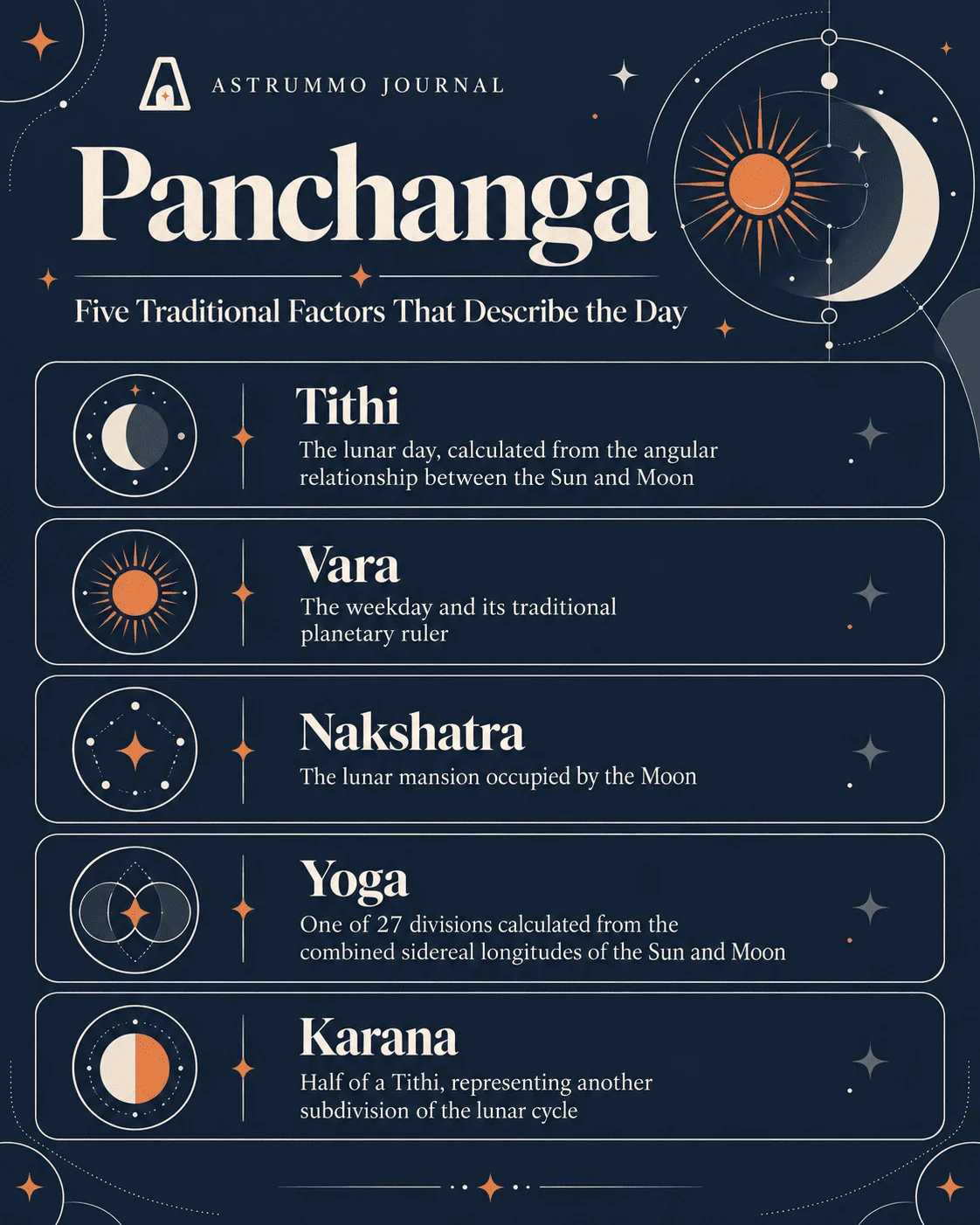
Each component describes a different aspect of the traditional astrological calendar.
Tithi is particularly important because it is based on the changing angular distance between the Sun and Moon, rather than simply the date printed on a calendar.
Nakshatra reflects the Moon's position in the sidereal zodiac.
Vara associates each weekday with a planetary ruler. Thursday, for example, is traditionally associated with Jupiter, while Saturday is associated with Saturn.
Yoga and Karana add further interpretive distinctions.
These factors have historically been used in a variety of astrological and calendrical practices, including the assessment of daily conditions and the selection of suitable times for particular activities.
However, a personal daily reading and a formal Muhurta consultation are not the same thing.
Muhurta is a specialized branch of astrology concerned with selecting an appropriate time for a particular activity or undertaking. That requires a more focused assessment than a general daily interpretation.
In a personalized Daily Reading, Panchanga provides supporting context. It does not replace the natal chart or establish that an entire day will be favorable or unfavorable for every person.
5. Why Two People Can Receive Different Readings on the Same Day
Consider a simple hypothetical example.
Two people live in the same city. They wake up on the same morning, beneath the same planetary sky.
The Moon occupies the same Nakshatra for both. Jupiter and Saturn are in the same zodiac positions. The Panchanga conditions are also the same at a given moment.
Yet their natal charts are different.
Person A has an Ascendant and planetary configuration that places particular emphasis on career and professional responsibilities.
Person B has a chart in which the same planetary conditions relate more strongly to personal relationships or domestic matters.
Their active Dasha periods may also differ.
An astrologer examining Person A's chart might interpret the day's conditions through professional communication, planning, or an existing responsibility.
For Person B, a different set of natal relationships might place greater interpretive weight on emotional understanding, personal commitments, or family discussions.
Neither interpretation should be inferred from a single house or planetary placement alone. Both require examination of the wider chart.
The essential point is that personalization comes from the interaction between a shared sky and an individual natal chart.
This also explains why knowing someone's zodiac sign is not enough to create a truly individualized Vedic astrology reading.
A more complete assessment benefits from accurate birth information, including the date, time, and location of birth.
The Ascendant and house positions are particularly sensitive to birth time, so inaccurate details can materially alter a natal interpretation.
If you are unfamiliar with the structure of a Vedic chart, a useful starting point is our beginner's guide to reading your birth chart in the Astrummo Journal.
6. Why Your Daily Reading May Sometimes Sound Similar to Yesterday's
This is an important question, and one that deserves a straightforward answer.
A trustworthy daily astrology system should not produce a completely different prediction every day merely to appear interesting.
Some astrological conditions persist.
A major planetary period may continue for years. Saturn can remain in the same zodiac sign for an extended period. Jupiter's broader influence may also develop over many months.
Even shorter-term factors can produce similar interpretive themes across consecutive days.
For example, if several conditions continue to emphasize professional responsibilities, it would be artificial to claim that one day is entirely about career, the next about romance, and the third about travel without sufficient astrological justification.
A more careful reading may recognize that the broader theme remains consistent while identifying a smaller change in emphasis.
One day might favor organizing an ongoing responsibility. The next could place greater attention on communicating about it.
Alternatively, the most useful interpretation might simply be that the established conditions continue.
Consistency is not a weakness when it reflects the actual astrological picture.
The quality of a daily reading should be judged by whether its conclusions are coherent, properly contextualized, and supported by the methods being used—not by how dramatic or different it sounds.
7. What Makes a Personalized Daily Reading More Useful Than a Generic Horoscope?
A conventional horoscope commonly begins with a zodiac sign and gives an interpretation intended for everyone associated with that sign.
This can be entertaining and easy to understand, but it is necessarily broad.
A personalized Vedic astrology reading begins with considerably more individual information.
The astrologer considers the birth chart, identifies relevant planetary relationships, examines the timing systems, and weighs the current conditions against that established foundation.
The distinction is not simply that one reading is longer or contains more complicated terminology.
In fact, a well-written personal reading may be quite short.
The difference lies in the reasoning behind it.
A generic statement might say:
"Today is a good day for success. Trust your instincts and embrace new opportunities."
A more carefully qualified Vedic interpretation might say:
"With your current planetary period emphasizing professional development, today's lunar conditions place additional attention on communication and planning. You may find it useful to clarify an existing proposal before committing to a new responsibility."
This second example is still hypothetical. It should only be presented as an individual's actual reading when the relevant astrological calculations support it.
Nevertheless, it demonstrates an important principle.
Good astrological writing connects interpretation, timing, and practical relevance without pretending to know the future with certainty.
The reader should understand not only what the traditional astrological picture suggests, but also why that interpretation has been offered.
8. How Astrummo Approaches Your Personal Daily Reading
Astrummo is designed to bring traditional Vedic astrology calculations into an accessible daily experience.
Its approach begins with the individual birth chart rather than a generalized zodiac forecast.
Planetary positions are calculated using the Swiss Ephemeris with Lahiri sidereal calculations. This provides an astronomical basis for identifying the positions used in its Vedic astrology assessments.
Astrummo's Daily Alignment then considers multiple traditional astrological factors, including planetary transits, natal relationships, Vimshottari Dasha, Ashtakavarga, lunar conditions, and components of the Panchanga.
Ashtakavarga is a traditional system that helps assess the support associated with planetary transits through different zodiac signs. Rather than treating every sign or transit as identical, it introduces another chart-specific layer of evaluation.
These calculations are brought together into the Daily Alignment assessment.
The Personal Daily Reading then interprets that assessment in natural language, drawing attention to the most relevant supporting and challenging influences.
The purpose is not to overwhelm you with technical information.
You do not need to memorize Nakshatras, identify every planetary aspect, or understand Dasha calculations before finding something useful in your daily interpretation.
Instead, the reading aims to explain the central astrological theme of the day and translate it into understandable, practical guidance.
For consistency, Astrummo uses a local-noon reference for each displayed date, with the daily assessment renewing at local midnight. This creates one consistent daily interpretation rather than a reading that changes unpredictably every time the app is opened.
Your Daily Alignment Score provides an at-a-glance assessment, while the Personal Daily Reading explains its context.
The score should not be mistaken for a mathematical probability that the day will be successful, nor should a lower score be interpreted as a prediction of misfortune.
A lower assessment can simply indicate that the astrological framework calls for greater care, restraint, or attention to particular influences.
Likewise, a higher assessment does not guarantee that plans will succeed.
Astrummo uses AI to communicate and interpret calculated astrological information. The underlying planetary positions and established chart facts come from the calculation system, not from AI inventing or independently recalculating them.
This separation is important: astronomical calculations establish positions, traditional Jyotish methods supply the interpretive framework, and the personal reading brings that framework into language a reader can understand.
9. How to Use Your Daily Reading in Everyday Life
A daily reading is most useful when approached as a tool for reflection rather than a set of compulsory instructions.
You do not need to reorganize your entire day because one planetary influence appears stronger than another.
Instead, consider three questions.
What is the main theme?
Read the interpretation as a whole. Is it emphasizing communication, patience, relationships, responsibility, creativity, or another area of life?
Try not to isolate one sentence from the broader context.
How does this relate to what is already happening in my life?
A reading emphasizing professional discussions may be more useful when you already have a meeting, presentation, or unresolved work conversation ahead.
It does not mean you must invent a professional opportunity simply because the interpretation mentions one.
What practical choice remains within my control?
Astrology should not replace judgment.
If the reading suggests patience, you might consider whether a decision genuinely needs to be made immediately. If it highlights communication, you could pay closer attention to how clearly you express your intentions.
The point is to encourage considered choices, not dependence on daily predictions.
This approach also creates room for disagreement.
If a particular interpretation does not resonate with your actual circumstances, you do not need to force events to fit it.
A useful personal practice is to reflect on the reading later in the day and notice whether its themes helped you think more clearly about your choices.
Over time, this can make the daily experience more meaningful without requiring you to treat every interpretation as an established fact.
10. Can Vedic Astrology Really Predict What Will Happen Today?
Vedic astrology has a long history and a sophisticated body of interpretive techniques. Its practitioners use planetary positions, natal charts, and timing systems to examine patterns and possibilities.
However, the precision of an astronomical calculation should not be confused with scientific proof of an astrological prediction.
The position of the Moon or Jupiter can be calculated with established astronomical methods. Whether a particular planetary relationship predicts a personal event is a different claim.
Astrology has not been scientifically established as a reliable method for predicting individual life events.
For that reason, a responsible reading should avoid claiming that a promotion, relationship development, financial gain, or other specific outcome is guaranteed.
Even within traditional Jyotish practice, a careful interpretation considers multiple factors and recognizes that individual circumstances matter.
A reading can suggest themes for reflection, but it cannot know every decision you will make, every person you will encounter, or every event that may occur.
This is especially important for major medical, legal, or financial decisions, which should rely on appropriate professional expertise and reliable evidence.
The most constructive way to approach daily astrology is as an interpretive tradition that may help you reflect on timing, priorities, and personal experience—not as an infallible forecast.
Final Thoughts: Your Chart Is Constant, but the Astrological Context Changes
Your birth chart remains the same throughout your life. The planetary sky does not.
In Vedic astrology, daily interpretation emerges from the relationship between that lasting natal foundation and changing factors such as planetary transits, lunar conditions, Panchanga, and the active phases of Vimshottari Dasha.
Some changes are subtle. Others may receive greater attention within the traditional framework.
Understanding these layers makes it easier to appreciate why your daily reading may emphasize different subjects on different days—and why some themes naturally continue.
The value of a personalized reading is not in promising an extraordinary event every morning. It lies in offering a thoughtful interpretation that reflects your individual chart, acknowledges the day's conditions, and gives you something meaningful to consider.
Explore your Personal Daily Reading with Astrummo.
Discover your Daily Alignment, understand the astrological themes highlighted for your chart, and explore your questions with Ask Astrummo—your personal Vedic astrology companion.
Your personal astrology experience begins with your birth chart.
Frequently Asked Questions
Does my Vedic birth chart change every day?
No. Your natal chart is calculated from your birth date, time, and location and remains fixed. Daily readings change because current planetary positions and other timing factors are interpreted in relation to that natal foundation.
Why is my Daily Alignment different from yesterday?
Daily Alignment considers several changing factors, including lunar conditions, planetary transits, Panchanga, and their relationship to your natal chart. Some influences change frequently, while others remain active for longer periods.
Why do two people with the same zodiac sign receive different readings?
They may have different Ascendants, planetary placements, house relationships, and active Dasha periods. A full Vedic astrology assessment considers more than a single zodiac sign.
Does a low Daily Alignment Score mean something bad will happen?
No. The score is an interpretive assessment within Astrummo's astrology framework, not a probability of success or failure. A lower score does not guarantee negative events.
Can my Daily Reading predict exactly what will happen today?
No reliable method has scientifically established that astrology can predict specific personal events with certainty. A daily reading is better understood as traditional astrological guidance for reflection.
Why is my reading sometimes similar on consecutive days?
Some planetary influences persist over several days, weeks, or months. Similar readings may reflect the continuation of those conditions rather than a lack of personalization.