23 October 2026 · Astrummo
2027 Vedic Astrology Forecast: The Major Planetary Transits to Watch
Discover the 2027 Vedic astrology forecast: Jupiter and Saturn transits, Rahu-Ketu, retrogrades and eclipses explained using the Lahiri sidereal zodiac.
Does Nakshatra change every day? Learn how often the Moon moves between Nakshatras, why your birth Nakshatra stays the same, and what it means for you.
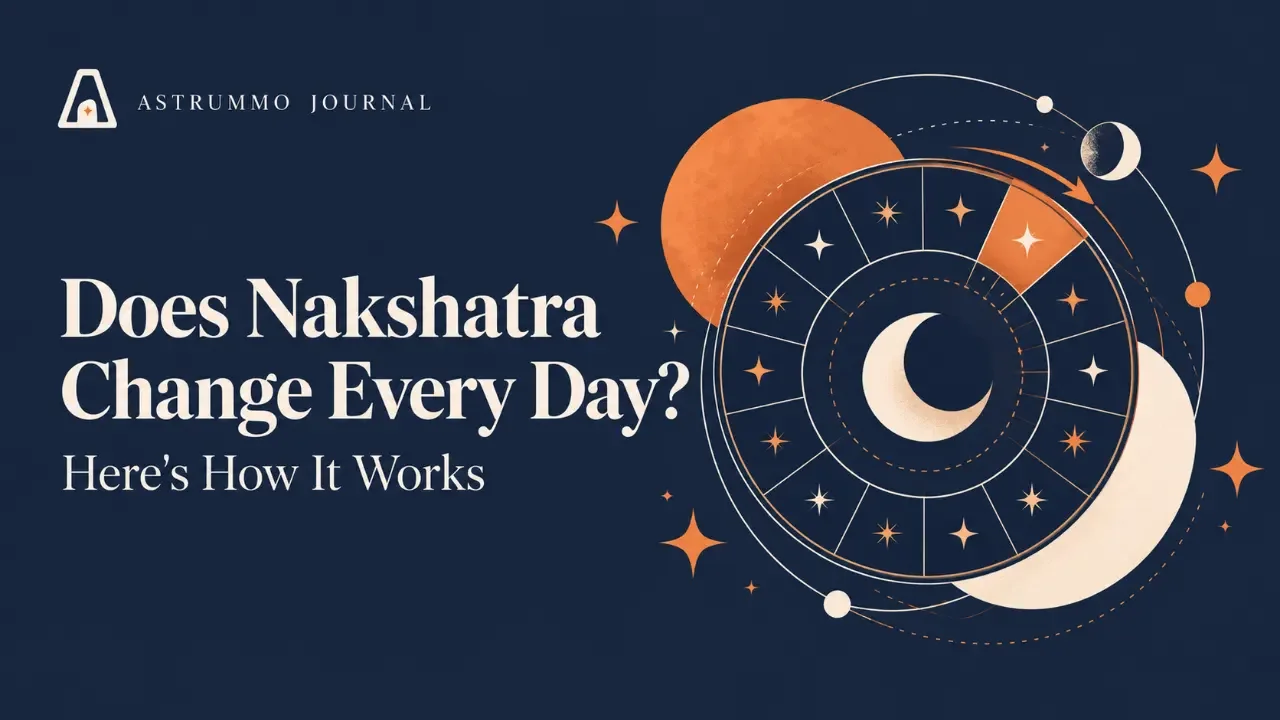
Yes, the Moon's Nakshatra changes approximately once every day—but your birth Nakshatra does not. The distinction is one of the most important concepts in Vedic astrology, and understanding it explains why the Moon's astrological significance can shift from one day to the next.
In Jyotish, the traditional Indian system of astrology, the Moon moves through 27 divisions of the sidereal zodiac known as Nakshatras, or lunar mansions. Each Nakshatra carries its own traditional symbolism, planetary ruler, and associations with different kinds of activities and experiences.
Because the Moon moves relatively quickly, its Nakshatra changes roughly every 24 hours, although the exact interval varies. These transitions are not tied to midnight. A Nakshatra can change in the morning, afternoon, or during the night.
Meanwhile, the Nakshatra occupied by the Moon at your birth remains a permanent part of your natal chart. Both positions are important, but they serve different purposes.
Vedic astrology divides the full 360-degree sidereal zodiac into 27 equal Nakshatras. Each occupies precisely 13 degrees and 20 arcminutes.
The Moon takes approximately 27.3 days to complete one orbit relative to the stars. During that journey, it passes through all 27 Nakshatras, spending about a day in each.
However, the Moon does not travel at a perfectly constant speed. Its orbital motion varies, meaning some Nakshatra passages are shorter and others longer than 24 hours.
This explains several common observations:
A Nakshatra can begin or end at almost any time of day.
The same Nakshatra may appear on two consecutive calendar dates.
A single calendar day can contain portions of two Nakshatras.
The Moon's Nakshatra changes independently of the beginning of a new calendar day.
For example, suppose the Moon enters Rohini at 3:00 PM on Monday and leaves it at 4:20 PM on Tuesday.
Someone checking the lunar calendar on Monday evening and again on Tuesday morning would see Rohini both times.
That does not mean the calculation is wrong. It simply means the Moon has not yet crossed the next Nakshatra boundary.
These times are illustrative, not a forecast for any particular date.
To explore the individual lunar mansions and their traditional meanings, read The Complete Guide to All 27 Nakshatras.
No. Your birth Nakshatra remains the same throughout your life.
Your birth Nakshatra, traditionally called Janma Nakshatra, is determined by the Moon's position at the exact moment of your birth.
If you were born while the Moon occupied Ashwini, Ashwini remains your birth Nakshatra even when the Moon subsequently travels through Bharani, Krittika, Rohini, and the other lunar mansions.
This creates an essential distinction between two different concepts.
Birth Nakshatra | Daily Moon Nakshatra |
|---|---|
Calculated from the Moon's position at birth | Calculated from the Moon's current position |
Remains fixed | Changes approximately every day |
Forms part of your natal chart | Forms part of the current astrological conditions |
Helps establish your starting Vimshottari Dasha | Used in transit interpretation, Panchanga, and Muhurta |
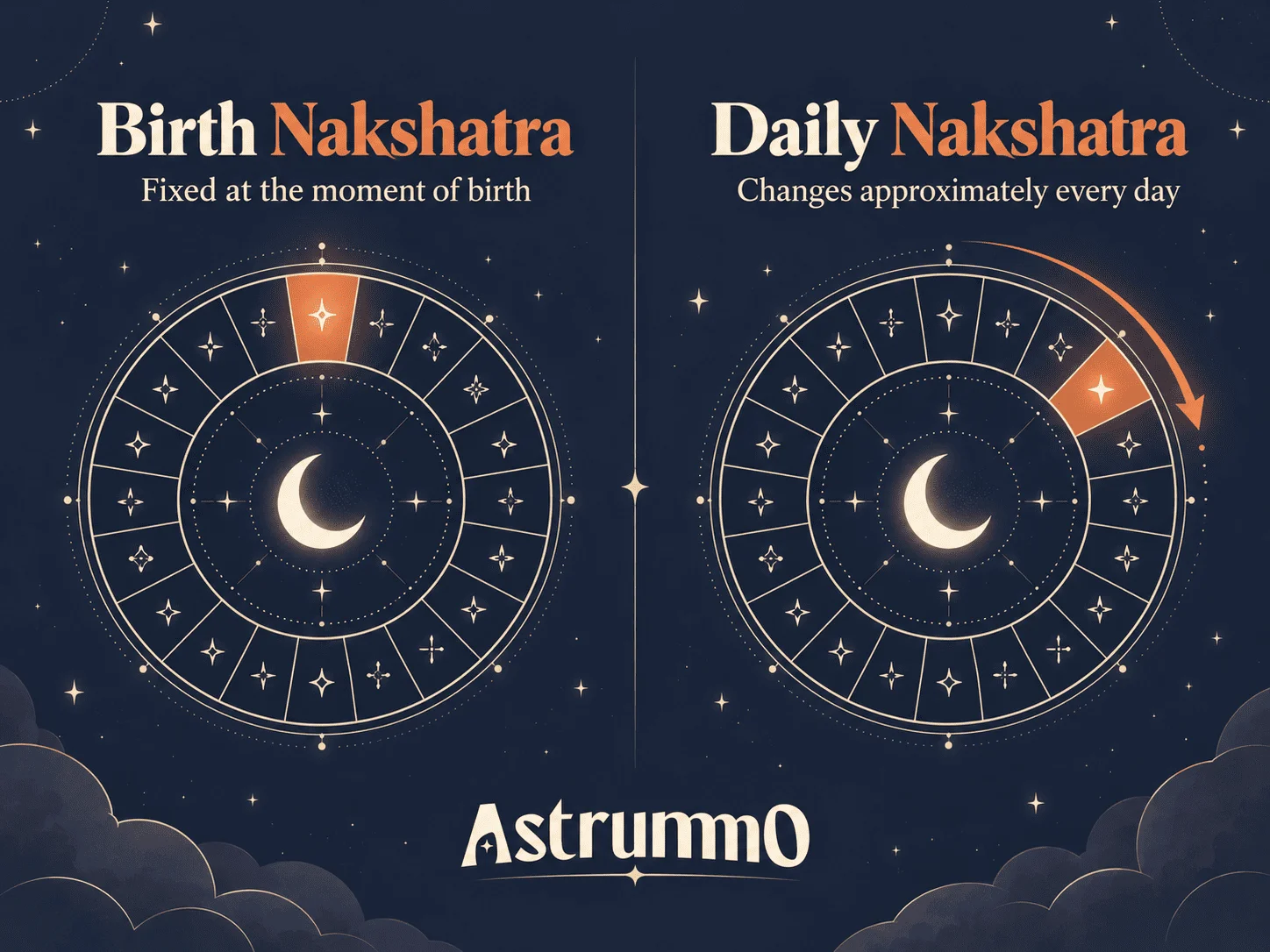
Your birth Nakshatra is traditionally associated with emotional tendencies, instinctive responses, and aspects of your psychological orientation. It also plays a mathematical role in planetary timing systems.
The current Moon Nakshatra, by contrast, is used to interpret the prevailing lunar conditions at a particular moment.
The distinction resembles the difference between your permanent birth chart and the changing positions of the planets in the sky.
Your birth chart remains the foundation. The transiting Moon provides a changing layer of interpretation.
In traditional Jyotish, your birth Moon's Nakshatra determines the starting ruler of the Vimshottari Dasha system.
Vimshottari Dasha divides a 120-year cycle into planetary periods, with the Moon's precise position at birth establishing where your personal sequence begins.
For example, if your birth Moon occupies a Nakshatra ruled by Venus, your starting Mahadasha belongs to Venus. The Moon's progress through that Nakshatra determines how much of the Venus period remains at birth.
A change in today's Moon Nakshatra does not recalculate your birth Dasha sequence.
You can explore this distinction in our separate guide, What Is Vimshottari Dasha? How Planetary Periods Work in Vedic Astrology.
In Jyotish, the Moon is traditionally associated with the mind, emotional responsiveness, receptivity, and the subjective experience of daily life.
Its relatively rapid movement makes it especially relevant to short-term astrological interpretation.
Each Nakshatra has a different set of traditional qualities. As the Moon moves between them, astrologers interpret changes in the symbolic character of the lunar environment.
Consider three examples.
Ashwini is traditionally connected with beginnings, speed, initiative, and restoration. In a daily interpretation, its symbolism may encourage attention to fresh starts or activities requiring initiative.
Rohini is associated with growth, nourishment, beauty, and cultivation. Its symbolism may support reflection on developing something gradually or caring for existing commitments.
Pushya is linked with nourishment, preservation, responsibility, and support. Its traditional themes emphasize sustaining what matters rather than pursuing novelty for its own sake.
These are not universal predictions.
A day under Ashwini does not guarantee a successful new beginning. Rohini does not automatically bring financial growth, and Pushya does not ensure favorable outcomes.
The Nakshatra describes one symbolic component of the astrological conditions. A meaningful personal interpretation also examines the Moon's condition, its relationship with the birth chart, other planetary transits, and the individual's active Dasha periods.
Imagine two people checking the Moon's Nakshatra at the same moment.
Both see Rohini. The astronomical position is identical.
However, their birth charts are different.
For one person, the transiting Moon may occupy a house associated with communication, learning, or everyday responsibilities. For another, the same transit may emphasize relationships, personal resources, or domestic matters.
Their active planetary periods may also differ.
A traditional interpretation would therefore consider not only the Moon's current Nakshatra but also how that Nakshatra and its ruler relate to each person's natal configuration.
This is why a personalized Vedic astrology reading involves more than identifying today's Nakshatra.
For a broader explanation of how changing planetary positions interact with the birth chart, read Why Does Your Vedic Astrology Reading Change Every Day?.
Absolutely. In fact, this is one of the most common sources of confusion when comparing Vedic astrology calendars.
A Nakshatra transition occurs when the Moon's calculated sidereal longitude crosses the boundary between two lunar mansions.
It does not wait for sunrise, sunset, or midnight.
Suppose a calendar displays Bharani for the morning, followed by Krittika beginning at 11:42 AM.
Both entries can be correct for the same date.
Traditional Panchanga calendars sometimes identify the Nakshatra present at sunrise while also providing its ending time. This means a calendar's prominent daily label may not describe the Moon's Nakshatra throughout the entire day.
Time zones also matter when displaying the local clock time of a transition.
The underlying astronomical event occurs at the same instant worldwide, but its local date and time differ by location.
For accurate interpretation, distinguish between a daily calendar label, the exact transition time, and the Moon's position at the moment being examined.
Different results can arise from calculation settings, time-zone handling, or the precise moment being evaluated.
Vedic astrology commonly uses the sidereal zodiac, but different ayanamsa conventions can produce slightly different calculated planetary longitudes.
These differences become especially important when the Moon is close to a Nakshatra boundary.
An incorrect birth time can also affect a natal Nakshatra calculation, particularly if the Moon was near a transition when the person was born.
Before assuming that one application is incorrect, compare its date, local time, ayanamsa, and astronomical calculation settings.
Our guide, Why Do Vedic Astrology Apps Show Different Birth Charts?, explains these differences in greater detail.
Understanding Nakshatra transitions is useful, but interpreting the Moon's position within your own astrological chart provides additional context.
Astrummo brings together traditional Vedic astrology calculations and personalized interpretations, helping users explore how current planetary conditions relate to their birth charts.
Astrummo uses Swiss Ephemeris astronomical calculations with the Lahiri sidereal zodiac to establish planetary positions and Nakshatras.
Within the app, Moon Today provides a view of the Moon's current astrological context, while your Personal Daily Reading interprets the broader daily conditions in relation to your birth chart.
The daily assessment considers several interacting factors, including lunar Nakshatra, planetary transits, Vimshottari Dasha, Ashtakavarga, and traditional Panchanga components.
The important distinction is that Astrummo does not treat a Nakshatra change as a complete personal prediction.
The same lunar position can carry different interpretive significance depending on the wider natal and transit context.
Your Personal Daily Reading is also based on a consistent daily reference point rather than being recalculated at every Nakshatra transition. Live lunar information and the dated daily assessment therefore serve related but different purposes.
You can explore your birth chart, discover the Moon's astrological context, and ask personalized questions through Astrummo.
Explore Your Vedic Astrology With Astrummo
No. Nakshatra changes occur when the Moon crosses a specific sidereal zodiac boundary. This can happen at any time of day or night, independently of midnight.
No. The Moon spends approximately one day in each Nakshatra, but its orbital speed varies. Individual Nakshatra durations are therefore not exactly 24 hours.
Yes. A Nakshatra can extend across portions of two consecutive calendar dates. Seeing the same Nakshatra on both days does not necessarily indicate an error.
Yes. If the Moon crosses a Nakshatra boundary during the day, the date will include part of the previous Nakshatra and part of the next one.
Your birth Nakshatra is fixed by the Moon's position at birth. It does not change as you grow older. However, correcting inaccurate birth details or changing calculation conventions can alter a previously reported result.
Not necessarily. Traditional Vedic astrology considers Nakshatra one factor among several. Its interpretation depends on the wider planetary conditions, the activity being considered, and the individual's birth chart.
Astrology is a traditional interpretive framework, not a scientifically established method for predicting personal luck or future events.
At a given instant, the Moon's Nakshatra is the same worldwide when calculated using the same sidereal convention. However, calendar dates and local transition times vary across time zones.
Its personal interpretation can also differ because individuals have different birth charts.
The answer to whether Nakshatra changes every day is straightforward: the Moon moves into a new Nakshatra approximately once every day, but the timing is not fixed to a 24-hour schedule or a calendar boundary.
Your birth Nakshatra remains part of your natal chart, while the transiting Moon continues its journey through the 27 lunar mansions.
In Vedic astrology, understanding both positions helps distinguish lasting natal symbolism from the changing lunar conditions traditionally used in daily interpretation.
The most useful question is therefore not simply which Nakshatra the Moon occupies today, but how that position relates to your individual chart and the wider astrological picture.
That is where a daily Nakshatra becomes more than a name on a calendar—and becomes one element of a more personalized understanding of Jyotish.
23 October 2026 · Astrummo
Discover the 2027 Vedic astrology forecast: Jupiter and Saturn transits, Rahu-Ketu, retrogrades and eclipses explained using the Lahiri sidereal zodiac.
22 October 2026 · Astrummo
Discover the best Nakshatras for starting projects, travel, learning and long-term plans. Learn how Vedic astrology evaluates auspicious timing.
21 October 2026 · Astrummo
Your birth chart stays the same, but the planetary sky never stands still. Discover how Vedic astrology uses transits, lunar Nakshatras, Vimshottari Dasha and Panchanga to interpret each day—and why your personal reading may differ from someone else's.
19 October 2026 · Astrummo
What is Sade Sati in Vedic astrology? Explore Saturn's 7.5-year transit, its three phases, how it's calculated, and what it means for your birth chart.
12 October 2026 · Astrummo
Discover all 27 Nakshatras in Vedic astrology, including their meanings, symbols, ruling planets, deities, zodiac degrees, and influence on your birth chart.
15 October 2026 · Astrummo
Learn how Vimshottari Dasha works, why the Moon’s Nakshatra determines your planetary periods, and how Mahadasha, Antardasha and transits are used in Vedic astrology.
10 October 2026 · Astrummo
Learn how to read your Vedic birth chart, from your Ascendant and houses to planetary placements, nakshatras, and aspects—with a real chart example.
10 October 2026 · Astrummo
Understanding that distinction helps you compare your charts without treating one as a mistake.