
10 October 2026 · Astrummo
How to Enable Astrummo Notifications & Choose Your Daily Reminder
Set up your Daily Alignment reminder in Astrummo, allow phone notifications, and choose a time that fits your routine.
Learn how to read your Vedic birth chart, from your Ascendant and houses to planetary placements, nakshatras, and aspects—with a real chart example.
Your Vedic birth chart can look like a puzzle at first: a geometric diagram, numbers from 1 to 12, abbreviated planet names, and unfamiliar terms such as Lagna, nakshatra, and house lord.
You do not need to understand every detail to begin. Start with three questions:
Which planet am I looking at? What sign is it in? Which house does it occupy?
These questions help you move from identifying a placement to understanding how astrologers interpret it. From there, you can explore how different placements connect.
In this guide, we will use one example chart throughout, illustrated with real Astrummo screens. The aim is to teach you a reading method you can apply to your own chart.
Astrology is an interpretive tradition rather than a scientifically established method of predicting personality or events. Approach a reading as a framework for reflection, rather than a fixed description of who you must be.
A Vedic birth chart records celestial positions for your birth date, time, and location, arranged according to the conventions of Jyotisha, the Indian astrological tradition.
The main natal chart is often called the D1 chart, Rashi chart, or birth chart. It provides the starting point for examining signs, planets, houses, and their relationships.
Most Vedic natal astrology uses a sidereal zodiac. Calculations also depend on the chosen ayanamsa, the offset used to relate the tropical and sidereal zodiacs. Different settings can produce differences in placements, particularly near boundaries.
Before interpreting anything, check your birth details. An incorrect birth time can change the Ascendant and house arrangement. If your time is approximate, keep that uncertainty in mind.
This emphasis on accurate inputs is longstanding: the classical text Phaladeepika, Chapter 1 begins its reading method with establishing the birth time and calculating positions before judging the chart.
Your Ascendant, also called your rising sign or Lagna, is the zodiac position rising on the eastern horizon at the moment of birth.
In a traditional reading, it provides a reference point for the houses and helps frame themes of identity, embodiment, and approach to life.
In our example, the Ascendant is Aries.
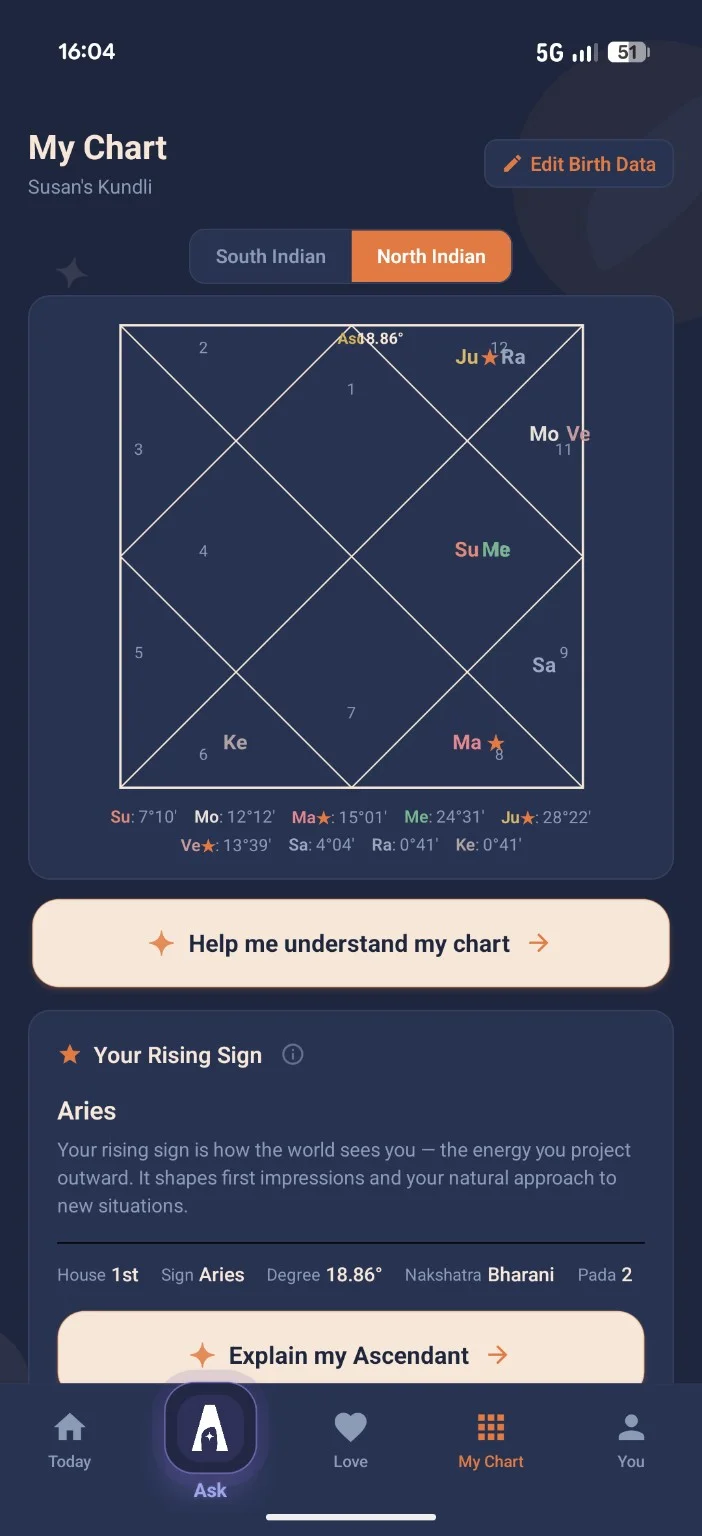
Start by locating the Ascendant label or rising-sign panel. You do not need to decode the whole diagram at once.
The screenshot uses a North Indian chart, where the house positions are fixed. The top central diamond represents the first house, and the remaining houses proceed counterclockwise.
The numbers inside the diagram identify zodiac signs:
Number | Sign | Number | Sign |
|---|---|---|---|
1 | Aries | 7 | Libra |
2 | Taurus | 8 | Scorpio |
3 | Gemini | 9 | Sagittarius |
4 | Cancer | 10 | Capricorn |
5 | Leo | 11 | Aquarius |
6 | Virgo | 12 | Pisces |
A sign number is not automatically a house number.
In this particular chart, they happen to match because Aries rises: Aries occupies the first house, Taurus the second, and so on.
For a Taurus Ascendant, the first house would contain sign number 2. It would still be the first house.
South Indian charts arrange the information differently, with fixed sign positions. The underlying placements remain the same when switching between layouts.
These are three separate layers of a reading:
Layer | Question it answers | Example |
|---|---|---|
Planet | What function or theme is involved? | Mercury: thinking and communication |
Sign | How might that function express itself? | Capricorn: a structured, practical style |
House | Which area of life is involved? | Tenth house: work and public contribution |
Our example has Mercury in Capricorn in the tenth house.
A preliminary interpretation might be:
Thinking and communication may express themselves through practical planning, professional responsibilities, or work that requires structure.
That is a starting point. Other placements, rulerships, aspects, and conditions can modify the reading.
The useful habit is to build your interpretation in layers instead of jumping directly from one placement to a prediction.
Houses describe areas of life. The following table gives a beginner-friendly selection of their traditional associations.
House | Common themes |
|---|---|
1st | Identity, body, personal approach |
2nd | Speech, family, accumulated resources |
3rd | Initiative, skills, communication, siblings |
4th | Home, emotional foundations, private life |
5th | Creativity, learning, children |
6th | Service, routines, conflict, obligations |
7th | Partnership, marriage, agreements |
8th | Shared resources, vulnerability, major change |
9th | Philosophy, teachers, higher learning |
10th | Career, responsibility, public contribution |
11th | Networks, gains, aspirations |
12th | Retreat, expenditure, solitude, spiritual practice |
These are broad associations, not exhaustive definitions. A house can carry several meanings, and context determines which are most relevant.
The classical Phaladeepika, Chapter 15 describes assessing a house through several factors, including its ruler and planetary influences. This is why a single occupied—or empty—house cannot tell the whole story.
An empty seventh house does not mean you will never have a relationship. An empty tenth house does not mean you lack a career.
You can still examine the sign associated with that house, its ruling planet, and relevant aspects.
A planet list can make your first reading easier than working entirely from the diagram.
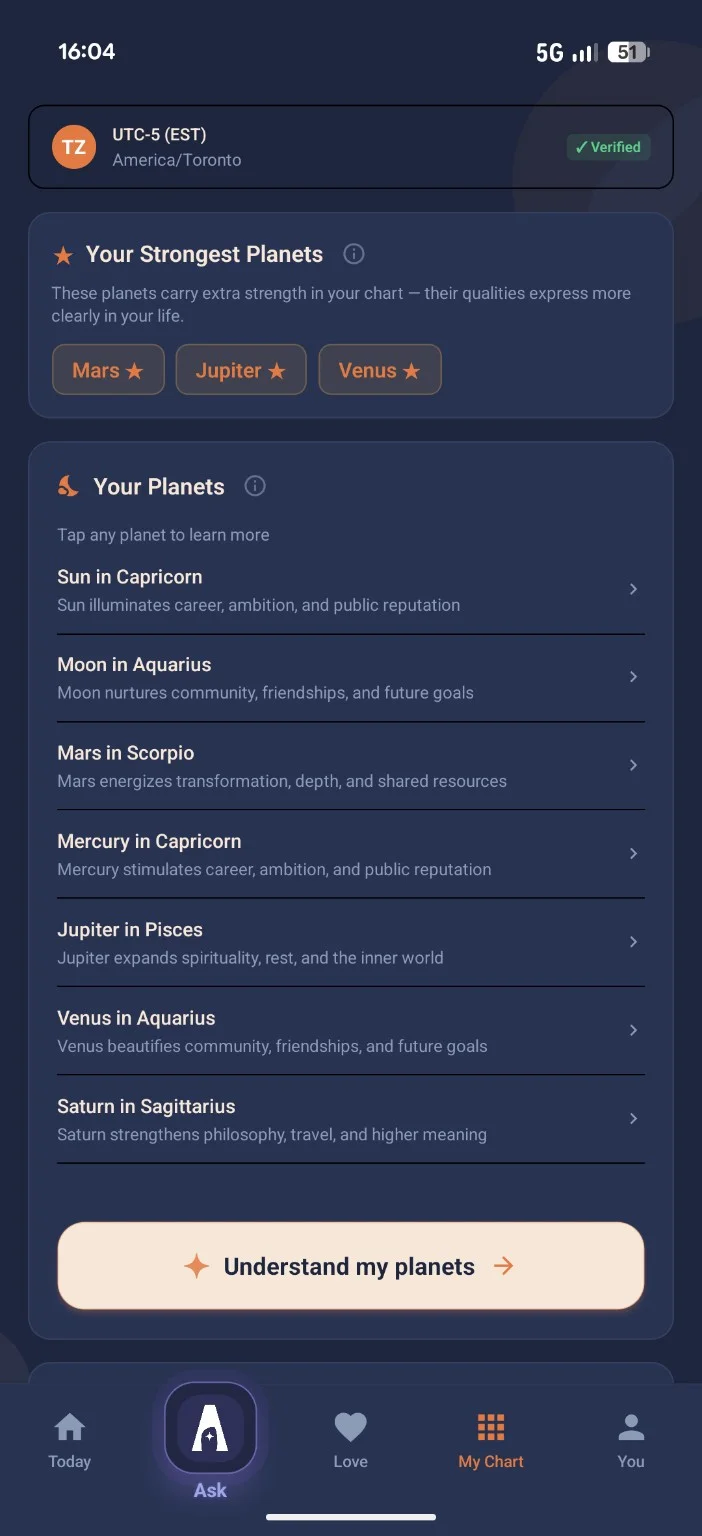
The planet list provides a readable starting point. Use the chart or individual planet details to confirm the house placement.
In the example chart, the main placements are:
Planet | Sign | House |
|---|---|---|
Sun | Capricorn | 10th |
Moon | Aquarius | 11th |
Mars | Scorpio | 8th |
Mercury | Capricorn | 10th |
Jupiter | Pisces | 12th |
Venus | Aquarius | 11th |
Saturn | Sagittarius | 9th |
Rahu | Pisces | 12th |
Ketu | Virgo | 6th |
Vedic astrology commonly works with nine grahas: the Sun, Moon, five visible planets, and the lunar nodes Rahu and Ketu. Rahu and Ketu are calculated points rather than physical planets.
For a first reading, use this compact vocabulary:
Chart label | Graha | Common interpretive themes |
|---|---|---|
Su | Sun | Identity, authority, purpose |
Mo | Moon | Mind, feelings, responsiveness |
Ma | Mars | Action, drive, assertion |
Me | Mercury | Thinking, language, analysis |
Ju | Jupiter | Learning, guidance, expansion |
Ve | Venus | Pleasure, relating, aesthetics |
Sa | Saturn | Limits, responsibility, endurance |
Ra | Rahu | Desire, amplification, unfamiliar territory |
Ke | Ketu | Detachment, separation, inward exploration |
The traditional symbolism of the planets is discussed in Phaladeepika, Chapter 2. These short descriptions are entry points; they do not capture every role a planet can play.
The Moon is a useful next step because its details show how several layers of interpretation fit together.
In our example, it is in Aquarius, in the eleventh house.
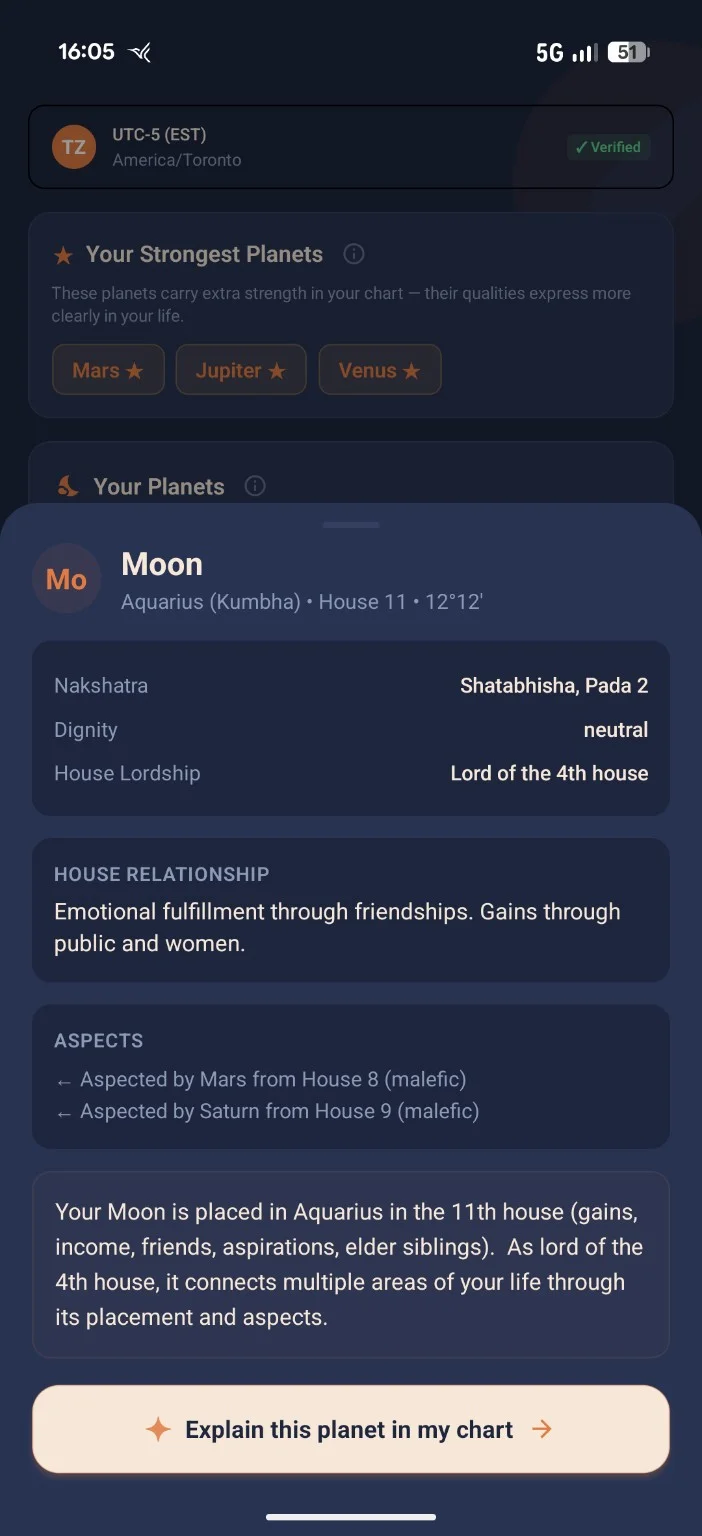
One placement, several layers: the Moon’s sign and house are the starting point. Nakshatra, rulership, and aspects add context.
A basic reading combines:
Moon: feelings, responsiveness, and the mind.
Aquarius: a sign traditionally ruled by Saturn.
Eleventh house: networks, aspirations, and gains.
A cautious synthesis might be:
Friendship, community, and shared goals may be meaningful sources of emotional connection.
That is more useful than treating “Moon in Aquarius” as a complete personality description.
In the commonly used 27-nakshatra system, each nakshatra spans 13°20′ of the zodiac. Each is divided into four padas of 3°20′.
The screenshot places the Moon at 12°12′ Aquarius, in Shatabhisha, Pada 2. These labels identify a more specific portion of the zodiac than the sign alone.
For a beginner, learn to locate this information before trying to interpret every associated symbol. Nakshatra meanings add another layer; they do not replace the sign, house, or wider chart.
A house lord is the planet ruling the sign associated with a house.
In the Aries-rising example:
Cancer occupies the fourth house.
Cancer is ruled by the Moon.
The Moon is placed in Aquarius in the eleventh house.
The Moon therefore connects fourth-house topics, such as home and emotional foundations, with eleventh-house topics, such as friendships and networks.
A possible reading is that belonging and emotional support may be closely connected with community. It does not establish a specific event.
You can apply the same method to the Ascendant:
Aries rises → Mars rules Aries → Mars occupies Scorpio in the eighth house.
Mars is therefore both the Ascendant ruler and an eighth-house occupant. This makes it relevant to the overall reading, beyond its generic symbolism.
Traditional sign rulerships are set out in Phaladeepika, Chapter 1.
Planet details often include dignity, strength, and aspects. These describe different things.
Dignity concerns a planet’s relationship with its sign. Familiar terms include own sign, exaltation, and debilitation.
In this example, Mars is in its own sign, Scorpio, and Jupiter is in its own sign, Pisces.
That adds context to their readings. It does not mean that every topic associated with them will unfold easily.
Likewise, a “neutral” dignity label does not make a planet unimportant.
The screenshot highlights Mars, Jupiter, and Venus as the strongest planets. Treat this as the app’s summary rather than assuming it displays a complete traditional strength calculation. Classical strength assessment is more involved, as illustrated by Phaladeepika, Chapter 4, on Shadbala.
An aspect describes a planetary influence on another location in the chart according to the astrological system being used.
The Moon panel shows influences from Mars and Saturn. Within a traditional reading, these may introduce themes of urgency, restraint, effort, or responsibility into the Moon’s expression.
The interface labels them “malefic.” This is a traditional classification, not a verdict about your character or future.
A useful question is:
How might emotional responsiveness interact with drive and self-control?
Once you understand individual placements, begin connecting them.
A strong reading explains how several chart factors support—or complicate—a theme. It avoids treating every placement as an isolated statement.
Here is how the supplied Astrummo interpretation relates to visible placements:
Visible placement | Theme explored in the interpretation |
|---|---|
Sun and Mercury in the 10th | Work, analysis, communication, public responsibility |
Mars in Scorpio in the 8th | Resourcefulness, resilience, navigating change |
Moon and Venus in Aquarius in the 11th | Friendship, community, shared aspirations |
Jupiter in Pisces in the 12th | Reflection, private study, compassion |
These are interpretive connections, rather than independently verified descriptions of the person.
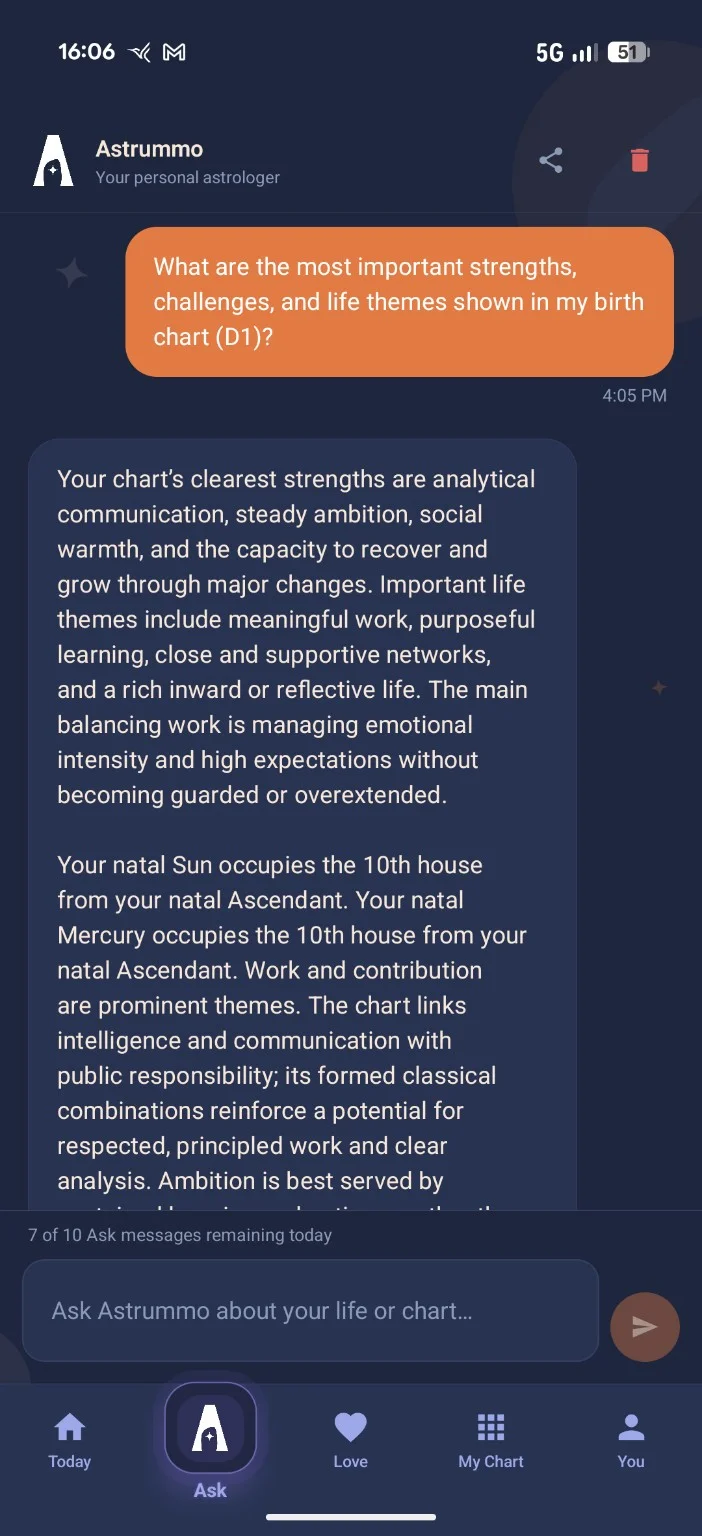
The supplied reading begins:
“Your chart’s clearest strengths are analytical communication, steady ambition, social warmth, and the capacity to recover and grow through major changes.”
Its value as a teaching example is the connection between the summary and the placements discussed below it.
The Mars passage also uses a helpful distinction:
“It suggests resourcefulness, not a requirement that life be difficult.”
That is a sensible way to approach challenging symbolism: explore possible capacities and tensions without assuming inevitable hardship.
The response also mentions “formed classical combinations.” A beginner should ask which combinations are intended and what conditions establish them. A general summary alone is not enough to verify a named yoga.
The full Ask Astrummo reading delivered in this example:
"Your chart’s clearest strengths are analytical communication, steady ambition, social warmth, and the capacity to recover and grow through major changes. Important life themes include meaningful work, purposeful learning, close and supportive networks, and a rich inward or reflective life.
The main balancing work is managing emotional intensity and high expectations without becoming guarded or overextended. Your natal Sun occupies the 10th house from your natal Ascendant. Your natal Mercury occupies the 10th house from your natal Ascendant. Work and contribution are prominent themes. The chart links intelligence and communication with public responsibility; its formed classical combinations reinforce a potential for respected, principled work and clear analysis.
Ambition is best served by sustained learning and patience rather than pressure to prove yourself quickly. Mars is in Scorpio and occupies the 8th house in your natal chart. A notable strength is resilience: you can meet complex or uncertain situations directly and become more capable through change.
This is supported by a strong, self-directed Mars and a formed classical combination associated with endurance and recovery. It suggests resourcefulness, not a requirement that life be difficult. Moon and Venus are together in Aquarius in your natal chart. Friendships, communities, and shared aspirations can bring warmth and creative fulfillment.
At the same time, emotional and relationship expression may carry both intensity and restraint: you may care deeply while needing time to trust, or feel pulled between acting quickly and holding back. Clear boundaries and honest communication help these qualities work together.
Jupiter is in Pisces and occupies the 12th house in your natal chart. A strong inward and philosophical thread favors reflection, private study, and compassion, including work or service done away from the spotlight.
Unusual or expansive ideas may draw you in; discernment helps distinguish genuine inspiration from distraction or avoidance." — From my personal astrologer, Astrummo
Your D1 chart is the foundation of a natal reading. It does not, by itself, identify when a particular event will happen.
Vedic astrologers also use dashas, or planetary periods, and transits when examining timing. Divisional charts can provide additional perspectives within particular methods.
For your first reading, keep the questions separate:
Natal question: What themes and relationships appear in the chart?
Timing question: How are astrologers interpreting a particular period?
Learn the natal structure first. Adding several timing systems before understanding your Ascendant, houses, and rulers can make the reading harder to follow.
Work through your chart in this order:
Check your birth details and note any uncertainty.
Find your Ascendant and identify the chart layout.
Distinguish sign numbers from house positions.
Locate the Moon and Sun.
Read one placement as planet + sign + house.
Follow its house rulership to see which topics it connects.
Add dignity and aspects as context.
Look for repeated themes before drawing a conclusion.
You do not need to interpret every label in one sitting. A first reading can simply identify a few important placements and explain how they relate.
Useful follow-up questions include:
“Which placements support this interpretation?”
“How does this planet’s house rulership change the reading?”
“What other factors could modify this conclusion?”
“Are you describing a natal theme or a timing prediction?”
These questions make an interpretation easier to understand and assess.
The most useful starting point is a placement you can identify clearly. Find its planet, sign, and house; then add the surrounding context.
In Astrummo, you can open My Chart, inspect individual planet details, and ask how those placements connect. Use the explanation alongside the chart so you can see the reasoning behind the interpretation.
10 October 2026 · Astrummo
Set up your Daily Alignment reminder in Astrummo, allow phone notifications, and choose a time that fits your routine.
10 October 2026 · Astrummo
Understanding that distinction helps you compare your charts without treating one as a mistake.
12 October 2026 · Astrummo
Discover all 27 Nakshatras in Vedic astrology, including their meanings, symbols, ruling planets, deities, zodiac degrees, and influence on your birth chart.
15 October 2026 · Astrummo
Learn how Vimshottari Dasha works, why the Moon’s Nakshatra determines your planetary periods, and how Mahadasha, Antardasha and transits are used in Vedic astrology.
17 October 2026 · Astrummo
Why do Vedic astrology apps show different birth charts? Discover 8 reasons, from birth time and GPS coordinates to ayanamsa, Rahu, Ketu, and D9 charts.