27 October 2026 · Astrummo
When Will I Get Married? How Vedic Astrology Reads Marriage Timing
Discover how Vedic astrology examines marriage timing through the 7th house, Navamsa (D9), Vimshottari Dasha and planetary transits.
Rahu and Ketu aren't physical planets, yet they are among the most intriguing grahas in Vedic astrology. Discover the astronomy behind the lunar nodes, their connection to solar and lunar eclipses, and the ancient symbolism that makes them central to Jyotisha.
They have no physical bodies, cannot be photographed through a telescope, and don't orbit the Sun like Mars or Jupiter. Yet Rahu and Ketu occupy a central place in Vedic astrology. Their story begins with an ancient myth about immortality — and leads to the remarkable astronomy behind solar and lunar eclipses.
Imagine looking at your Vedic birth chart for the first time.
You recognize the Sun and Moon. Jupiter, Venus, Mars, and Saturn are familiar names. Even Mercury makes sense.
Then you notice two others: Rahu and Ketu.
They have zodiac signs. They occupy houses. They appear in planetary-period calculations, and astrologers discuss their influence on everything from ambition to spiritual development.
Naturally, you might wonder where these two mysterious planets are.
Could you see Rahu with a powerful telescope? Is Ketu a distant celestial body that astronomers haven't properly explored?
The answer to both questions is no.
There are no physical planets named Rahu and Ketu.
But that doesn't mean their astronomical positions are imaginary.
In fact, they represent something quite real in the geometry of the Earth–Moon–Sun system. Without understanding those positions, predicting eclipses would be much more difficult.
And when we examine how ancient Indian traditions came to interpret them, the story becomes considerably more interesting.
Let's begin with something familiar.
Every month, the Moon travels around Earth. We watch it change from a thin crescent into a Full Moon and then gradually disappear from the evening sky.
If the Moon's orbit were perfectly aligned with Earth's orbit around the Sun, eclipses would happen far more frequently.
Every New Moon could produce a solar eclipse, and every Full Moon could bring a lunar eclipse.
But that isn't what we see.
Some months pass without a single eclipse. Then, during certain periods, the Sun, Earth, and Moon align closely enough to create one of the sky's most spectacular displays.
Why?
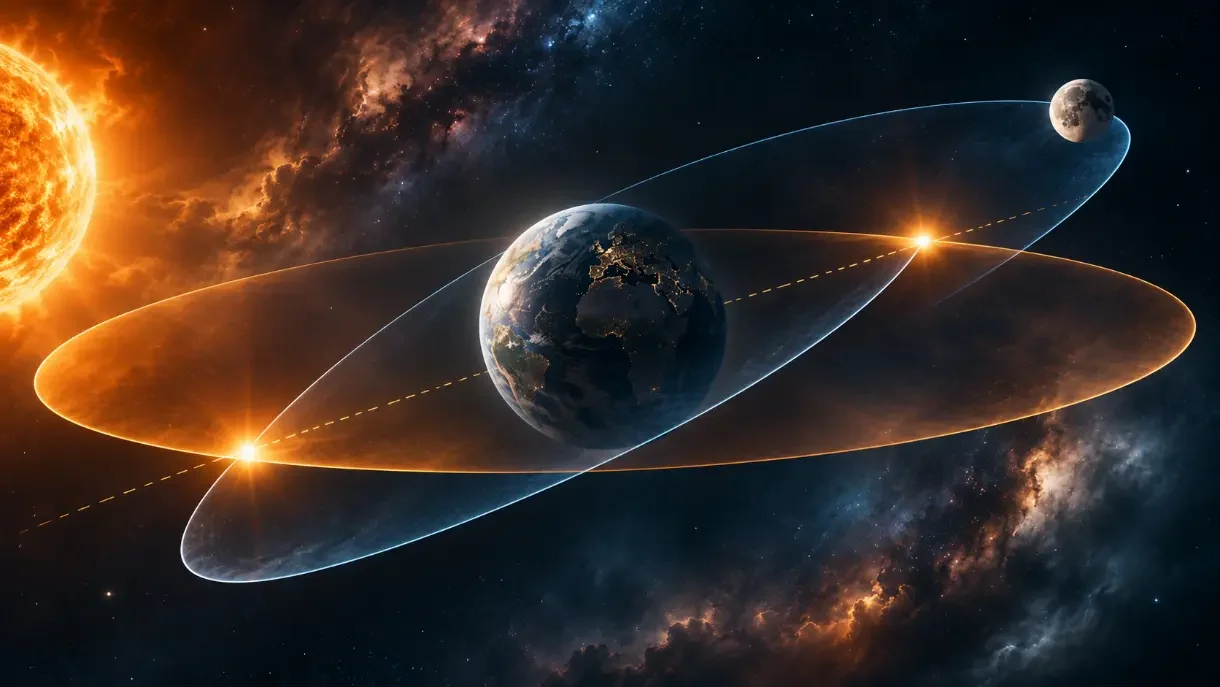
Because the Moon's orbit is tilted by approximately five degrees relative to the ecliptic — the plane of Earth's orbit around the Sun.
Most of the time, when the Moon passes between Earth and the Sun, it travels slightly above or below the alignment needed to produce an eclipse.
The same is true at Full Moon. Earth's shadow usually misses the Moon.
But there are two places where the Moon's orbital plane crosses the ecliptic.
Astronomers call them the lunar nodes.
One is the ascending node, where the Moon crosses from south to north of the ecliptic.
The other is the descending node, where it crosses from north to south.
In Jyotisha, the ascending node is Rahu.
The descending node is Ketu.
That is the astronomical foundation of these two remarkable grahas.
A solar eclipse occurs when the Moon passes between Earth and the Sun during a New Moon, with the alignment close enough for the Moon's shadow to reach Earth.
A lunar eclipse occurs when Earth comes between the Sun and Moon during a Full Moon, allowing Earth's shadow to fall across the Moon.
In both cases, the Moon must be sufficiently close to one of its orbital nodes.
This doesn't mean Rahu or Ketu physically blocks the sunlight. Neither is an object casting a shadow.
Rather, the nodes identify the locations where the required orbital alignment can occur.
NASA's explanation of lunar nodes and eclipses describes this geometry, while the European Space Agency's guide to eclipse prediction explains why eclipses occur only during particular windows.
There is another intriguing detail.
The lunar nodes aren't fixed permanently against the stars.
They gradually move around the zodiac, generally in the direction opposite to the Moon's ordinary orbital motion. Their mean cycle takes approximately 18.6 years.
That is why Rahu and Ketu have changing zodiac positions even though they aren't physical planets.
A point in space can have a calculated position without being a celestial body.
Consider the equator or the North Pole. Both are meaningful geographical references, even though neither is an independent physical object.
The lunar nodes are similarly useful reference points — only their geometry is orbital rather than geographical.
But astronomy is only half of the story.
Because long before modern orbital calculations, Indian mythology had already given Rahu a memorable identity.
One of the best-known accounts appears in the Bhagavata Purana, within the story of the churning of the cosmic ocean.
According to the narrative, gods and asuras seek amrita, the nectar of immortality.
When the nectar is distributed, an asura named Rahu disguises himself and slips among the gods to obtain a share.
The Sun and Moon recognize the deception and expose him.
Vishnu then severs Rahu's head with his discus.
But Rahu has already tasted the nectar.
His head survives.
In the traditional narrative, the immortal head continues pursuing the Sun and Moon. The dramatic imagery of a celestial being attempting to swallow the luminaries becomes associated with eclipses.
Later traditional representations commonly connect the severed head with Rahu and the headless body or tail with Ketu.
The story is wonderfully vivid. The Sun disappears, then returns. The Moon darkens, then reappears.
But it is important to understand what kind of explanation we are reading.
The Bhagavata Purana offers a sacred mythological narrative. Modern astronomy explains eclipses through orbital inclination, lunar phases, and celestial alignment.
Those accounts belong to different ways of understanding the sky.
What connects them is the extraordinary fact that Rahu's traditional identity became closely associated with the very celestial phenomenon for which the lunar nodes are mathematically essential.
You can explore the original narrative in Bhagavata Purana, Canto 8, Chapter 9.
Here is where a common misunderstanding enters the conversation.
In English, the Sanskrit word graha is frequently translated as "planet."
But that translation is not exact.
Jyotisha traditionally works with nine grahas, known collectively as the Navagraha: the Sun, Moon, Mars, Mercury, Jupiter, Venus, Saturn, Rahu, and Ketu.
The Sun is a star. The Moon is Earth's natural satellite. Rahu and Ketu are calculated orbital nodes.
Clearly, the traditional category was never identical to the modern astronomical definition of a planet.
A graha is better understood as a celestial factor given significance within the astrological framework.
That distinction matters.
When a Vedic astrologer describes Rahu as a powerful graha, they are not claiming that astronomers have overlooked an invisible planet.
They are referring to its role within the traditional system of planetary symbolism, house interpretation, Nakshatras, and timing techniques.
And within that system, Rahu and Ketu represent a particularly intriguing contrast.
Rahu is often associated with ambition, appetite, fascination, unconventional experiences, and the desire to cross established boundaries.
It is sometimes portrayed as the force that is never completely satisfied.
The mythology makes that image memorable: an immortal head that has tasted something extraordinary but cannot experience ordinary satisfaction in the way a complete body might.
In traditional interpretation, Rahu can describe the urge to pursue what feels unfamiliar, powerful, or just beyond reach.
It might be recognition, knowledge, influence, financial success, social status, or a completely new way of living.
But calling Rahu simply a negative influence misses an important part of its symbolism.
Ambition isn't always destructive.
Curiosity can lead to scientific discovery. Dissatisfaction with an old system can inspire innovation. The willingness to question convention can create possibilities that didn't previously exist.
Rahu's traditional symbolism can therefore be read constructively or destructively, depending on the wider chart.
The important distinction is not whether someone has Rahu in their birth chart — everyone does.
It is where Rahu is placed, what it is connected to, and how those relationships are interpreted.
If Rahu symbolizes the urge to acquire, explore, and become, Ketu is frequently associated with the opposite movement.
Detachment.
Withdrawal from superficial rewards.
Introspection.
A search for understanding that is no longer satisfied by appearances alone.
Ketu is often linked with spiritual inquiry and the gradual release of attachments.
But that doesn't mean it guarantees enlightenment.
Nor does it mean that someone with a prominent Ketu must reject ordinary life, relationships, or material responsibilities.
Consider a person who spends years pursuing professional recognition.
Eventually, they achieve the position they once wanted.
And then something unexpected happens.
The title no longer feels as important as it once did.
They may still enjoy their work, but they begin asking different questions. What is genuinely worthwhile? Which responsibilities matter? What would they continue doing without applause?
This is a relatable illustration of Ketu's traditional symbolism.
It doesn't require a dramatic spiritual awakening.
Sometimes it simply suggests the difference between pursuing an experience and understanding what that experience means.
Rahu and Ketu are therefore not neatly divided into a good influence and a bad influence.
They represent contrasting movements of attention and attachment.
And in a birth chart, they always belong to the same axis.
In the standard Jyotisha chart convention, Rahu and Ketu occupy opposite zodiac positions.
If Rahu is at 15° Taurus, Ketu will be at 15° Scorpio.
This isn't an astrologer's artistic choice.
It follows from the nodal axis: the ascending and descending lunar nodes are opposite ends of the same intersection line.
The two placements are separated by 180 degrees.
In a whole-sign birth chart, if Rahu occupies the first house, Ketu will occupy the seventh. If Rahu is in the tenth, Ketu is in the fourth.
This creates a relationship between two areas of the natal chart.
For example, a tenth-house Rahu and fourth-house Ketu may invite a traditional exploration of public ambition and private foundations.
What are you trying to establish in the world? What gives you a sense of belonging when nobody is watching?
But those questions do not constitute a prediction.
They are an interpretive starting point.
An astrologer would still need to examine the signs, house rulers, conjunctions, and other relevant planetary conditions.
And this leads to one of the most useful rules for reading Rahu and Ketu professionally.
Their positions are only the beginning of their interpretation.
You have probably encountered descriptions such as "Rahu in the tenth house means fame" or "Ketu in the seventh house means relationship problems."
They are memorable, but they are far too simple.
In Parashari Jyotisha, nodal interpretation is highly contextual.
The sign occupied by a node matters, particularly the condition of that sign's planetary ruler, often called its dispositor.
A node in a sign ruled by Venus, for example, is interpreted in relation to Venus's placement and condition.
The houses involved matter, too.
So do conjunctions with other grahas, aspects under the interpretive rules being used, and the individual's current planetary periods.
There are also differences between Jyotisha lineages in the treatment of nodal aspects, dignity, and other technical rules. A careful reading should make its method clear rather than presenting every convention as universally agreed.
This is why Astrummo's guide to reading a Vedic birth chart begins with the structure of the full chart, rather than assigning fixed meanings to individual placements.
Rahu and Ketu are especially good examples of why that approach matters.
The nodes have another role that is easy to overlook.
They each rule three Nakshatras in the traditional Vimshottari sequence.
Rahu rules Ardra, Swati, and Shatabhisha.
Ketu rules Ashwini, Magha, and Mula.
These Nakshatras occupy different parts of the zodiac, but their ruling graha gives them a shared place within the traditional planetary-period system.
This becomes especially relevant when determining a person's starting Vimshottari Dasha.
The Moon's Nakshatra at birth establishes the first Mahadasha ruler, while the Moon's precise position within that Nakshatra establishes how much of the starting period remains.
In the standard 120-year Vimshottari cycle, Rahu receives an 18-year Mahadasha and Ketu a 7-year Mahadasha.
That doesn't mean everyone experiences the same 18 years of ambition or seven years of detachment.
The period is interpreted in relation to the individual's natal placements and supporting planetary conditions.
For instance, Rahu placed in a particular house, associated with its dispositor, and connected to other planets creates a different traditional context from Rahu in another configuration.
The period ruler is only one part of that larger reading.
Our complete guide to the 27 Nakshatras explains their ruling grahas, while What Is Vimshottari Dasha? takes a closer look at how planetary periods are calculated and interpreted.
There is one last technical detail that deserves attention.
If you've ever compared two Vedic astrology apps, you may have noticed that Rahu and Ketu appear at slightly different degrees.
Sometimes, near a sign or Nakshatra boundary, their labels can even differ.
One possible reason is the choice between Mean Node and True Node calculations.
The Mean Node is a smoothed mathematical representation of the lunar nodal motion.
The True Node convention follows an osculating orbital model, retaining short-term variations that the mean calculation smooths out.
The word true in this context is the name of a calculation convention. It should not be interpreted as proof that every associated astrological interpretation is more accurate.
Both conventions are used in astrology software.
Astrummo uses True Node calculations with Swiss Ephemeris and the Lahiri sidereal zodiac.
This means the application's nodal positions may differ from those shown by a service using Mean Node or a different ayanamsa.
That discrepancy is not necessarily a software error.
The important thing is to know which calculation settings are being used.
For a detailed comparison, read Astrummo's Why Do Vedic Astrology Apps Show Different Birth Charts?.
Perhaps the most interesting thing about Rahu and Ketu is that they bring together two very different human impulses.
The desire to move toward something new.
And the desire to understand what we no longer need.
Both are familiar.
We pursue opportunities, build careers, form relationships, and try to expand our understanding of the world.
At other times, we discover that achievement alone doesn't answer every question.
Something that once seemed essential begins to lose its importance.
This tension between seeking and releasing sits near the heart of many traditional interpretations of the nodal axis.
But the deeper lesson is methodological.
A chart isn't a collection of independent labels.
Rahu and Ketu make that particularly obvious because they are inseparable astronomically, permanently opposite by the standard nodal convention, and interpreted through the signs, houses, planets, and timing frameworks around them.
Looking at one while ignoring the other misses half the picture.
And assigning a dramatic prediction to either without considering the rest of the chart misses even more.
There is something wonderful about the fact that Rahu and Ketu cannot be seen.
No spacecraft will land on Rahu. No telescope will reveal Ketu's surface.
They aren't objects waiting to be discovered.
They are positions defined by the geometry of the Moon's orbit.
Yet these invisible points help astronomers understand when the Sun, Moon, and Earth can align to produce an eclipse.
In Indian mythology, they became part of an unforgettable story about immortality, deception, and the darkening of the Sun and Moon.
In Jyotisha, they became two of the nine grahas, associated with desire, detachment, and the complex relationship between what we seek and what we release.
These are different layers of meaning, and each deserves to be understood on its own terms.
Astronomy can tell us where the nodes are and why eclipses happen.
Traditional astrology offers a symbolic way to reflect on their positions within a birth chart.
Neither requires inventing two physical planets.
And perhaps that is the most fascinating part of the entire story.
Sometimes the most important points on a map are not places you can stand on.
They are the intersections that help you understand everything around them.
Are Rahu and Ketu real planets?
No. Rahu and Ketu correspond to the ascending and descending lunar nodes — calculated points associated with the intersection of the Moon's orbital plane and the ecliptic. They are not physical celestial bodies.
Why are Rahu and Ketu important in Vedic astrology?
Jyotisha includes them among the nine grahas. Their traditional interpretations involve desire, attachment, detachment, and other themes that are evaluated through the complete birth chart.
Can Rahu and Ketu cause eclipses?
The nodes do not physically cause eclipses. They identify the orbital locations near which the Sun, Earth, and Moon can align closely enough for eclipses to occur.
Are Rahu and Ketu always opposite each other?
Yes, under the standard lunar-node convention used in Jyotisha. Their zodiac positions are separated by 180 degrees.
Is Rahu bad and Ketu good?
No. Traditional interpretations of both nodes depend on their placements, dispositors, conjunctions, houses, and wider chart context. Neither has one fixed meaning for everyone.
What is the difference between True Node and Mean Node?
Mean Node uses a smoothed nodal-motion model, while True Node incorporates short-term variations in an osculating model. They can produce different calculated degrees, particularly relevant near zodiac or Nakshatra boundaries.
How long do Rahu and Ketu Mahadashas last?
In the standard Vimshottari Dasha system, Rahu has an 18-year Mahadasha and Ketu has a 7-year Mahadasha, within the complete 120-year sequence.
Understanding Rahu and Ketu becomes far more interesting when you can see where they actually fall in your own chart.
Astrummo calculates lunar-node positions using Swiss Ephemeris, the Lahiri sidereal zodiac, and True Node settings, then places those positions within a personalized Vedic birth chart.
Rather than stopping at a generic description of Rahu or Ketu, you can explore their houses, sign rulers, Nakshatras, and relationships with your current Vimshottari Dasha.
A useful question to bring to Ask Astrummo is:
“Where are Rahu and Ketu in my birth chart, how do their sign rulers affect their interpretation, and are either of them connected to my current Dasha?”
That is where two invisible astronomical points become part of a much larger conversation about Jyotisha.
Your Sky. Your Story.
Bhagavata Purana, Canto 8, Chapter 9 — Distribution of Nectar by Mohini
Brihat Parashara Hora Shastra — Traditional graha interpretation and Vimshottari Dasha
Editorial note: Astronomical descriptions refer to established orbital geometry. References to Rahu and Ketu's personal significance describe traditional Jyotisha interpretation, which is not scientifically established as a method of predicting individual events.
27 October 2026 · Astrummo
Discover how Vedic astrology examines marriage timing through the 7th house, Navamsa (D9), Vimshottari Dasha and planetary transits.
24 October 2026 · Astrummo
Does Nakshatra change every day? Learn how often the Moon moves between Nakshatras, why your birth Nakshatra stays the same, and what it means for you.
23 October 2026 · Astrummo
Discover the 2027 Vedic astrology forecast: Jupiter and Saturn transits, Rahu-Ketu, retrogrades and eclipses explained using the Lahiri sidereal zodiac.
22 October 2026 · Astrummo
Discover the best Nakshatras for starting projects, travel, learning and long-term plans. Learn how Vedic astrology evaluates auspicious timing.
21 October 2026 · Astrummo
Your birth chart stays the same, but the planetary sky never stands still. Discover how Vedic astrology uses transits, lunar Nakshatras, Vimshottari Dasha and Panchanga to interpret each day—and why your personal reading may differ from someone else's.
19 October 2026 · Astrummo
What is Sade Sati in Vedic astrology? Explore Saturn's 7.5-year transit, its three phases, how it's calculated, and what it means for your birth chart.