Is there a better day to start a new job, launch a project, schedule an important meeting, or begin something meaningful? In Vedic astrology, the answer is more interesting than simply choosing a lucky date.
Some days are traditionally associated with swift action and quick beginnings. Others emphasize stability, creativity, movement, or the completion of difficult tasks. But a date considered suitable for one activity may not be the ideal choice for another.
This approach belongs to Muhurta, the traditional Vedic astrology practice of evaluating the suitability of particular times for particular activities.
Rather than treating every day as universally good or bad, Muhurta examines the Moon's Nakshatra, the lunar phase, the weekday, and other astronomical conditions to understand which kinds of undertakings a period traditionally supports.
In this guide, you'll learn how auspicious timing works in Jyotish, which Nakshatras are associated with different activities, and how to approach choosing dates for everyday plans.
What Does an Auspicious Day Mean in Vedic Astrology?
The Sanskrit word Muhurta can refer to a traditional division of time and, in astrology, to the practice of selecting a suitable moment for an undertaking.
In everyday language, people often describe such a moment as "auspicious" or "lucky." But these words can be misleading.
An auspicious date is not a promise that something will succeed. In traditional Jyotish, it describes a time whose astrological characteristics are considered relatively compatible with the activity being planned.
Consider two situations.
Someone wants to send a résumé, make an introduction, or begin a short project. They may be looking for a period traditionally associated with movement, initiative, or swift results.
Another person wants to establish a long-term routine, plant a garden, or begin a lasting community project. Traditional astrologers might instead examine periods associated with stability and continuity.
Neither activity is inherently better. They simply involve different intentions.
This distinction appears in the classical Sanskrit work Brihat Samhita, Chapter 98, attributed to the sixth-century scholar Varahamihira. The text groups lunar mansions according to the kinds of activities traditionally associated with them.
The central idea is surprisingly practical: the nature of an activity matters when considering its timing.
That does not make astrology a scientifically established method of predicting outcomes. Muhurta is a traditional interpretive system, best approached as a cultural and reflective framework rather than a replacement for evidence, preparation, or professional judgment.
Why the Moon's Nakshatra Matters So Much
One of the foundations of Vedic timing is the Nakshatra system.
While the zodiac contains twelve signs, or Rashis, Jyotish also divides the sidereal zodiac into 27 Nakshatras, commonly called lunar mansions.
Each Nakshatra occupies 13°20′ of the zodiac.
Because the Moon moves relatively quickly, it generally passes through approximately one Nakshatra per day. Its exact transit duration varies, however, and a Nakshatra can change during the morning, afternoon, evening, or night.
This matters for timing.
A date that begins under one Nakshatra may end under another with a different traditional activity classification. Consequently, looking up a single Nakshatra for an entire calendar date can oversimplify the actual conditions.
The Nakshatra active when you were born is also significant in natal astrology, but birth Nakshatra and the Moon's current Nakshatra serve different purposes.
Your birth Nakshatra helps establish the starting point of your Vimshottari Dasha sequence. The Moon's current Nakshatra describes a changing element of the traditional cosmic timing system.
For the individual meanings, ruling planets, deities, and positions of all 27 lunar mansions, explore our Complete Guide to All 27 Moon Nakshatras.
The Seven Types of Nakshatras and What They Are Traditionally Good For
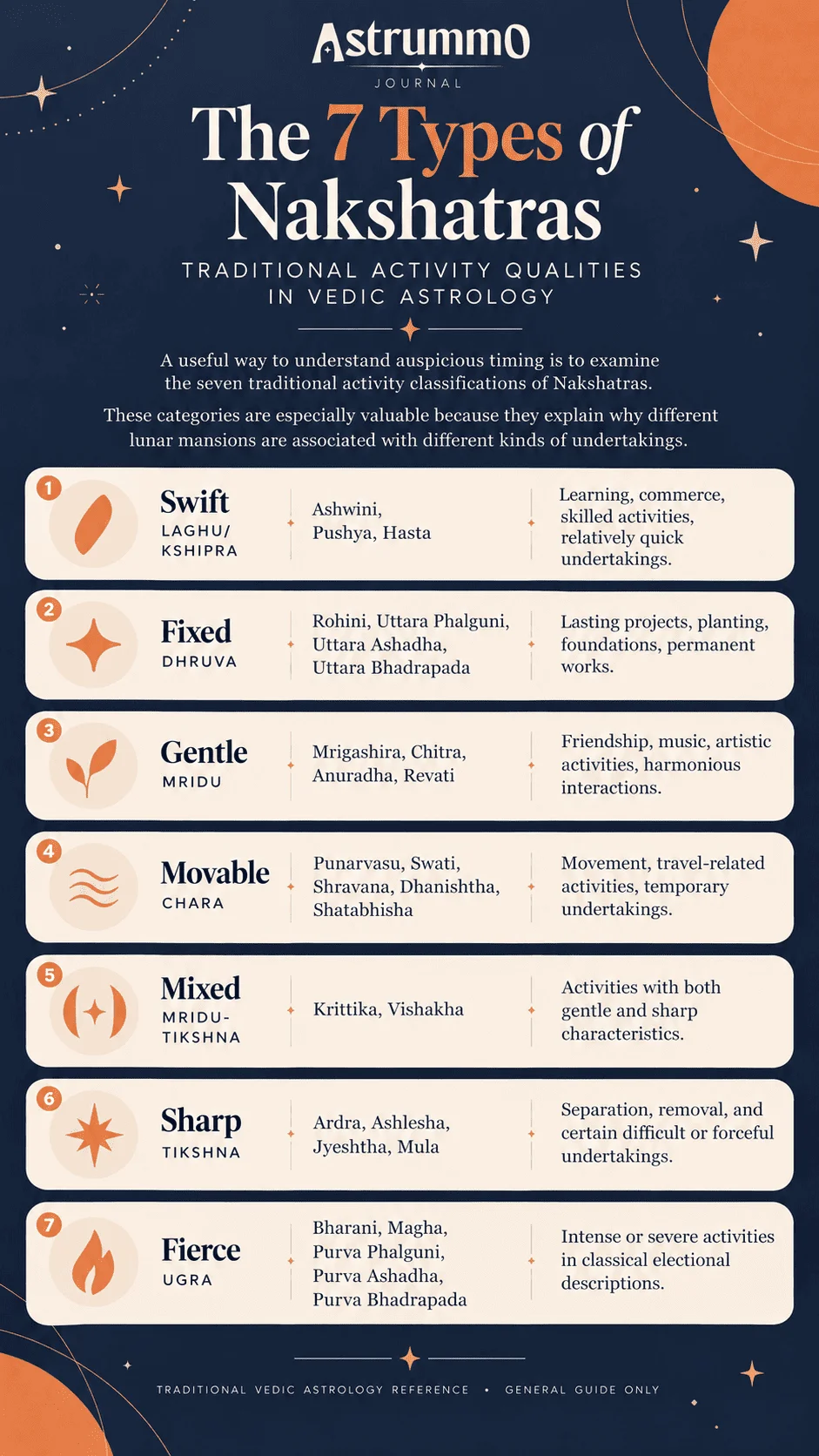
A useful way to understand auspicious timing is to examine the seven traditional activity classifications of Nakshatras.
These categories are especially valuable because they explain why different lunar mansions are associated with different kinds of undertakings.
Nakshatra Type | Nakshatras | Traditional Activity Focus |
|---|
Swift — Laghu/Kshipra | Ashwini, Pushya, Hasta | Learning, commerce, skilled activities, relatively quick undertakings |
Fixed — Dhruva | Rohini, Uttara Phalguni, Uttara Ashadha, Uttara Bhadrapada | Lasting projects, planting, foundations, permanent works |
Gentle — Mridu | Mrigashira, Chitra, Anuradha, Revati | Friendship, music, artistic activities, harmonious interactions |
Movable — Chara | Punarvasu, Swati, Shravana, Dhanishtha, Shatabhisha | Movement, travel-related activities, temporary undertakings |
Mixed — Mridu-Tikshna | Krittika, Vishakha | Activities with both gentle and sharp characteristics |
Sharp — Tikshna | Ardra, Ashlesha, Jyeshtha, Mula | Separation, removal, and certain difficult or forceful undertakings |
Fierce — Ugra | Bharani, Magha, Purva Phalguni, Purva Ashadha, Purva Bhadrapada | Intense or severe activities in classical electional descriptions |
These are traditional classifications, not personality judgments or predictions about what will happen on any particular date.
The following examples show how their underlying activity associations can be understood in modern life.
1. Swift Nakshatras: Activities That Benefit From Momentum
Ashwini, Pushya, and Hasta
Swift Nakshatras, also called Laghu or Kshipra, are traditionally associated with relatively light or readily undertaken activities.
Varahamihira's Brihat Samhita connects this category with commerce, acquiring knowledge, arts, skilled work, and other practical undertakings.
In contemporary Jyotish practice, these associations are sometimes extended to everyday actions such as:
Sending job applications or professional introductions.
Beginning a short educational course.
Making routine business inquiries.
Starting a small, well-prepared project.
Completing practical administrative tasks.
For example, someone intending to send a carefully prepared résumé might view an Ashwini period as symbolically compatible with the goal of taking prompt action.
That does not mean the applicant will receive a faster response or a job offer. The traditional association concerns the nature of the undertaking, not a guaranteed external result.
Similarly, references to medicine in classical sources should not be used to choose or postpone medical treatment. Clinical advice, medical urgency, and available appointments must always take priority.
2. Fixed Nakshatras: Building Something That Lasts
Rohini, Uttara Phalguni, Uttara Ashadha, and Uttara Bhadrapada
Fixed Nakshatras belong to the Dhruva category.
Their classical associations include planting, constructing foundations, public works, and undertakings intended to have lasting effects.
This makes them especially interesting when thinking about stability.
Modern examples might include:
Beginning a long-term personal project.
Establishing a sustainable daily routine.
Starting a garden or planting trees.
Organizing a lasting educational initiative.
Laying the groundwork for a community project.
Notice the difference between initiating a quick task and building something designed to endure.
A swift Nakshatra may be associated with prompt execution, while a fixed Nakshatra emphasizes continuity.
Traditional practitioners also discuss fixed Nakshatras in connection with homes, property, institutions, and marriage. However, these consequential decisions require considerably more than identifying the Moon's Nakshatra.
A property purchase still depends on legal checks, financing, inspections, and personal circumstances. A wedding requires its own more complete Muhurta considerations rather than a general fixed-Nakshatra association.
3. Gentle Nakshatras: Connection, Creativity, and Harmony
Mrigashira, Chitra, Anuradha, and Revati
Gentle Nakshatras, known as Mridu, are traditionally associated with friendship, artistic activities, music, ornaments, and harmonious interaction.
They provide a different perspective on auspiciousness.
Not every meaningful day needs to be about launching something ambitious. Some activities involve connection, creativity, or developing an existing relationship.
Their traditional associations can be applied to ordinary activities such as:
Reconnecting with friends.
Organizing a relaxed social gathering.
Starting a creative or artistic project.
Practicing music.
Planning a collaborative activity.
Certain practitioner traditions provide additional Nakshatra-specific examples.
For instance, Chitra is associated in some contemporary teachings with drawing plans, design-related preparation, and bookkeeping. Revati is associated with writing, poetry, searching for lost objects, and meditation.
These specific examples should be distinguished from the broader classical Mridu classification. Not every modern interpretation carries the same textual authority.
The overall theme is gentle, constructive engagement rather than an assurance of romantic, artistic, or social success.
4. Movable Nakshatras: Travel, Transitions, and Flexible Plans
Punarvasu, Swati, Shravana, Dhanishtha, and Shatabhisha
Chara means movable.
This category is traditionally associated with activities characterized by movement or change.
In practical terms, the symbolism is relevant to plans such as:
Some practitioner traditions extend these associations to vacations, concerts, and other movement-oriented experiences.
Suppose you are planning a weekend road trip. A movable Nakshatra may be an interesting traditional consideration.
But weather conditions, transportation safety, your budget, and actual availability remain more important than the astrological classification.
Movable does not automatically mean favourable for every journey, and a different Nakshatra does not make travelling inherently unsafe.
5. Mixed Nakshatras: Practical Work Requiring Discernment
Krittika and Vishakha
Krittika and Vishakha are classified as Mridu-Tikshna, combining gentle and sharp characteristics.
Their traditional classification indicates a mixed character rather than universal favourability.
Some contemporary practitioner teachings associate these Nakshatras with activities involving fire, preparation, editing, cutting, and other practical processes.
Examples include:
Editing or refining existing work.
Preparing food.
Organizing or separating materials.
Completing carefully controlled craft activities.
Photography is also associated with these two Nakshatras in certain practitioner teachings, although it should not be mistaken for a universal classical prescription.
The important lesson is that a mixed classification calls for activity-specific interpretation. It should not be reduced to an automatic warning or a generic positive rating.
6. Sharp Nakshatras: Removal and Necessary Endings
Ardra, Ashlesha, Jyeshtha, and Mula
Sharp Nakshatras are called Tikshna.
Classical electional literature contains forceful and, in some cases, harmful historical associations for this group. Those historical descriptions should not be presented as recommendations for modern behavior.
The non-harmful theme that may be useful for reflection is separation or removal.
For example, a person might choose to think about ordinary tasks such as:
Clearing unnecessary belongings.
Removing obsolete files.
Closing an unused account.
Reviewing commitments that no longer serve a practical purpose.
These are modern, low-stakes analogies to a broader traditional association with separation. They are not individually established classical Muhurta prescriptions.
A sharp Nakshatra does not mean an ordinary day must be feared. Nor does it provide grounds for harmful actions, legal disputes, or consequential relationship decisions.
7. Fierce Nakshatras: Intensity Does Not Mean a Bad Day
Bharani, Magha, Purva Phalguni, Purva Ashadha, and Purva Bhadrapada
The Ugra classification is generally translated as fierce or severe.
Classical sources associate this group with intense undertakings, including activities that are not appropriate as modern recommendations.
It would be misleading to invent reassuring lists of supposedly beneficial actions simply to make every Nakshatra sound positive.
But it would be equally misleading to conclude that every ordinary activity becomes unfortunate whenever the Moon enters a fierce Nakshatra.
A fierce Nakshatra is not a universally bad day.
It means the traditional category has a particular character, and a careful interpretation should avoid unsupported claims about specific outcomes.
When activity-specific evidence is limited, a responsible guide should acknowledge the limitation rather than manufacture certainty.
Which Nakshatra Should You Consider for Different Activities?
For everyday planning, it helps to begin with the intention behind an activity.
Here is a quick reference.
Your Activity | Traditionally Relevant Category | Important Consideration |
|---|
Sending a résumé or professional introduction | Swift | Modern practitioner application; no response guarantee |
Starting a short course | Swift | Classical learning association |
Beginning a long-term project | Fixed | Associated with lasting undertakings |
Planting a garden | Fixed | Classical planting association; season and climate matter |
Meeting friends | Gentle | Classical friendship association |
Practicing music or beginning an art project | Gentle | Classical artistic associations |
Organizing a journey | Movable | Practitioner-supported practical extension |
Editing or refining work | Mixed | Practitioner-specific association |
Removing obsolete belongings or files | Sharp | Modern analogy to separation; not a literal classical prescription |
This table is useful as an orientation, not a complete system for electing exact auspicious times.
A date may contain one of these Nakshatras while other Panchanga conditions introduce additional qualifications.
That's why understanding Nakshatras is only the beginning.
Why Nakshatra Alone Cannot Tell You Whether a Day Is Auspicious
One of the most common mistakes in simplified Vedic calendars is declaring an entire date lucky or unlucky based on a single factor.
Traditional Panchanga considers five elements:
1. Tithi — Lunar Day
Tithi describes the changing angular relationship between the Sun and Moon. There are thirty Tithis in a lunar month, divided between the waxing and waning halves.
Traditional texts assign different associations to different lunar days.
2. Vara — Weekday
Vara refers to the traditional weekday, associated with a planetary ruler.
In local Panchanga practice, the traditional day is generally determined by sunrise rather than simply changing at midnight.
3. Nakshatra — Lunar Mansion
Nakshatra identifies the Moon's position within the 27-part sidereal lunar division.
It is especially relevant to the traditional activity classifications explained above.
4. Yoga — Sun-Moon Combination
Nitya Yoga is calculated from the combined sidereal longitudes of the Sun and Moon and divides the complete cycle into 27 parts.
Different Yogas receive different traditional interpretations. Some contain specific cautions, but those cautions should not automatically be generalized to every activity or every hour.
5. Karana — Half of a Tithi
Karana divides each Tithi into two parts.
The classical Brihat Samhita, Chapter 99 describes different activity associations for Karanas.
For example, Gara is associated with cultivation and construction, while Vanija is associated with trade and fixed undertakings. Vishti, also called Bhadra, carries traditional restrictions concerning certain auspicious beginnings.
These associations are specific, not evidence that routine responsibilities should be abandoned whenever a particular Karana occurs.
Together, the five elements provide a more nuanced picture than Nakshatra alone.
They also explain why a traditionally supportive Nakshatra might coincide with conditions that require additional consideration.
Why Location and Exact Time Matter
Panchanga calculations are time-sensitive.
The Moon may enter a new Nakshatra during a particular date. A Tithi or Karana can also change within the same day.
Meanwhile, local sunrise depends on location.
Consequently, the traditional Panchanga for someone in New York may not line up with the same civil-date boundaries as the Panchanga for someone in Los Angeles.
Daylight saving time adds another practical consideration when converting calculated astronomical transitions into local clock times.
For meaningful timing guidance, it is better to use calculated local intervals rather than assume a single astrological condition lasts from midnight to midnight.
General Auspiciousness vs. Your Personal Astrology
There is another distinction that is easy to overlook.
General cosmic timing and personal astrological alignment are not the same thing.
The Moon occupies the same astronomical Nakshatra at a given moment regardless of who observes it. Its traditional activity classification therefore provides a shared general reference.
But two individuals can have very different birth charts.
In personal Jyotish interpretation, an astrologer may additionally consider:
The individual's natal Moon Nakshatra.
Tara Bala, which examines the relationship between the current and birth Nakshatras.
Relevant Vimshottari Dasha periods.
Planetary transits and natal house placements.
Other chart-specific strengths, challenges, and timing factors.
Suppose a period is generally associated with beginning a course or engaging in commerce.
That general association does not establish that both activities have equal personal significance for every individual.
One person may be navigating a career-oriented planetary period, while another may be focused on relationships, family, or personal responsibilities.
This is where natal interpretation provides an additional perspective.
To understand how personal planetary periods are calculated, read our guide to Vimshottari Dasha and the role of the Moon's Nakshatra.
And if you're unfamiliar with how planets, houses, and signs interact, our beginner's guide to reading your Vedic birth chart offers a practical starting point.
How to Use Vedic Astrology for Everyday Planning
You do not need to turn every small decision into an elaborate astrological calculation.
A more practical approach is to use traditional timing as an additional layer of reflection.
Start with these four steps.
Step 1: Define What You Actually Want to Do
Be specific.
"Have a productive day" is vague.
"Send three job applications," "begin a writing project," or "prepare a long-term study plan" describes an actual activity.
The more clearly you define your intention, the easier it becomes to identify the traditional activity category that might be relevant.
Step 2: Identify the Relevant Nakshatra
Look at the Moon's calculated Nakshatra for your intended date and location.
Check whether a transition occurs before or during the time you plan to act.
For example, a day might begin with one traditional activity character and later transition into another.
That does not automatically make the second period better. It simply means the relevant associations have changed.
Step 3: Consider the Wider Panchanga
Look beyond the Nakshatra.
Relevant Tithi, Vara, Yoga, and Karana conditions can strengthen, qualify, or complicate a traditional activity association.
For major ceremonies or consequential undertakings, an exact Muhurta analysis can involve additional factors beyond these five elements.
If the evidence is inconclusive, it is better to acknowledge uncertainty than to force a favourable or unfavourable conclusion.
Step 4: Keep Practical Reality in Charge
An astrologically interesting date does not replace preparation.
If you are applying for a job, the strength of your application matters.
If you are starting a business, research, financing, legal compliance, and execution matter.
If you are travelling, safety and available transportation matter.
And medical treatment should follow qualified medical guidance, not astrological timing.
Traditional timing can serve as a personal ritual for intentional action, but it cannot guarantee an outcome or establish what another person will do.
Can a Day Be Good for One Activity but Challenging for Another?
Yes. Within the traditional system, this is one of the most important distinctions.
Imagine a date that includes a Nakshatra traditionally associated with swift undertakings.
An individual might regard it as symbolically appropriate for sending a routine professional message or beginning a short learning task.
That same association does not establish suitability for a wedding or a major property commitment.
Similarly, a date containing a Fixed Nakshatra may have a documented association with lasting projects, while other Panchanga factors introduce cautions for certain kinds of beginnings.
This is why a useful Vedic astrology calendar should explain what conditions are traditionally suited to, not just label every day green or red.
A simple good-day/bad-day label can obscure the distinction between the type of activity, the time of day, and the surrounding astrological factors.
The deeper value comes from understanding the reasoning.
Bring More Context to Your Daily Astrology With Astrummo
Traditional Jyotish contains several interconnected systems: lunar Nakshatras, Panchanga, planetary transits, natal charts, and Dasha periods.
Learning how they fit together can be rewarding, but interpreting all those calculations independently is not always straightforward.
Astrummo is designed to make personal Vedic astrology easier to understand.
Using Swiss Ephemeris planetary calculations with the Lahiri sidereal framework, Astrummo brings traditional astrological calculations into an accessible experience focused on your individual birth chart.
You can explore your planetary placements, understand your personal astrological context, follow daily insights, and ask questions about the themes that matter to you.
Rather than replacing your judgment, Astrummo helps you reflect on traditional astrological interpretations in clear, practical language.
Explore Astrummo — Your Personal Vedic Astrologer
Discover Astrummo and get started
Available on Android through Google Play.
Frequently Asked Questions
What is the best Nakshatra for starting something new?
There is no single best Nakshatra for every kind of beginning.
Ashwini, Pushya, and Hasta belong to the Swift category and have traditional associations with activities such as commerce, knowledge acquisition, and skilled undertakings.
For projects intended to last, the Fixed Nakshatras—Rohini, Uttara Phalguni, Uttara Ashadha, and Uttara Bhadrapada—have different traditional associations.
Other Panchanga factors and the nature of the proposed activity still matter.
Is Ashwini Nakshatra good for starting a new project?
Ashwini belongs to the traditional Laghu/Kshipra category, associated with relatively swift activities.
Some modern practitioners extend this association to short projects, applications, or practical initiatives.
However, Ashwini alone does not establish that every project or entire day is auspicious.
Which Nakshatra is associated with long-term success?
Fixed or Dhruva Nakshatras are traditionally connected with permanence and lasting undertakings.
That is an activity classification, not evidence that a project will succeed or remain profitable.
Can one day have two different Nakshatras?
Yes. The Moon can change Nakshatra during the day.
For accurate traditional timing, the relevant start and end times should be considered in the user's local timezone.
Is my birth Nakshatra the same as today's Nakshatra?
No.
Your birth Nakshatra is determined by the Moon's position at your birth.
Today's Nakshatra describes the Moon's current position in the sidereal lunar mansion system.
The relationship between the two may be considered in personal astrology through methods such as Tara Bala.
Final Thoughts: Choosing a Day With Intention
The most useful lesson from traditional Vedic auspicious timing is not that the universe divides every month into lucky and unlucky dates.
It is that different activities have different characteristics, and traditional Jyotish developed a detailed framework for considering those differences.
A quick initiative, a lasting commitment, a creative project, and a journey do not necessarily share the same timing considerations.
The Nakshatra system provides an entry point into that tradition. The wider Panchanga adds context. Personal astrology contributes an individual perspective.
Ultimately, a thoughtfully chosen date can serve as a moment of intention—a reminder to act deliberately, prepare well, and understand what you hope to begin.
The stars may offer a traditional language for timing. What you build with that moment remains your responsibility.