
10 October 2026 · Astrummo
How to Enable Astrummo Notifications & Choose Your Daily Reminder
Set up your Daily Alignment reminder in Astrummo, allow phone notifications, and choose a time that fits your routine.
Understanding that distinction helps you compare your charts without treating one as a mistake.
You have always considered yourself a Leo. Then you enter your birth details into a Vedic astrology app and discover that your Sun is in Cancer. Or your familiar Libra Moon becomes a Virgo Moon.
Did you enter something incorrectly? Has your zodiac sign changed?
Usually, neither. Vedic and Western astrology commonly use different starting points to measure planetary positions. The same Sun, Moon and planets can therefore receive different zodiac labels for the same moment of birth.
Understanding that distinction helps you compare your charts without treating one as a mistake. It also opens up a more interesting question: beyond your familiar Sun sign, what does each tradition actually examine?
Most mainstream Western astrology uses the tropical zodiac, while most Vedic astrology uses a sidereal zodiac. Both divide the zodiac into twelve equal signs of 30 degrees, but they position the beginning of those signs differently. These are common practices, rather than universal rules: Western sidereal astrologers also exist.
The tropical zodiac places 0 degrees Aries at the March equinox. Its reference point follows Earth's relationship with the Sun and the annual seasonal cycle. The US Naval Observatory's explanation of seasons and Earth's orbit explains the equinox-to-equinox tropical year and how precession changes the relationship between the seasons and Earth's orbit.
A sidereal zodiac instead uses an origin defined relative to the stellar background. To convert tropical positions to sidereal ones, calculations apply an angular offset called an ayanamsa. The Indian Meteorological Department's Rashtriya Panchang explanation describes this use of ayanamsa and a fixed reference point for nirayana, or sidereal, longitudes.
Imagine measuring the same location using two maps with different coordinate origins. The location has not moved; the numbers used to describe it differ.
Earth's rotational axis slowly changes direction, rather like the gradual wobble of a spinning top. This movement is known as axial precession.
Over time, it changes the position of the equinox relative to the background stars. NASA's explanation of precession describes a cycle lasting roughly 26,000 years. That is why an equinox-based zodiac and a stellar-reference zodiac do not remain aligned indefinitely.
For a simple illustration, use a rounded offset of 24 degrees, representative of the approximate contemporary difference for a commonly used Indian sidereal convention. This is not a universal conversion constant: the exact offset depends on the birth date and the selected ayanamsa.
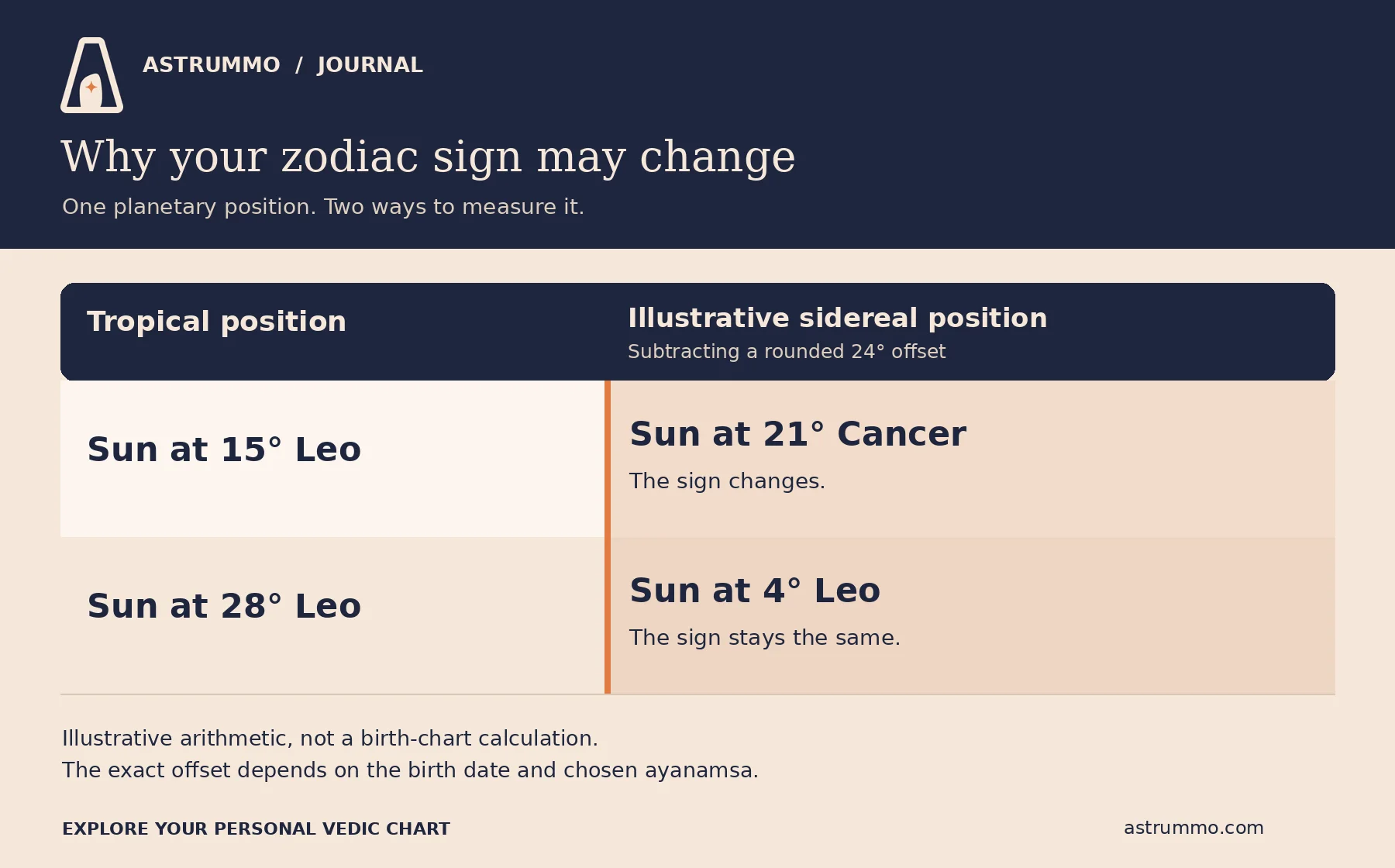
Tropical positionIllustrative sidereal position, subtracting 24°Sun at 15° LeoSun at 21° CancerSun at 28° LeoSun at 4° Leo
In the first example, subtracting the offset moves the Sun into the preceding sign. In the second, it remains in Leo.
Your sign therefore does not automatically move back by one sign. It depends on the planet's exact degree. These examples illustrate arithmetic, not a calculation for a particular birthday.
There is another distinction that often gets lost in discussions about “your real sign.”
Astrological signs are twelve equal divisions of 30 degrees. Astronomical constellations have unequal boundaries and occupy different amounts of sky. NASA's zodiac educational resource explicitly distinguishes the two.
Consequently, “sidereal” does not mean that every sign boundary exactly matches the modern astronomical boundary of its namesake constellation. Describing Vedic astrology as simply “the actual constellations” leaves out how its zodiac is constructed.
The zodiac reference is the most visible difference, but the traditions also have different interpretive methods. This comparison describes common practices. Neither tradition is completely uniform, and individual astrologers may work differently.
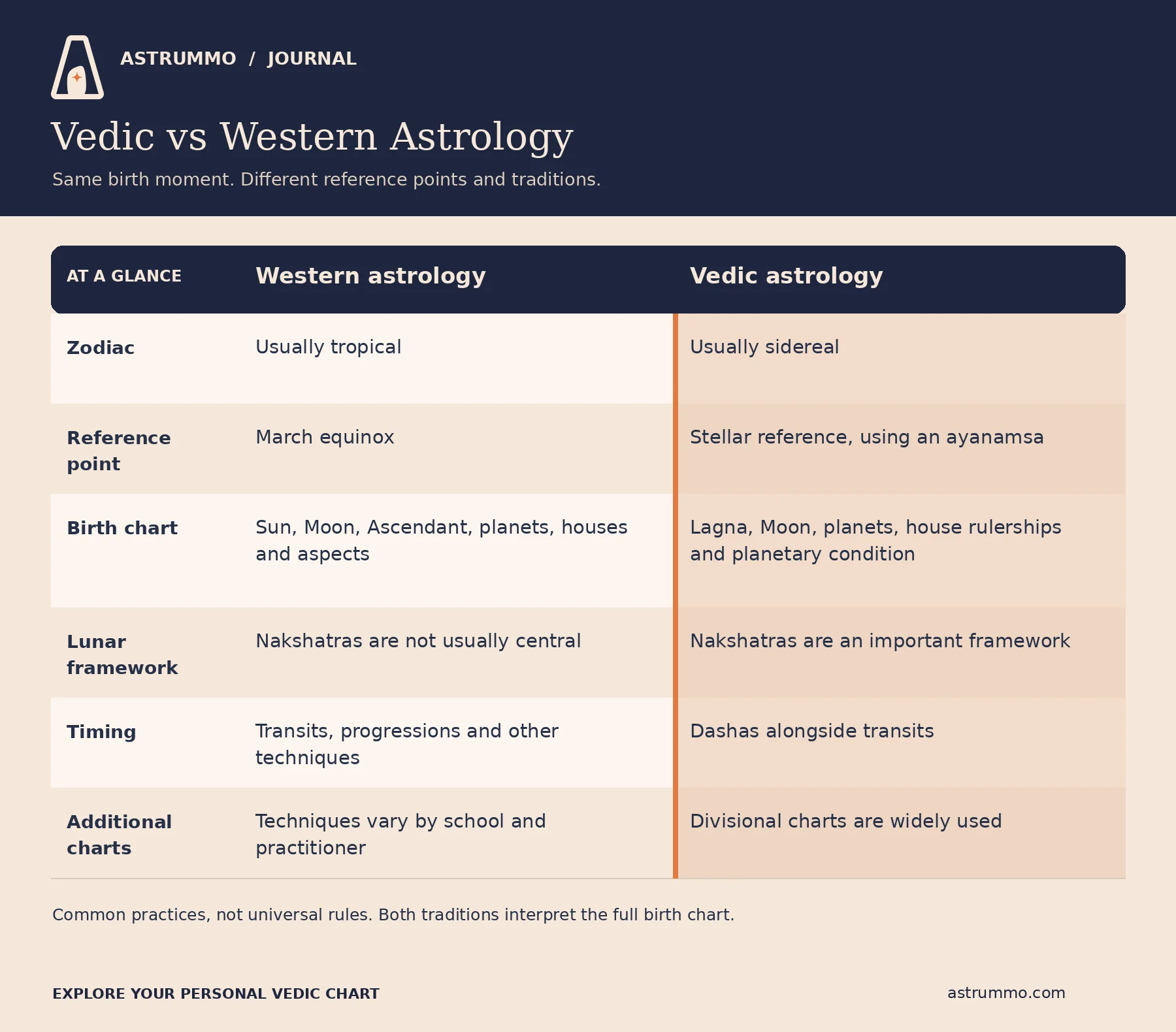
AreaCommon Western practiceCommon Vedic practiceZodiacUsually tropicalUsually siderealReference pointMarch equinoxStellar reference, using an ayanamsaBirth chartSun, Moon, Ascendant, planets, houses and aspectsLagna, Moon, planets, house rulerships and planetary conditionLunar frameworkNakshatras are not usually centralNakshatras are an important frameworkTimingTransits, progressions and other techniquesDashas alongside transitsAdditional chartsTechniques vary by school and practitionerDivisional charts are widely used
These are differences in emphasis, rather than a rigid division between “personality astrology” and “prediction astrology.” The table does not mean that house rulerships or planetary condition are absent from Western astrology, or that the Sun and aspects are absent from Vedic astrology.
The familiar question “What's your sign?” usually refers to the Sun. That shorthand is useful socially, but it is not a full Western birth-chart reading.
Western astrologers also examine the Moon, Ascendant, houses and planetary relationships. Timing methods can include transits, progressions and other techniques, depending on the school. A general encyclopedic overview of Western astrology describes its broader horoscopic framework.
It would be misleading to compare a detailed Vedic consultation with a generic Western horoscope and conclude that only one tradition offers personalization. Compare like with like: a full natal reading with a full natal reading.
In Vedic astrology, often called Jyotish, the Lagna, or rising sign, helps establish the chart's structure. Practitioners consider planets, house rulerships, aspects and planetary condition, alongside lunar and timing frameworks.
Nakshatras provide another way of dividing the zodiac. The Moon's birth nakshatra has a longstanding interpretive role in Indian astrology. Audrius Beinorius's study published by Vilnius University discusses that history and the tradition's connections with Mesopotamian and Hellenistic astrology.
Discovering a different Moon sign is therefore a starting point for exploring a chart, not a complete explanation of your personality. A meaningful interpretation should explain how factors work together rather than attaching a sweeping conclusion to one label.
One distinctive Vedic technique is the dasha, a sequence of planetary periods.
In the widely used Vimshottari dasha system, the starting period and its remaining duration are derived from the Moon's position in its natal nakshatra. Longer periods, called mahadashas, contain shorter subperiods.
These techniques belong to an established textual tradition. The classical Phaladeepika, available in a digitized edition through India's Indira Gandhi National Centre for the Arts, discusses planetary periods and their subdivisions. It is a source for traditional methods, not scientific proof of their predictive claims.
For someone exploring the tradition, the useful question is not merely “Which planet rules this period?” It is how that period is interpreted in the context of the whole birth chart. A period should not be presented as a guaranteed date for marriage, employment or money.
A difference caused by tropical versus sidereal settings is not, by itself, a calculation error. The charts use different reference points.
However, settings and birth information can introduce genuine discrepancies. Before comparing interpretations, make sure both calculations use the same birth date, birth time and birthplace. Check AM/PM entry, the historical time zone and daylight-saving adjustment. Do not substitute your current location for your birthplace.
Also check what each result means by “your sign.” One service may prominently display your Sun sign, while another emphasizes your Moon sign or Ascendant. Those are different placements even within the same zodiac system.
Compare Sun with Sun, Moon with Moon, and Ascendant with Ascendant. Otherwise, you may be comparing different parts of the chart rather than different traditions.
“Sidereal” does not identify one universally agreed starting point. Different ayanamsa conventions exist, and their offsets are not identical. A small difference can matter when a placement sits close to a boundary.
If two Vedic services disagree, ask which ayanamsa each uses and verify the birth data before deciding that one result is faulty. This is also why a rounded 24-degree subtraction is useful for explanation but should not replace an actual chart calculation.
Your natal sign does not gradually change because you age. A natal chart refers to the moment of birth. Current transits or progressed charts are separate calculations.
If you enjoy Western astrology, exploring Vedic astrology does not require abandoning it. You can learn how another tradition approaches the same birth information while keeping the methods clearly distinguished.
Start by comparing the Sun, Moon and Ascendant. Then move beyond labels: what factors does the interpretation consider, and how clearly does it explain its reasoning?
Be cautious about choosing a system solely because one description feels flattering or familiar. Personal resonance can make a reading meaningful, but it does not establish predictive accuracy.
The astronomical calculations and astrological interpretations should also be distinguished. Astronomy explains planetary positions and precession; that does not scientifically validate claims about personality or future events. NASA's explanation of astronomy and astrology makes that distinction explicit.
A thoughtful way to engage with either tradition is as a framework for reflection, while keeping personal judgment and real-world evidence central to your decisions.
A different zodiac sign can be surprising, especially if you have identified with your familiar sign for years. Understanding the reference systems turns that surprise into something you can examine.
Astrummo lets you explore your personal Vedic birth chart and ask questions grounded in your birth details and planetary timing.
Enter your birth date, birth time and birthplace carefully. Begin with your Sun, Moon and rising sign, then explore the wider chart. A different label is an invitation to learn how the tradition works—not a reason to reduce yourself to a new sign.
10 October 2026 · Astrummo
Set up your Daily Alignment reminder in Astrummo, allow phone notifications, and choose a time that fits your routine.
10 October 2026 · Astrummo
Learn how to read your Vedic birth chart, from your Ascendant and houses to planetary placements, nakshatras, and aspects—with a real chart example.
12 October 2026 · Astrummo
Discover all 27 Nakshatras in Vedic astrology, including their meanings, symbols, ruling planets, deities, zodiac degrees, and influence on your birth chart.
15 October 2026 · Astrummo
Learn how Vimshottari Dasha works, why the Moon’s Nakshatra determines your planetary periods, and how Mahadasha, Antardasha and transits are used in Vedic astrology.
17 October 2026 · Astrummo
Why do Vedic astrology apps show different birth charts? Discover 8 reasons, from birth time and GPS coordinates to ayanamsa, Rahu, Ketu, and D9 charts.