23 October 2026 · Astrummo
2027 Vedic Astrology Forecast: The Major Planetary Transits to Watch
Discover the 2027 Vedic astrology forecast: Jupiter and Saturn transits, Rahu-Ketu, retrogrades and eclipses explained using the Lahiri sidereal zodiac.
Mercury retrograde is famous for communication mishaps, technology problems, and unexpected complications. But what does it actually mean? Explore the real astronomy, traditional Jyotisha interpretation, and every Mercury retrograde date for 2026 and 2027.
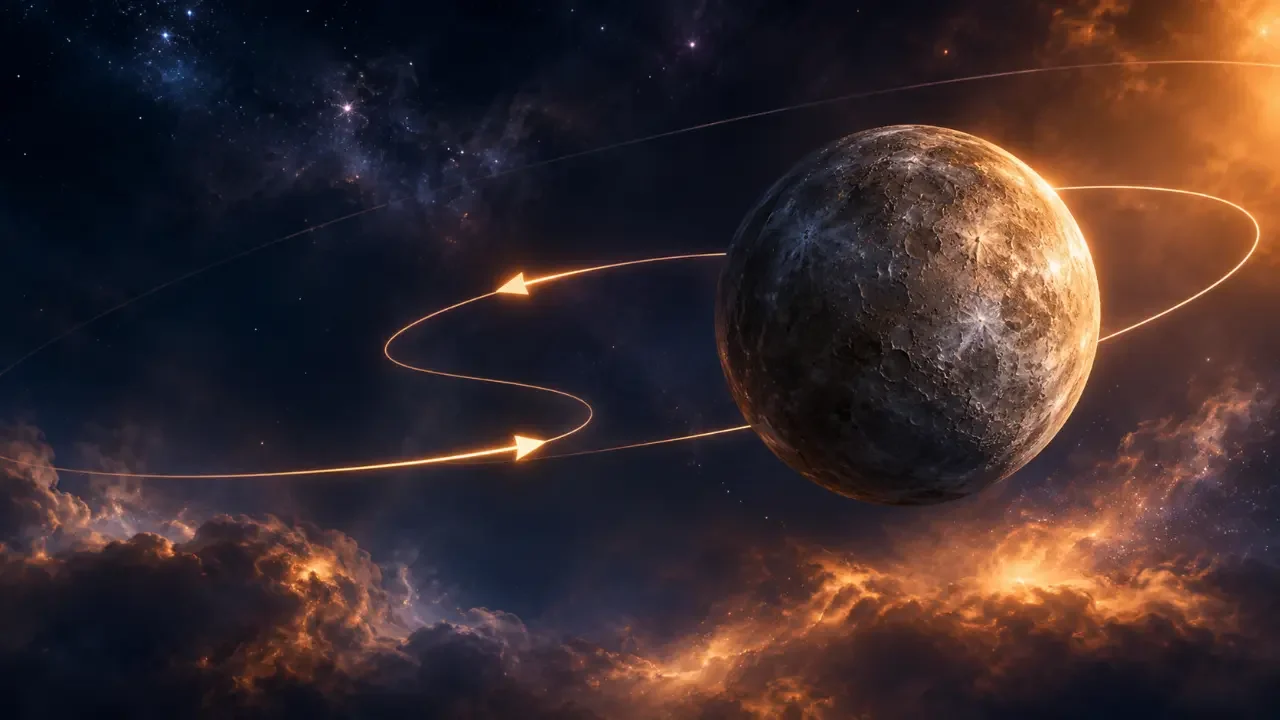
Mercury retrograde has become shorthand for missed messages, awkward conversations, travel delays, and everything that goes wrong at the worst possible moment. But what is actually happening in the sky? And why does Vedic astrology interpret it differently? Here's a closer look, including every Mercury retrograde date for 2026 and 2027.
You send a message. No reply.
Your laptop freezes halfway through something important. An old friend unexpectedly gets in touch. Suddenly, somebody says the two words that seem to explain everything.
“Mercury retrograde.”
It's one of astrology's most recognizable expressions. Even people who have never opened a birth chart have probably heard it.
But there's a rather wonderful irony behind its reputation.
Mercury isn't actually moving backward.
And once you understand what the planet is doing, the story becomes much more interesting than the usual warnings about broken technology and unfortunate text messages.
Let's begin with the astronomy.
Mercury is the smallest planet in our solar system and the closest to the Sun.
It is also remarkably fast.
A complete orbit around the Sun takes approximately 88 Earth days. By comparison, Earth needs about 365 days.
Because Mercury moves along an orbit inside Earth's, the relative positions of the two planets change constantly.
Most of the time, Mercury appears to travel eastward against the background of distant stars. But during certain parts of its orbit, that apparent movement slows, stops briefly, and reverses direction.
For several weeks, Mercury appears to move westward.
Astronomers call this apparent retrograde motion.
The key word is apparent.
Mercury continues orbiting the Sun in its usual direction. It doesn't reverse course, slow to a physical standstill, or suddenly behave differently because of something happening on Earth.
Our changing viewpoint creates the illusion.
Imagine watching another car from a moving vehicle. Depending on your relative speeds and positions, the car can appear to drift backward against the distant surroundings, even though both vehicles continue moving forward.
Planetary retrograde motion involves more complicated orbital geometry, but the principle is similar: movement can look different depending on where the observer is standing.
Mercury goes through this apparent reversal about three or four times a year, typically spending around three weeks in retrograde motion.
It's a perfectly ordinary part of the planet's orbital cycle.
And yet, in Jyotisha, the changing apparent motion has a distinct traditional significance.
In Jyotisha, Mercury is known as Budha.
It is traditionally associated with intelligence, speech, calculation, commerce, writing, language, learning, and the ability to process information.
Think of the moments when these skills matter most.
You're choosing the right words for a difficult conversation. Working through a contract. Comparing two opportunities. Trying to explain an idea clearly enough that someone else can understand it.
Those everyday activities fit naturally within Mercury's traditional symbolism.
Its association with communication is one reason retrograde Mercury attracts so much public attention.
But there's an important difference between saying that Mercury represents communication within an astrological tradition and claiming that its apparent motion causes messages to disappear.
The first describes Jyotisha symbolism.
The second would require scientific evidence that hasn't been established.
A thoughtful interpretation keeps those ideas separate.
Mercury completes three retrograde periods during 2026.
Retrograde period | Begins | Ends |
|---|---|---|
First | February 26, 2026 | March 20, 2026 |
Second | June 29, 2026 | July 23, 2026 |
Third | October 24, 2026 | November 13, 2026 |
Dates are based on UTC. Depending on your location, a station close to midnight may appear on a different local calendar date.
For Astrummo readers, there is an important detail beyond the dates.
Using the Lahiri sidereal zodiac, the three retrograde passages take place through these signs:
Period | Lahiri sidereal movement |
|---|---|
February–March | Aquarius |
June–July | Cancer → Gemini |
October–November | Libra |
You may have seen Western astrology calendars describing the final 2026 retrograde as occurring in Scorpio.
That isn't necessarily an error.
Most Western astrology uses the tropical zodiac, while Astrummo uses the Lahiri sidereal zodiac. The same astronomical event can therefore receive different zodiac sign labels.
If you've ever wondered why your signs differ between apps, our guide to Vedic vs Western Astrology explains the distinction.
The year's final Mercury retrograde runs from October 24 to November 13.
During this period, Mercury also reaches inferior conjunction with the Sun on November 4.
At inferior conjunction, Mercury passes between Earth and the Sun in its orbital journey, although it does not necessarily cross the visible solar disk.
In the Lahiri sidereal zodiac, this particular conjunction occurs in Libra, within Swati Nakshatra.
This adds several layers to the traditional Jyotisha interpretation.
Mercury is retrograde, very close to the Sun, and occupying a Nakshatra associated with movement, independence, and adaptability.
Meanwhile, Venus — the ruler of Libra — is also retrograde during much of the period.
Rather than treating the combination as an automatic warning, it is more useful to examine how Mercury's traditional themes of communication and discernment interact with Libra's symbolism of balance, relationships, and exchange.
We've explored the exact event in Mercury Meets the Sun on November 4: What Makes This Retrograde Different?.
For a closer look at the simultaneous retrogrades, see Mercury and Venus Retrograde: Why November 2026 Is Unusual for Love.
There are also three Mercury retrograde periods in 2027.
Retrograde period | Begins | Ends |
|---|---|---|
First | February 9, 2027 | March 3, 2027 |
Second | June 10, 2027 | July 4, 2027 |
Third | October 7, 2027 | October 28, 2027 |
All dates use UTC.
Under Lahiri sidereal calculations, the movements are:
Period | Lahiri sidereal movement |
|---|---|
February–March | Aquarius → Capricorn |
June–July | Gemini |
October | Libra → Virgo |
Notice that 2027 doesn't simply repeat the zodiac pattern of 2026.
In February and October, Mercury crosses a sidereal sign boundary while moving retrograde. The June–July period remains within Gemini in the Lahiri zodiac.
This matters because Jyotisha doesn't interpret every Mercury retrograde as identical.
A planet's sign, its ruler, the houses it occupies, and its relationships with other grahas all contribute to the traditional assessment.
For example, Mercury in Gemini is in its own sign, while Mercury in Virgo also occupies a sign of its rulership and traditional exaltation.
Mercury in Libra operates in a Venus-ruled sign. Mercury in Capricorn is in a Saturn-ruled sign.
These distinctions belong to the interpretive framework and shouldn't be flattened into one universal Mercury retrograde prediction.
Our broader 2027 Vedic Astrology Forecast places these periods alongside the year's other planetary movements.
You may occasionally see Mercury retrograde calendars displaying dates well before or after the three-week retrograde itself.
These are often called the pre-shadow and post-shadow periods.
The idea is relatively straightforward.
Before Mercury stations retrograde, it passes through the zodiac degrees that it will later revisit while appearing to move backward.
After it stations direct, it travels forward through that same stretch again.
Astrological calendars commonly call the first passage the pre-shadow, the backward passage the retrograde, and the final forward passage the post-shadow.
But here's the distinction worth remembering.
Mercury is not retrograde during the entire shadow period.
The actual retrograde begins when its apparent geocentric longitude changes from increasing to decreasing and ends when that direction changes back.
Shadow dates describe repeated passages through the same zodiac degrees, not additional changes in the planet's orbital direction.
This is where the conversation becomes more interesting.
In Sanskrit astrological terminology, retrograde motion is called Vakra.
Classical Jyotisha evaluates planets through a variety of conditions, including their apparent motion, zodiac placement, house position, strength, relationships with other planets, and role within the individual birth chart.
Retrograde motion contributes to this analysis, but it doesn't replace the rest of it.
One related concept is Cheshta Bala, a component of the Shadbala system concerned with planetary strength associated with apparent motion.
In traditional calculations, retrograde conditions can give a planet substantial Cheshta Bala.
This produces a somewhat surprising distinction.
A retrograde planet isn't simply a weakened planet.
Its motion-related strength may actually be significant under the traditional rules.
But strength is not the same thing as favorable results.
A planet can possess substantial calculated strength while ruling houses or participating in combinations that require more complicated interpretation.
This is why a professional Jyotisha reading shouldn't begin and end with the word retrograde.
There's a familiar internet version of Mercury retrograde that goes something like this:
Don't sign anything. Don't buy electronics. Don't start a relationship. Don't travel. And definitely don't text your ex.
It's memorable advice.
It is also a remarkably broad set of restrictions for an astronomical pattern that happens several times every year.
In Jyotisha, Mercury's significance depends on the complete configuration.
For someone with Gemini rising, Mercury traditionally rules the first and fourth houses.
For someone with Virgo rising, Mercury rules the first and tenth houses.
That means the same Mercury transit has different house-rulership contexts in those two charts.
And the difference becomes greater when we consider where Mercury is moving, which planets influence it, and whether Mercury is connected to the person's active planetary periods.
This is the difference between a generalized Mercury retrograde description and a natal-chart-based interpretation.
The same sky does not create identical house configurations for everyone.
Imagine Mercury moving through sidereal Libra, as it does during the final retrograde of 2026.
For someone with Aquarius rising, Libra is the ninth house in a whole-sign Vedic chart.
Traditional ninth-house subjects include teachers, higher learning, guiding beliefs, philosophy, and long-distance journeys.
For someone with Scorpio rising, Libra is the twelfth house.
Traditional twelfth-house subjects include expenditure, withdrawal, distant places, solitude, and certain kinds of spiritual activity.
The astronomical Mercury position is the same.
But the relationship to each person's natal houses is different.
That doesn't mean the first person must reconsider their beliefs while the second experiences an unexpected expense.
It means the transit enters a different traditional interpretive framework for each chart.
Then we must also examine Mercury's natal placement and house rulership, along with other planetary conditions.
If you are unfamiliar with the houses and planetary rulers, How to Read Your Vedic Birth Chart is a useful place to begin.
Here is something that often gets lost in conversations about Mercury retrograde.
Jyotisha doesn't rely on transits alone.
One of its most widely used timing systems is Vimshottari Dasha, which divides a traditional 120-year sequence into planetary periods.
The starting sequence is calculated from the Moon's Nakshatra at birth.
Within this system, Mercury rules a 17-year Mahadasha.
A person may also experience a Mercury Antardasha, or subperiod, within another planet's Mahadasha.
In traditional interpretation, the condition and role of Mercury may receive additional attention during Mercury-related periods.
But even then, the specific house rulerships, planetary relationships, and natal chart remain essential.
Someone experiencing a Mercury period during a Mercury retrograde is not automatically destined for a crisis or a breakthrough.
The timing system simply adds another factor to the analysis.
Our Vimshottari Dasha guide explains how those planetary periods are calculated and why they differ from person to person.
Another source of confusion is the relationship between retrograde motion and the Sun.
Mercury stays relatively close to the Sun in Earth's sky because its orbit lies inside Earth's.
During its retrograde cycle, it reaches inferior conjunction, passing through roughly the same direction as the Sun from Earth's perspective.
In Jyotisha, close proximity to the Sun is evaluated through the separate concept of combustion, often described as Asta or Astangata.
Retrograde motion and combustion are not interchangeable.
One describes apparent motion; the other concerns angular proximity to the Sun.
Mercury can be retrograde while far enough from the Sun to fall outside a particular traditional combustion threshold, and direct while within that threshold.
Understanding the difference is important because combining the two into a single label obscures how Jyotisha actually evaluates planetary conditions.
Perhaps this is the question most readers really want answered.
Should you postpone a major decision?
Should you avoid sending an important message?
Should you worry about your relationship?
A Mercury retrograde calendar cannot answer those questions on its own.
But the symbolism associated with Budha can offer a useful way to think about them.
Suppose you're preparing to agree to a significant professional commitment.
You might review the terms carefully, clarify anything ambiguous, and make sure your expectations match those of the other person.
Those are good habits at any time.
Or perhaps you're returning to a conversation that never reached a satisfying conclusion.
Instead of assuming that Mercury retrograde will bring an old relationship back into your life, you can consider whether there's something important you haven't yet communicated clearly.
The traditional themes of reconsideration and review can be used constructively without turning them into predictions.
There's a difference between being attentive and being afraid.
You can travel, communicate, work, and make decisions during Mercury retrograde.
The planet's apparent motion doesn't establish that these activities are inherently unsafe or doomed to fail.
And if something genuinely important is at stake, real-world evidence, professional judgment, and careful communication matter far more than a date on an astrology calendar.
Mercury is retrograde from October 24 through November 13, 2026. It stations direct on November 13 at approximately 15:55 UTC.
The first Mercury retrograde of 2027 begins February 9 and ends March 3. Two additional periods follow from June 10 to July 4 and October 7 to October 28.
No. Retrograde motion describes Mercury's apparent backward movement against the background stars as observed from Earth. The planet continues orbiting the Sun in its usual direction.
There is no established scientific evidence that Mercury's apparent retrograde motion causes technical failures, communication problems, or other personal events.
Its association with communication and technology belongs to astrology's symbolic tradition.
No. Retrograde motion is one factor within a broader assessment. Jyotisha also evaluates the planet's strength, sign, house rulerships, associations, and relationship to the person's current Dasha.
Western astrology commonly uses the tropical zodiac, while Vedic astrology generally uses a sidereal zodiac. Astrummo uses Lahiri ayanamsa. The astronomical event is the same, but the sign labels can differ.
There is no astronomical or scientific reason to treat Mercury's station as a universal deadline for decisions. Within Jyotisha, anyone seeking a personalized traditional interpretation would examine their full birth chart and relevant timing factors rather than relying only on the retrograde dates.
Perhaps the most surprising thing about Mercury retrograde is how ordinary the astronomical event really is.
A small planet moves around the Sun. Earth follows a different orbit. For a few weeks, Mercury appears to retrace part of its path against the stars.
Nothing has broken in the solar system.
Yet that simple change in perspective has become one of astrology's most recognizable ideas.
In Jyotisha, Mercury's retrograde motion belongs to a much larger system involving planetary strength, zodiac dignity, house rulership, Nakshatras, and personal Dasha periods.
The point isn't to assign every missed phone call to the sky.
It's to understand what Mercury symbolizes within the tradition — and why a meaningful interpretation requires more than knowing whether the planet appears to be moving backward.
After all, reconsidering something doesn't always mean you've made a mistake.
Sometimes it means you've learned enough to see it differently.
Astrummo brings together astronomical planetary calculations using Swiss Ephemeris, the Lahiri sidereal zodiac, and traditional Parashari Jyotisha principles.
Its birth-chart readings and Cosmic Events Feed help explain the current planetary positions, while personalized interpretations place them within the individual's natal chart.
For a more meaningful way to explore Mercury retrograde, try asking:
“Which houses does Mercury rule in my Vedic birth chart, where is it transiting during the next retrograde, and how does this relate to my current Vimshottari Dasha?”
The calendar tells you when Mercury is retrograde.
Your birth chart provides the traditional context for understanding what that movement represents in Jyotisha.
Your Sky. Your Story.
The 2026 and 2027 retrograde dates are based on geocentric apparent motion and station dates expressed in UTC. Sidereal sign positions were independently checked using Swiss Ephemeris 2.10.03, Lahiri ayanamsa, and the Moshier calculation fallback.
Retrograde station dates are the same astronomical events regardless of tropical or sidereal zodiac choice. The zodiac sign labels differ because the reference systems differ.
Further reading:
The Planetary Society — What Does Mercury in Retrograde Actually Mean?
Brihat Parashara Hora Shastra — Classical planetary-strength and interpretive principles
Astrology is a traditional interpretive practice. Its personal predictions are not scientifically established.
23 October 2026 · Astrummo
Discover the 2027 Vedic astrology forecast: Jupiter and Saturn transits, Rahu-Ketu, retrogrades and eclipses explained using the Lahiri sidereal zodiac.

17 October 2026 · Astrummo
Why do Vedic astrology apps show different birth charts? Discover 8 reasons, from birth time and GPS coordinates to ayanamsa, Rahu, Ketu, and D9 charts.
25 October 2026 · Astrummo
Explore 7 major cosmic events in November 2026, from Mercury and Venus turning direct to the Full Moon, and discover their meaning in Vedic astrology.
6 November 2026 · Astrummo
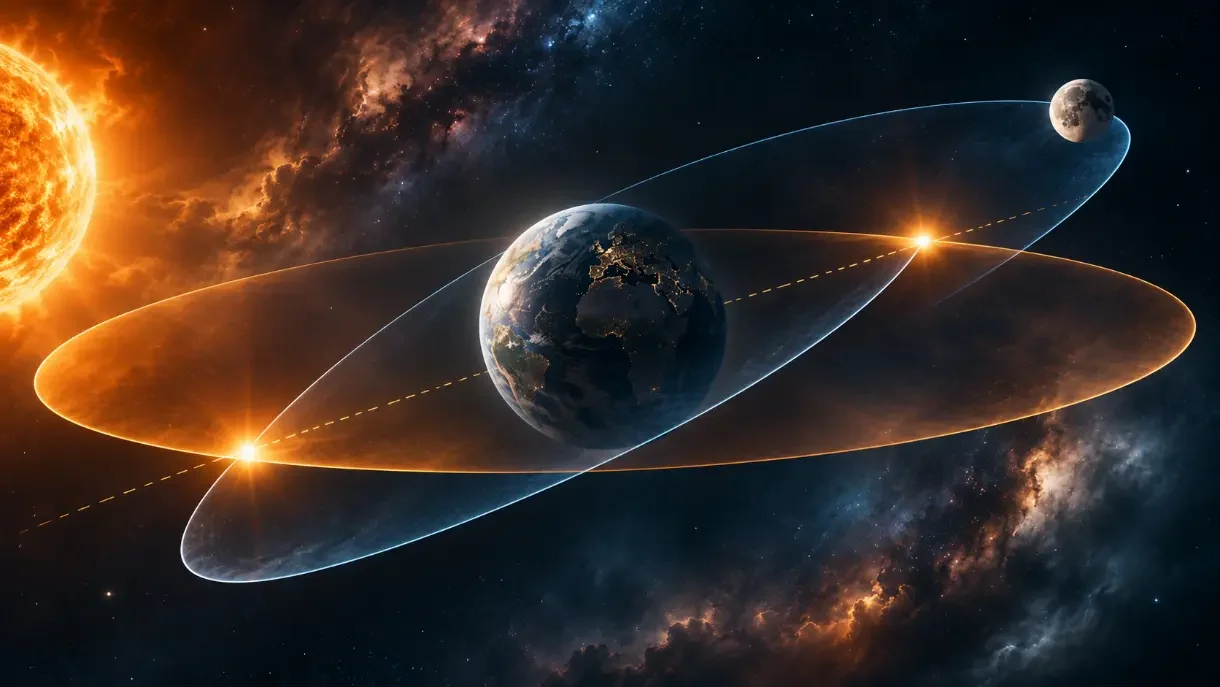
Rahu and Ketu aren't physical planets, yet they are among the most intriguing grahas in Vedic astrology. Discover the astronomy behind the lunar nodes, their connection to solar and lunar eclipses, and the ancient symbolism that makes them central to Jyotisha.