Mercury Meets the Sun on November 4: What Makes This Retrograde Different?
On November 4, 2026, retrograde Mercury meets the Sun in sidereal Libra, within Swati Nakshatra. Discover the astronomy behind this conjunction, how Jyotisha distinguishes retrograde motion from combustion, and why the event's meaning depends on your birth chart.
By Astrummo
On November 4, 2026, Mercury passes between Earth and the Sun during its retrograde journey. In Vedic astrology, the conjunction takes place in sidereal Libra, within Swati Nakshatra. Here's why this particular meeting deserves a closer look — and what it reveals about the difference between planetary motion and personal interpretation.
There is something curious about Mercury retrograde. For all the attention it receives, most people never get to see the planet doing anything unusual.
There is no dramatic change in the night sky. No sudden flash of light. No visible sign that Mercury has started moving backward.
And yet, on November 4, 2026, something quite remarkable happens.
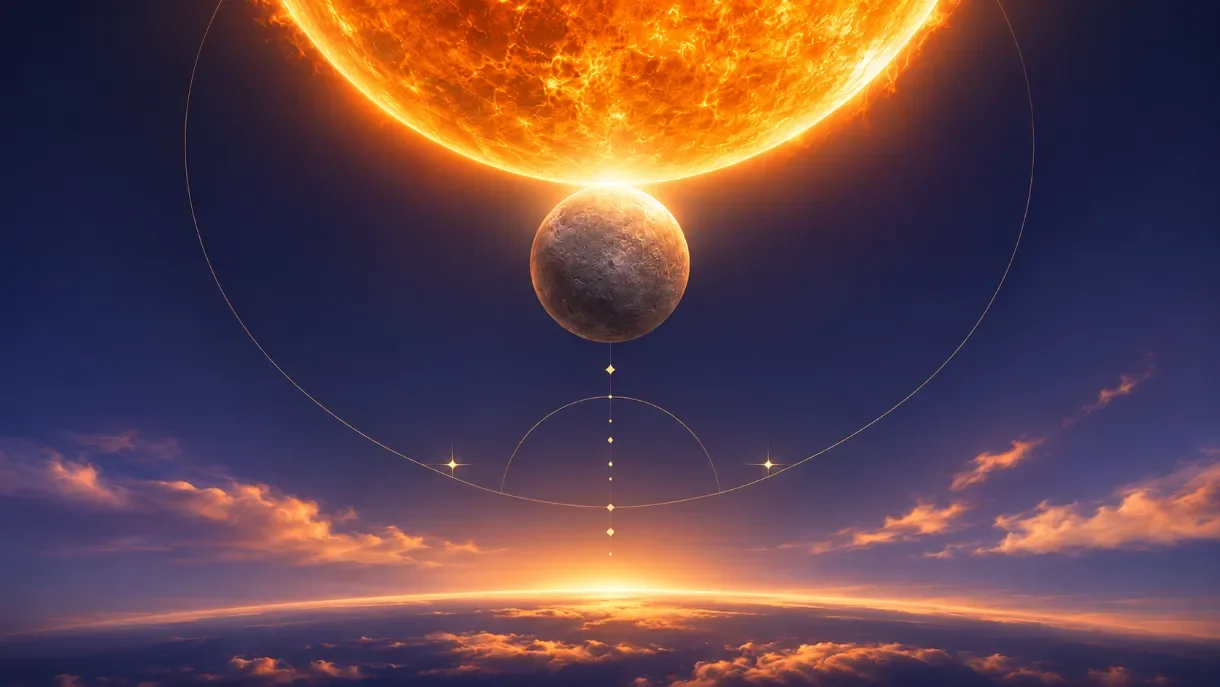
Mercury passes between Earth and the Sun, reaching the central conjunction of its current retrograde cycle. From our perspective, the two bodies line up in almost the same direction, and Mercury disappears into the Sun's overwhelming glare.
Astronomers call this an inferior conjunction.
For anyone following Vedic astrology, the same event has another layer of interest. Both the Sun and Mercury meet in sidereal Libra, within Swati Nakshatra, bringing together two grahas traditionally associated with authority, intelligence, judgment, communication, and the ability to make sense of the world.
But this is not an ordinary Sun–Mercury meeting.
Mercury is retrograde. It is also extremely close to the Sun, a condition Jyotisha examines through the traditional concept of combustion.
That creates an interesting question: how should an astrologer interpret a planet that is simultaneously retrograde, conjunct the Sun, and combust?
The answer is more nuanced than the familiar advice to avoid signing contracts or sending important messages.
What Actually Happens When Mercury Meets the Sun?
Mercury travels around the Sun in approximately 88 Earth days. Because it orbits closer to the Sun than Earth does, we never see it very far from the Sun in our sky.
Sometimes Mercury appears after sunset. At other times, it emerges shortly before sunrise.
Between those appearances, it periodically moves into the Sun's direction and becomes difficult or impossible to observe.
On November 4, Mercury reaches inferior conjunction. This means the planet is on the near side of its orbit, positioned broadly between Earth and the Sun.
The exact equal-ecliptic-longitude conjunction occurs at approximately 14:24 UTC.
Using the Lahiri sidereal zodiac, the Sun and Mercury meet at about 17°57′ Libra, within Swati Nakshatra.
Both planets occupy the same sidereal sign and have virtually identical ecliptic longitudes, although their ecliptic latitudes differ. Mercury therefore does not cross the visible solar disk in this event.
For observers on Earth, the conjunction is not something to watch through an ordinary telescope. Mercury is lost in the Sun's glare, and looking toward the Sun without proper solar equipment is dangerous.
The event is nevertheless significant in Mercury's orbital cycle.
Why Mercury appears to move backward
Mercury does not actually reverse its orbit around the Sun.
Retrograde motion is an apparent change in direction against the background of stars, produced by the changing positions and velocities of Earth and Mercury.
Imagine watching two vehicles travel along different curved roads. Depending on where you stand and how the vehicles move relative to each other, one may briefly appear to reverse direction against the distant landscape.
Mercury's retrograde movement is a more complicated astronomical version of this change in perspective.
Its current retrograde began on October 24 and ends on November 13, 2026.
The November 4 conjunction falls close to the middle of that interval. Afterward, Mercury gradually separates from the Sun's direction, eventually becoming visible again in the morning sky.
The sequence is entirely predictable through celestial mechanics.
The interesting part for Jyotisha begins when these astronomical positions are placed into the sidereal zodiac and interpreted through traditional planetary rules.
Why Libra and Swati matter
In the Lahiri zodiac used by Astrummo, the conjunction occurs in Libra, known in Sanskrit as Tula.
Libra is ruled by Venus and is traditionally associated with balance, agreements, exchange, relationships, proportion, and the negotiation of different interests.
Those themes are particularly relevant to Mercury.
Known as Budha in Jyotisha, Mercury is associated with speech, reasoning, calculation, commerce, writing, analysis, and the ability to distinguish one thing from another.
The Sun, or Surya, represents a different set of principles: authority, identity, leadership, vitality, and the capacity to direct one's life.
Their conjunction therefore brings two distinct forms of symbolism into the same region of the zodiac.
The Sun asks questions about purpose and authority. Mercury asks questions about information, understanding, and communication.
Libra introduces the matter of balance.
Traditionally, an astrologer might explore how personal conviction interacts with the willingness to listen, negotiate, or reconsider an established position.
But the Nakshatra adds another detail.
Swati extends from 6°40′ to 20°00′ sidereal Libra. Its presiding deity is Vayu, associated with wind, while its Vimshottari planetary ruler is Rahu.
Wind is an evocative image for Swati. It moves, adjusts, and responds to changing conditions.
In traditional interpretation, this Nakshatra is often associated with independence, adaptability, movement, and the ability to find one's way through uncertain circumstances.
Placed within Swati, the Sun–Mercury conjunction offers an interesting symbolic contrast: the desire for certainty meeting the need for flexibility.
A firm opinion may need another conversation. A decision may benefit from additional information. A familiar assumption may deserve closer examination.
These are themes suggested by the traditional symbolism, not predictions that a particular conversation or disagreement must occur.
Retrograde Mercury is not unusual by itself. Neither is a conjunction between Mercury and the Sun.
In fact, Mercury can never stray particularly far from the Sun as observed from Earth. Their proximity is a regular feature of its orbit.
What makes November 4 worth examining is the combination of conditions operating at once.
The conjunction occurs during Mercury's retrograde movement, in Libra, within Swati Nakshatra, while Venus — the ruler of Libra — is also retrograde.
Each condition contributes something different to the traditional interpretation.
Retrograde and combustion are not the same thing
This is one of the most important distinctions in the entire event.
In Jyotisha, retrograde motion is called Vakra. It describes a planet's apparent backward movement relative to its ordinary direction through the zodiac.
Combustion, commonly described through Asta or Astangata, concerns a planet's closeness to the Sun.
These are separate conditions.
A planet can be retrograde without being combust, or combust without being retrograde. Mercury can also experience both simultaneously, as it does around this conjunction.
Traditional combustion rules commonly use an angular separation of approximately 14° for direct Mercury and 12° for retrograde Mercury, although textual interpretations and practical rules vary between schools.
At the exact November 4 conjunction, the separation in ecliptic longitude is effectively zero.
Mercury therefore falls well within the conventional combustion range.
In classical interpretation, combustion may limit a planet's ability to express its significations independently. But it should not automatically be translated into a prediction of poor communication, mistakes, or personal difficulties.
A complete reading must consider the planet's sign, house rulership, strength, associations, and wider chart conditions.
The Sun itself is also in Libra, traditionally its sign of debilitation. Yet even this should not be reduced to a blanket negative judgment. Its exact degree and other strength factors remain relevant.
The point is that several different rules are operating together. None should be used in isolation.
What about Budha–Aditya Yoga?
You may have encountered the term Budha–Aditya Yoga, a traditional Sun–Mercury combination commonly associated with intellect, learning, communication, and administrative ability.
It is often described when the Sun and Mercury occupy the same sign or house in a natal chart.
But the November 4 transit should not be advertised as a powerful Budha–Aditya Yoga for everyone.
A passing conjunction is not the same as a permanent natal configuration.
Furthermore, Mercury's extreme proximity to the Sun raises the separate question of combustion.
Classical and later interpretive traditions differ in how these conditions should be weighed. The mere presence of Sun and Mercury together is not enough to establish an exceptional result.
That is why a professional Jyotisha reading examines the relationship rather than assigning a dramatic label.
The overlooked Venus connection
There is one more reason this November is interesting.
Both the Sun and Mercury are in Libra, a sign ruled by Venus. Venus itself is undergoing retrograde motion during this period.
In Jyotisha, the ruler of a sign matters when evaluating the planets occupying it.
This does not mean that Venus controls everything happening to Mercury. It means the condition of the sign's ruler is one of the factors an astrologer considers.
With Mercury associated with communication and Venus associated with relationships, values, and harmony, the combination offers an especially natural subject for reflection.
How do we communicate what matters to us?
Are we making decisions because they are well considered, or because we want agreement?
Can we change an opinion without treating the change as a personal defeat?
These questions connect the traditional symbolism of Mercury, Venus, and Libra without inventing specific outcomes.
This is where the distinction between general astrology and personalized Jyotisha becomes particularly important.
At a given moment, the Sun and Mercury occupy the same calculated celestial positions for everyone using the same geocentric zodiac reference.
But their placement within a natal house framework differs.
Someone with Libra rising may traditionally examine the conjunction in relation to first-house themes such as personal direction and self-presentation.
For someone with Aquarius rising, Libra is the ninth house in a whole-sign chart, associated with higher learning, teachers, beliefs, and broader perspectives.
For someone with Scorpio rising, Libra is the twelfth house, traditionally associated with retreat, expenditure, distant places, and certain forms of private or spiritual activity.
The event is the same. The house context changes.
And this is not the end of the calculation. A serious interpretation would also examine the natal Sun and Mercury, their house rulerships, the current Vimshottari Dasha periods, and other relevant transits.
A broad statement such as “Mercury retrograde will bring an important message” does not establish any of those personal conditions.
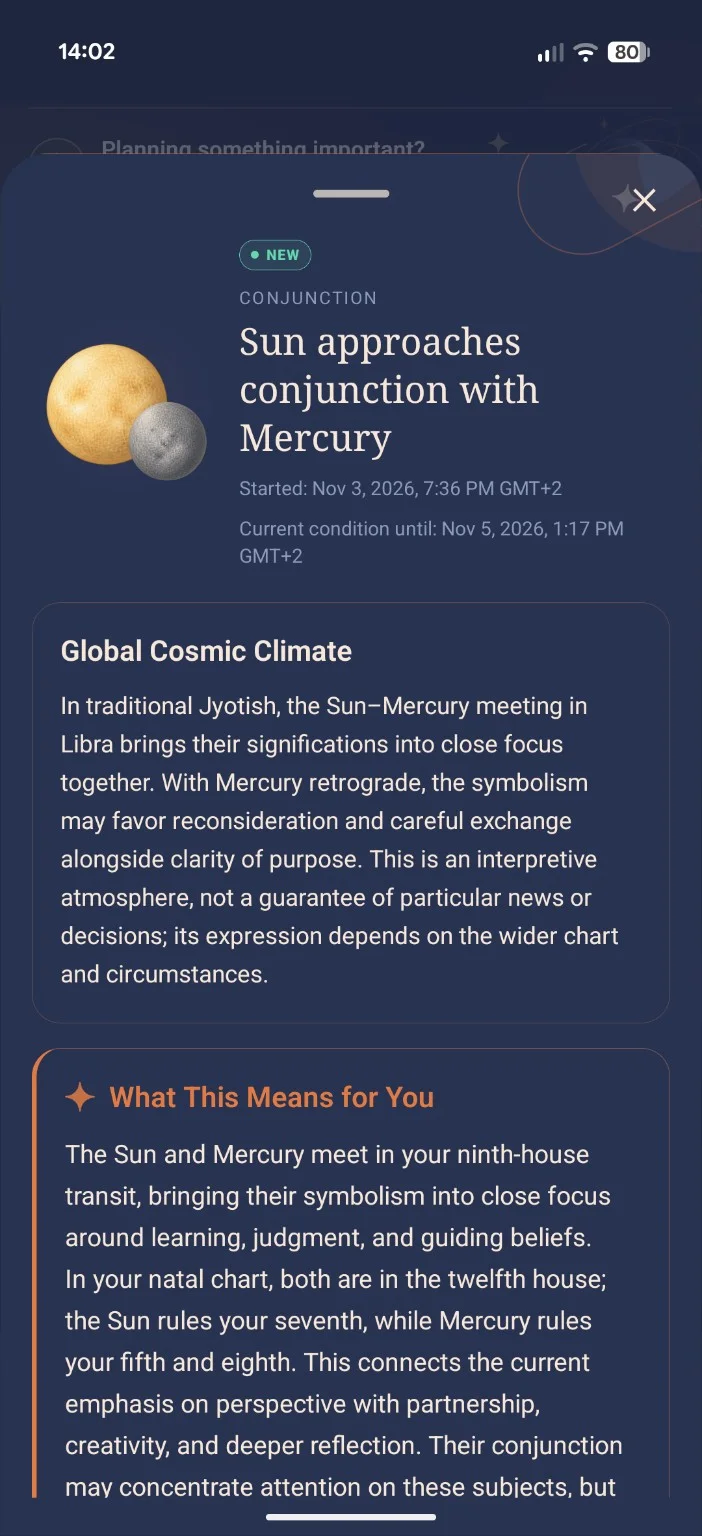
Astrummo's Cosmic Events Feed presents the November 2026 Sun–Mercury conjunction alongside a birth-chart-specific interpretation. The personalized example shown reflects one natal chart and is not a universal forecast.
The screenshot above from the Astrummo app illustrates this distinction particularly well.
The Global Cosmic Climate describes the traditional symbolism of the conjunction. The personalized section goes further, connecting the event to the individual's natal houses and planetary rulerships.
That is the difference between identifying a celestial event and interpreting it within a particular chart.
For readers new to these concepts, How to Read Your Vedic Birth Chart explains how the Lagna, house placements, and planetary rulers fit together.
What should you actually do with this information?
Perhaps the most useful response to a Mercury retrograde is not to fear it.
A calendar date does not require you to stop communicating, postpone every agreement, or assume that technology will fail.
If you are working through an important decision, however, Mercury's traditional symbolism can provide a useful reason to examine how you are approaching it.
Have you understood the other person's position? Are important details missing? Is the problem really unclear information, or are two people working from different expectations?
November's conjunction in Libra and Swati offers a particularly thoughtful framework for considering these questions.
You might discover that a conversation needs greater precision. Or that listening is more useful than preparing another argument.
There is no need to turn either possibility into a prophecy.
Sometimes the most valuable insight is simply recognizing that confidence and clarity are not always the same thing.
When Mercury Moves Forward Again
Mercury's retrograde period ends on November 13, but its journey does not abruptly reset on that date.
Its apparent motion slows near the station, changes direction, and gradually increases again. The planet also moves farther from the Sun's glare, becoming more accessible to morning observers later in November.
This is an astronomical progression rather than a switch that suddenly makes every decision favorable.
In traditional Jyotisha, the significance of the transit still depends on the wider chart and the relevant timing methods.
Readers who want to understand that longer personal timing framework can explore What Is Vimshottari Dasha?.
The November 4 conjunction is a useful reminder of why the sky is more interesting than a collection of isolated planetary labels.
Mercury is retrograde. It meets the Sun. Both occupy Swati in Libra, while Venus, the sign's ruler, is also retrograde.
Each fact adds context, but none supplies a complete personal prediction.
And perhaps that is the most constructive interpretation of this particular Mercury story.
Being thoughtful does not mean never changing your mind. Sometimes it means understanding why you need to.
Frequently Asked Questions
What happens on November 4, 2026?
Mercury reaches inferior conjunction with the Sun at approximately 14:24 UTC. Both occupy about 17°57′ sidereal Libra using Lahiri ayanamsa.
Is Mercury retrograde during the conjunction?
Yes. Mercury's retrograde period runs from October 24 to November 13, 2026.
Which Nakshatra contains the conjunction?
Swati Nakshatra, traditionally associated with Vayu and ruled by Rahu in the Vimshottari sequence.
Is Mercury combust on November 4?
Yes, under conventional Jyotisha combustion-distance rules. At exact conjunction, its longitudinal separation from the Sun approaches zero.
Can the conjunction be seen from Earth?
No. Mercury is lost in the Sun's glare. This is not a visible transit of Mercury across the solar disk.
Does the conjunction affect everyone in the same way?
Not within a personalized Jyotisha framework. Natal houses, planetary rulerships, other planetary conditions, and operating Dashas all contribute to the traditional interpretation.
Explore the November Conjunction with Astrummo
Astrummo connects current planetary positions with individual birth-chart calculations using Swiss Ephemeris, Lahiri sidereal positions, and traditional Jyotisha frameworks.
Its Cosmic Events Feed provides an overview of notable planetary movements, while personalized readings examine how those events connect with a user's natal chart.
One useful question to explore in Ask Astrummo is:
“Which houses does the November 4 Sun–Mercury conjunction activate in my birth chart, and how does its significance relate to my current Dasha?”
The goal is to move beyond a generic description and understand the actual astrological reasoning.
Your Sky. Your Story.
Calculation Methodology and References
Event calculations use Swiss Ephemeris 2.10.03, the Lahiri sidereal zodiac, geocentric ecliptic longitudes, and UTC. The independent verification used the Moshier ephemeris fallback rather than Astrummo's licensed production files.
The equal-longitude conjunction occurs at approximately 14:24 UTC on November 4, 2026, near 17°57′ sidereal Libra, in Swati Nakshatra. Times may differ slightly between astronomical sources depending on the conjunction definition and ephemeris model.
Venus reaches its brightest point of 2026 in late November, blazing in the dawn sky as the Morning Star. In Vedic astrology, the event becomes even more intriguing: Venus shines from Libra, its own sign, within Chitra Nakshatra. Explore what makes this November special through astronomy, Jyotisha, and your birth chart.
Mars and Jupiter meet on November 16, 2026, in a remarkable celestial encounter. In Vedic astrology, their conjunction in Magha Nakshatra—close to Ketu—adds a deeper story of courage, wisdom, leadership, and ancestral legacy. Explore the science, Jyotisha calculations, and what this transit may mean for your birth chart.
Two planets traditionally linked with love and communication are moving retrograde at the same time. Explore November 2026 through the lens of Vedic astrology, from Libra and Virgo to the deeper meaning of your birth chart.
Discover your November Power Score, the month's defining themes, and how the major planetary transits may be interpreted for your Vedic Ascendant (Lagna). Grab a coffee. This one's a long read.
The November 24, 2026 Full Moon brings a powerful combination of traditional Vedic symbolism: an exalted Moon in Taurus, Krittika Nakshatra, and the sacred observance of Kartik Purnima. Discover its spiritual significance, what makes this supermoon special, and how its meaning may differ according to your personal birth chart.