27 October 2026 · Astrummo
When Will I Get Married? How Vedic Astrology Reads Marriage Timing
Discover how Vedic astrology examines marriage timing through the 7th house, Navamsa (D9), Vimshottari Dasha and planetary transits.
The November 24, 2026 Full Moon brings a powerful combination of traditional Vedic symbolism: an exalted Moon in Taurus, Krittika Nakshatra, and the sacred observance of Kartik Purnima. Discover its spiritual significance, what makes this supermoon special, and how its meaning may differ according to your personal birth chart.
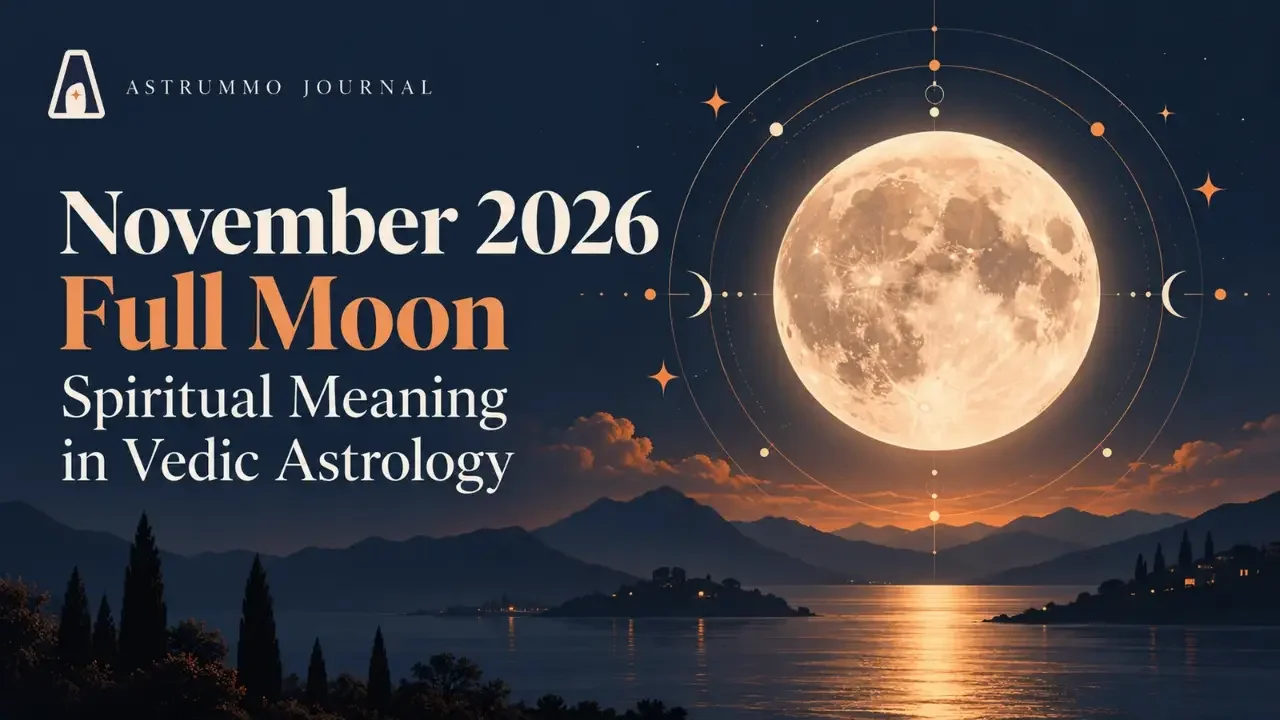
The November 2026 Full Moon is more than another date on the lunar calendar. On November 24, the Moon reaches its full phase close to Earth, creating a supermoon. In Vedic astrology, the same moment falls in sidereal Taurus, in Krittika Nakshatra, and coincides with Kartik Purnima—a day of deep religious and cultural significance in several Hindu traditions.
That combination makes this full moon especially interesting: a bright astronomical event, a lunar mansion traditionally associated with purification and discernment, and a festival connected with light, devotion, and generosity. But what does any of it mean for you?
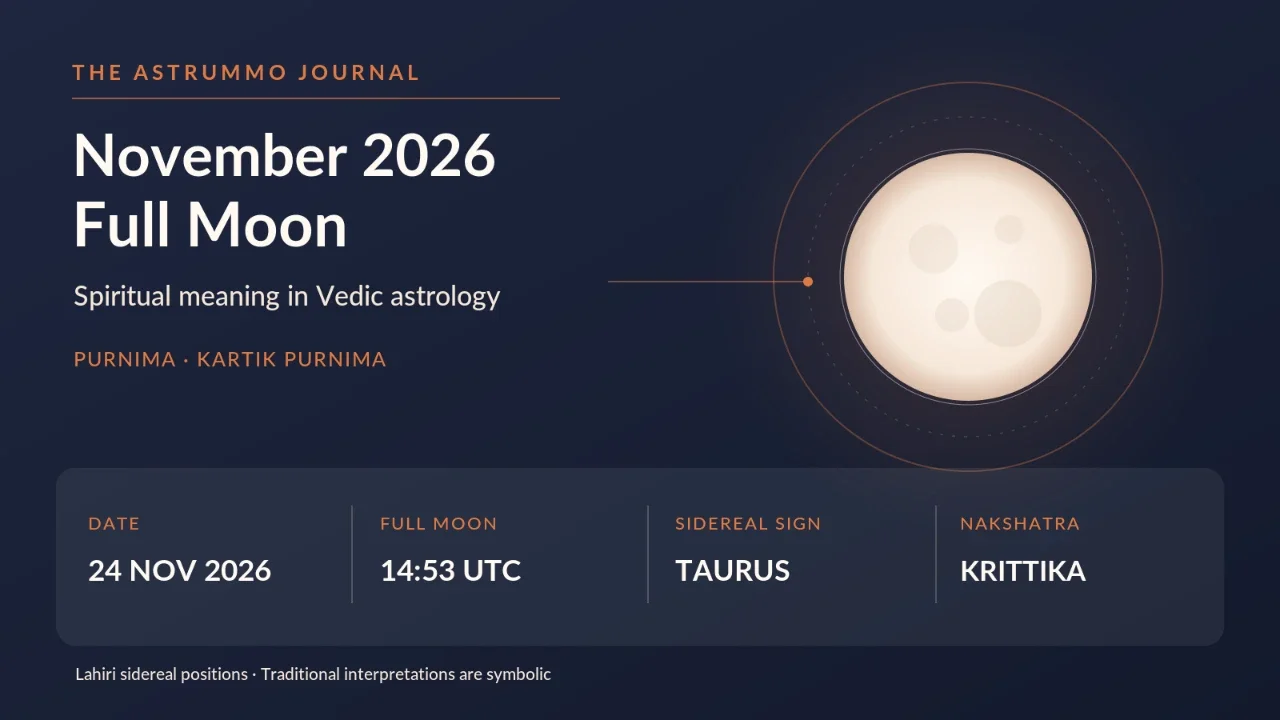
The U.S. Naval Observatory gives the exact full-moon time as November 24, 2026, at 14:53 UTC. The traditional meaning is another question—one best approached through the Panchanga, the sidereal zodiac, and your individual birth chart rather than a universal prediction.
Detail | November 2026 Full Moon |
|---|---|
Exact astronomical phase | Tuesday, November 24, 2026, 14:53 UTC |
New York / London | 9:53 a.m. EST / 2:53 p.m. GMT |
India | 8:23 p.m. IST |
Vedic Moon sign | Taurus (Vrishabha), Lahiri sidereal zodiac |
Lunar mansion at the exact phase | Krittika Nakshatra, fourth pada |
Vedic Sun sign | Scorpio (Vrishchika) |
Traditional lunar observance | Kartik Purnima |
Astronomical distinction | A supermoon, according to NASA |
The full Moon can be enjoyed during the surrounding evenings, even when the precise astronomical moment occurs in daylight locally. Moonrise and visibility depend on your location and weather.
A supermoon occurs when the full Moon happens relatively close to the Moon's nearest distance to Earth. NASA includes November 24, 2026, among its upcoming supermoons. The term is popular rather than a formal astronomical classification, and an unusually large-looking Moon near the horizon may also involve the familiar Moon illusion.
A supermoon does not establish a stronger spiritual or psychological effect. Its proximity can affect tides, but claims that it must trigger emotional crises, breakthroughs, or dramatic personal events are not scientifically demonstrated.
In Jyotish and the traditional Hindu lunar calendar, Purnima refers to the full-moon tithi—the fifteenth lunar day of the waxing half of the cycle, or Shukla Paksha. A tithi is calculated from the angular separation of the Sun and Moon; it is not simply a fixed 24-hour calendar day.
This is an important distinction. The astronomical full Moon happens at a single instant, while the Purnima tithi spans an interval leading up to that moment. For New Delhi in 2026, Drik Panchang places the Kartik Purnima tithi from about 11:42 p.m. IST on November 23 to 8:23 p.m. IST on November 24. The exact astronomical full-moon moment occurs near the end of that interval.
Traditionally, Purnima can be associated with prayer, contemplation, charitable giving, fasting, or other religious observances, depending on the community and family. These practices should not be confused with modern, generic promises that a full moon will manifest a desired outcome.
November 24, 2026, is also Kartik Purnima, associated in different traditions with sacred bathing, offerings of lamps, generosity, and worship. In Varanasi, Dev Deepawali is especially known for the illumination of the ghats along the Ganges. The observance is also connected in Hindu tradition with Tripurari Purnima and narratives concerning Shiva. Customs and festival timing vary by region, temple, and calendar convention.
The image of lighting a lamp is a meaningful way to understand the day's symbolism: cultivating clarity, reverence, and generosity rather than demanding an instant answer from the sky.
In the Lahiri sidereal zodiac used by Astrummo, the Moon occupies Taurus (Vrishabha) at the moment of the November 24 full Moon, opposite the Sun in Scorpio (Vrishchika).
Taurus is traditionally the Moon's sign of exaltation in Jyotish. It is associated with steadiness, nourishment, physical security, continuity, and the ability to sustain what matters. Yet saying “the Moon is in its exaltation sign” is not the same as declaring it extraordinarily strong in every person's chart. Its exact degree, Nakshatra, aspects, house placement, and other conditions still matter.
Scorpio, the opposite sign, is linked in traditional astrology with deeper investigation, vulnerability, persistence, and change. Together, this Taurus–Scorpio axis provides a reflective contrast: What offers stability, and what needs to transform? What are you holding onto for security, and what deserves closer examination?
These are themes for contemplation, not predictions that something must be lost, gained, or revealed on November 24.
The most distinctive feature of this full Moon is its Krittika Nakshatra placement. Krittika extends from late sidereal Aries into the first 10 degrees of Taurus and is traditionally associated with Agni, fire, and symbols such as a blade. Its planetary ruler in the Vimshottari sequence is the Sun.
Within this symbolism, fire is not simply destruction. It can represent refinement: separating what is useful from what no longer serves a purpose. Krittika's blade suggests precision, honesty, and discernment—but also the danger of becoming unnecessarily harsh.
For November's full Moon, that invites a thoughtful question: Can you be honest about what needs to change without becoming unkind to yourself or others? The Taurus placement adds an interesting counterpoint. Discernment is most constructive when it supports a steadier foundation, not when it becomes impulsive criticism.
At the exact full-moon moment, the Moon is in Krittika's fourth pada. It moves into Rohini later that night in India, at approximately 11:25 p.m. IST according to Lahiri-based daily Panchanga calculations. So a guide describing the full Moon itself as “in Rohini” would confuse the exact event with the Moon's later movement. Read more in The Complete Guide to All 27 Moon Nakshatras.
The same sky is visible to everyone, but a Jyotish interpretation does not assign the same life event to everyone. To understand this full Moon in personal context, start with three layers.
First, locate Taurus and Scorpio in your natal chart. For someone with Taurus rising, the full Moon falls along the first–seventh-house axis in a whole-sign chart, a traditional framework for reflecting on the relationship between self and partnership. For someone with Aries rising, it activates the second–eighth-house axis, associated with resources, family matters, shared commitments, and change. Neither example, by itself, predicts marriage, separation, financial gain, or loss.
Second, examine your natal Moon and birth Nakshatra. Your birth Nakshatra stays fixed even as the transiting Moon changes Nakshatras roughly once a day. Its relationship with the current Krittika transit may be evaluated through traditional methods such as Tara Bala, but a single Nakshatra comparison is not a complete reading. Astrummo explains the distinction in Does Nakshatra Change Every Day?.
Third, consider your planetary periods and supporting conditions. In Parashari Jyotish, relevant Vimshottari Dasha and Antardasha periods help establish which natal themes are emphasized over time. Planetary strength, rulership, and relationships matter too. An emotionally evocative Full Moon can be an interesting symbolic marker without being the dominant influence in a person's overall chart. See What Is Vimshottari Dasha? for how this timing system works.
The useful question is not “Will this full Moon change my life?” but “Which natal houses and planets does this transit connect with, and how significant is that connection in my wider chart?”
You do not have to follow an elaborate ritual to make the evening meaningful. If you belong to a religious tradition that observes Kartik Purnima, its established practices and your local community's calendar should take precedence over generic internet suggestions.
For a personal, nonreligious reflection, consider a simple practice:
Notice the sky. Step outside when the Moon is visible, if weather and circumstances allow.
Reflect on stability. Write down one habit, relationship, or commitment that genuinely supports your life.
Practice discernment. Name one pattern you would like to approach more honestly or gently.
Choose an ordinary act of generosity. Offer help, share time, or donate if it suits your means and values.
Avoid dramatic deadlines. You do not have to make a major decision because of a full Moon.
In Jyotish, the Full Moon's broader symbolism does not automatically make every hour auspicious for weddings, business launches, travel, or other activities. Traditional timing judgments consider the complete Panchanga and individual context. Our guide to finding the best days in Vedic astrology explains why.
Both signs may appear in online forecasts because they use different zodiacs. Western tropical astrology places the November 24 full Moon in Gemini, while Vedic sidereal astrology using Lahiri ayanamsa places it in Taurus. Astrummo uses the latter. This difference is not a change in the Moon's actual position; it reflects different reference systems for naming zodiac signs.
You may also see “Beaver Moon,” a seasonal name in North American naming traditions. That name is not a synonym for Kartik Purnima, which belongs to a different religious and calendrical context.
Tuesday, November 24, 2026, at 14:53 UTC (8:23 p.m. in India, 9:53 a.m. in New York).
Yes. NASA lists the November 24 full Moon among the 2026 supermoons. That refers to the Moon's relative proximity to Earth, not a proven increase in spiritual influence.
Krittika Nakshatra, fourth pada, in sidereal Taurus. The Moon enters Rohini later in the day, so the distinction depends on the time being discussed.
Neither label can be assigned universally. Purnima, Krittika, the Taurus placement, the wider Panchanga, and each person's natal chart must be considered separately. Traditional symbolism is not a guarantee of an outcome.
There is no established scientific basis for saying that a particular Full Moon causes everyone to experience a specific emotional response. Jyotish offers an interpretive and cultural framework, not a scientifically verified forecast of personal events.
An astronomical calendar tells you when the full Moon happens. A Vedic calendar adds which tithi, sign, and Nakshatra are involved. Your birth chart is what makes the traditional interpretation personal.
Astrummo connects current celestial positions with your natal chart through the Lahiri sidereal zodiac, Swiss Ephemeris calculations, and traditional Jyotish frameworks. Explore the Cosmic Events Feed, Personal Daily Reading, and Astrology Calendar, or use Ask Astrummo to investigate the Taurus–Scorpio axis in your own chart.
Try asking: “What does the November 24, 2026, Full Moon in Krittika mean for my birth chart, and which factors support that interpretation?”
The aim is not to turn a beautiful night sky into an alarming prediction. It is to approach an old tradition with curiosity, precision, and perspective.
Astrology is a symbolic and cultural interpretive tradition. It is not a scientifically established method for predicting personal outcomes.
27 October 2026 · Astrummo
Discover how Vedic astrology examines marriage timing through the 7th house, Navamsa (D9), Vimshottari Dasha and planetary transits.
25 October 2026 · Astrummo
Explore 7 major cosmic events in November 2026, from Mercury and Venus turning direct to the Full Moon, and discover their meaning in Vedic astrology.
23 October 2026 · Astrummo
Discover the 2027 Vedic astrology forecast: Jupiter and Saturn transits, Rahu-Ketu, retrogrades and eclipses explained using the Lahiri sidereal zodiac.
22 October 2026 · Astrummo
Discover the best Nakshatras for starting projects, travel, learning and long-term plans. Learn how Vedic astrology evaluates auspicious timing.