November 2026 Brings a Striking Mars–Jupiter Conjunction: What Does It Mean?
Mars and Jupiter meet on November 16, 2026, in a remarkable celestial encounter. In Vedic astrology, their conjunction in Magha Nakshatra—close to Ketu—adds a deeper story of courage, wisdom, leadership, and ancestral legacy. Explore the science, Jyotisha calculations, and what this transit may mean for your birth chart.
By Astrummo · Updated 2 November 2026
On November 16, Mars and Jupiter will appear remarkably close in the predawn sky. But in Vedic astrology, their meeting reveals something more intricate: a conjunction in sidereal Leo, within Magha Nakshatra, and remarkably close to Ketu. Here's what the astronomical event means, how classical Jyotisha interprets it, and why your birth chart changes the picture.
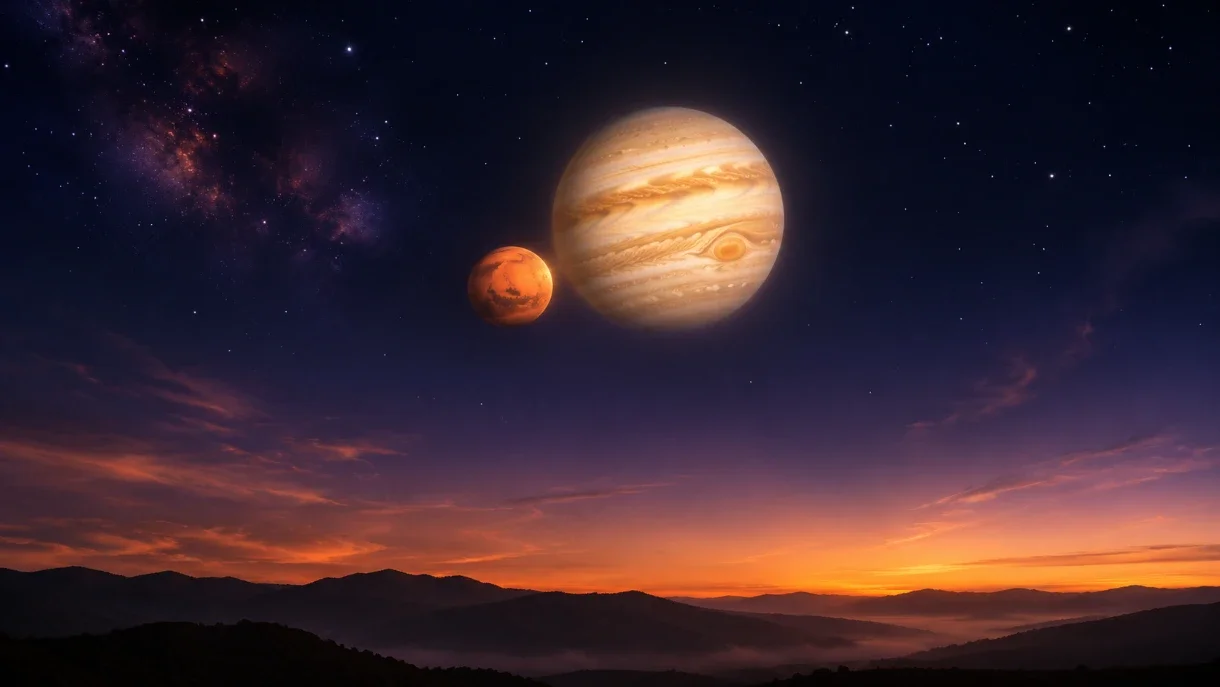
On November 16, 2026, two of the brightest and most recognizable planets in the night sky will appear almost side by side.
Jupiter, the brilliant giant, and Mars, identifiable by its warmer reddish-orange appearance, will be separated by little more than one degree. Under suitable viewing conditions, both will be visible without a telescope.
Astronomically, the event is a planetary conjunction: a meeting in apparent position as observed from Earth. The planets themselves remain separated by enormous distances in space.
But the Vedic astrological interpretation becomes considerably more interesting when we look beyond the visible sky.
Using the Lahiri sidereal zodiac, Mars and Jupiter meet at approximately 1°39′ Leo (Simha), inside Magha Nakshatra, first pada.
And there is a third participant.
Ketu, the descending lunar node, occupies the same part of the zodiac, less than one sidereal degree away.
That makes this encounter more than a straightforward Mars–Jupiter conjunction in traditional Jyotisha. It brings together planetary symbolism associated with initiative, wisdom, authority, inheritance, detachment, and the relationship between worldly ambition and personal principles.
To understand why, we need to begin with the mathematics.
Mars and Jupiter Conjunction: November 16, 2026
The conjunction occurs on Monday, November 16.
The Royal Observatory Greenwich identifies it as a notable event in the November night sky, with the planets passing approximately 1.2 degrees apart. Both should be visible from many locations during the early morning hours.
That apparent separation is roughly twice the angular diameter of the Full Moon.
Despite looking close together, Mars and Jupiter are not physically approaching each other. Their apparent meeting is the result of orbital geometry and Earth's viewpoint.
Key astronomical and Vedic details
Detail
November 2026 event
Date
Monday, November 16, 2026
Exact equal-longitude event
Approximately 06:24 UTC
India time
Approximately 11:54 a.m. IST
Geocentric sidereal longitude
Approximately 121°39′
Vedic zodiac sign
Leo (Simha), 1°39′
Nakshatra
Magha
Pada
First pada
Nakshatra ruler
Ketu
Sign ruler
Sun (Surya)
Mars motion
Direct
Jupiter motion
Direct
Approximate angular separation in the sky
1.2°
True Ketu longitude
Approximately 0°55′ Leo
Jupiter–Ketu longitudinal separation
Approximately 0°44′
The sidereal positions use Lahiri ayanamsa and geocentric ecliptic longitude. The visible angular separation is a different astronomical measurement from the difference in zodiacal longitude.
The distinction between those two measurements matters.
Two planets can share almost exactly the same ecliptic longitude without appearing perfectly superimposed in the sky. Their ecliptic latitudes can differ.
For astronomical observers, the relevant measurement is the apparent distance between the planets on the celestial sphere.
For a conventional Vedic sign-based conjunction, their sidereal longitudes and sign placements are central to the analysis.
Why the dates sometimes differ between astronomy websites
Some calendars list November 15, while others emphasize November 16.
This is partly because different services use different definitions of conjunction, including equal right ascension, equal ecliptic longitude, and the moment of minimum apparent angular separation.
Local time zones also affect the displayed calendar date.
The closest visible approach occurs around 02:04 UTC on November 16, while an equal-longitude conjunction is calculated later that morning.
In countries west of Greenwich, part of the observing opportunity falls on the night of November 15.
For skywatchers, the simplest advice is to look during the predawn hours around November 15–17, with local conditions determining the best opportunity.
How to see Mars and Jupiter
Look toward the eastern or southeastern part of the sky during the late-night and early-morning hours, depending on your latitude and observing location.
Jupiter will be noticeably brighter. Mars will appear fainter, with a distinct orange or reddish tone.
The pair will be visible in the region of the constellation Leo.
A telescope is unnecessary to appreciate the conjunction. Binoculars can make the view particularly rewarding, although individual visibility depends on weather, light pollution, and the height of the planets above the horizon.
It is worth distinguishing astronomical constellations from astrological signs.
The planets appear against the background of Leo in the sky, while their placement in a defined astrological zodiac depends on the reference system being used.
The Vedic Astrology Meaning of Mars and Jupiter
In Jyotisha, Mars is known as Mangala or Kuja, while Jupiter is known as Guru or Brihaspati.
They represent different but potentially complementary principles.
Mars is traditionally associated with initiative, courage, conflict, energy, technical ability, assertion, and the capacity to act.
Jupiter is associated with wisdom, teaching, counsel, ethical principles, religious learning, expansion, and the transmission of knowledge.
One represents the capacity to move decisively. The other is associated with understanding why, when, and toward what purpose action should be directed.
When action meets wisdom
The most useful traditional interpretation of a Mars–Jupiter conjunction concerns the relationship between conviction and execution.
Mars without sufficient judgment can symbolize impulsiveness, unnecessary confrontation, or a tendency to act before considering consequences.
Jupiter without corresponding action can symbolize excessive theorizing, moral certainty without practical application, or ambitions that remain abstract.
When the two occupy the same region of the zodiac, astrologers may examine how initiative and principles interact.
The conjunction can therefore be interpreted through questions such as:
Is confidence supported by preparation?
Are important decisions being made from conviction or impatience?
Does personal ambition serve a meaningful purpose?
Is the desire to lead accompanied by sufficient judgment?
These are interpretive themes within astrology, not scientifically established effects of planetary positions.
A conjunction does not guarantee courage, financial success, leadership, or spiritual progress.
Its traditional significance depends on the wider chart.
Is this Guru Mangala Yoga?
A Jupiter–Mars relationship is sometimes discussed under the name Guru Mangala Yoga, but traditional and modern schools differ in how broadly they define its formation and strength.
A transiting conjunction should not automatically be presented as a powerful natal yoga.
In classical chart interpretation, the significance of Mars and Jupiter depends on factors such as their house rulerships, dignity, aspects, associations, planetary strength, and relevant operating periods.
A temporary transit does not create a permanent natal configuration.
For Astrummo, that distinction is essential: a planetary meeting in the sky is a timing event, not a substitute for examining the individual's birth chart.
Why Leo Changes the Interpretation
The conjunction takes place in sidereal Leo, or Simha.
Leo is ruled by the Sun, a planet traditionally associated with sovereignty, authority, identity, recognition, and leadership.
Mars and Jupiter are both traditionally friendly toward the Sun in the Parashari framework.
This gives the conjunction an interpretive environment different from what it would have in a sign ruled by Venus, Mercury, or Saturn.
In traditional Jyotisha, the symbolism of Leo can direct attention toward responsibility, public roles, personal authority, family legacy, and the use of influence.
But sign placement alone is insufficient to declare the transit favorable.
An individual's Ascendant determines which natal house Leo occupies, while the conditions of the planets and the wider chart determine how those placements are traditionally interpreted.
A question about leadership
One possible reading of Mars and Jupiter in Leo is the distinction between power and responsible leadership.
Mars can symbolize the willingness to act.
Jupiter can symbolize the principles guiding action.
Leo introduces the theme of authority.
Taken together, the configuration invites reflection on whether confidence is accompanied by wisdom, and whether leadership is driven primarily by status or by responsibility.
Magha Nakshatra: The Connection to Ancestors and Legacy
The conjunction occurs in Magha Nakshatra.
Magha spans the first 13°20′ of sidereal Leo. Both Mars and Jupiter are located in its first pada at the conjunction.
In the traditional Nakshatra system, Magha is associated with the Pitris, or ancestral beings, and its symbolism includes lineage, inherited status, ceremonial authority, and the throne.
Magha's central symbolism should not be reduced simply to ambition or personal success.
It also concerns the responsibilities, traditions, and identities inherited from earlier generations.
The meaning of inherited authority
Magha can be explored through a series of questions:
What have you inherited that deserves preservation?
Which obligations are meaningful, and which are maintained only because they are familiar?
Does inherited authority carry responsibility, or is it being used simply to claim status?
The combination of Mars and Jupiter in Magha symbolically brings action and principle into the territory of heritage and leadership.
Mars supplies the traditional symbolism of initiative.
Jupiter introduces counsel, wisdom, and established teachings.
Magha provides the setting of ancestry, authority, and legacy.
But the event includes another factor that makes it more distinctive.
The Third Participant: Ketu
A particularly important detail of the November 16 configuration is the position of Ketu.
Ketu is not a physical planet. It represents the descending intersection of the Moon's orbital plane with the ecliptic: the south lunar node.
In traditional Jyotisha, Ketu is frequently associated with detachment, severance, introspection, renunciation, and spiritual inquiry.
Its symbolism varies by context and interpretive school.
Astrummo uses the True Node calculation mode, which places Ketu at approximately 0°55′ sidereal Leo at the Mars–Jupiter conjunction.
Mars and Jupiter meet near 1°39′ Leo.
Their longitudinal separation from Ketu is therefore approximately 0°44′.
This is a genuinely close relationship in zodiacal longitude.
Why the proximity matters
All three occupy the first pada of Magha Nakshatra.
That is especially notable because Magha itself is ruled by Ketu.
The resulting traditional configuration includes:
Mars + Jupiter + Ketu in Magha, within the Sun-ruled sign of Leo.
An interpretation limited to Mars and Jupiter would overlook a significant part of the classical chart context.
Ketu does not automatically make the event negative, dangerous, or spiritually transformative.
But its involvement complicates a simplistic prediction that Mars and Jupiter together must produce confidence, wealth, or success.
The conjunction may instead be interpreted through the tension between ambition and detachment, practical action and inherited principles, or public recognition and internal purpose.
In symbolic terms, the question becomes:
What is worth pursuing, and what are you pursuing merely because you have been taught to value it?
This is a traditional reflective interpretation, not a prediction that everyone will experience the same event.
What about Rahu?
Rahu, the ascending lunar node, is positioned opposite Ketu by definition.
With Ketu in early sidereal Leo, Rahu occupies early sidereal Aquarius.
This places the nodal axis across Leo and Aquarius.
The broader configuration therefore raises traditional themes involving personal authority, collective interests, belonging, and the relationship between individual recognition and wider systems.
However, the involvement of the lunar nodes should not be interpreted as an eclipse.
There is no solar or lunar eclipse associated with the November 16 Mars–Jupiter conjunction.
The presence of planets near a lunar node is not enough to produce an eclipse, which requires a suitable Sun–Moon alignment.
What Classical Parashari Rules Add
A serious Jyotisha interpretation should not stop after identifying the sign and Nakshatra.
Several additional layers matter.
1. Planetary dignity
Mars and Jupiter both occupy Leo, a sign ruled by the Sun.
According to the standard natural planetary friendship scheme, the Sun is friendly to both.
This provides a conventional dignity consideration, but not a complete assessment of planetary strength.
Planetary strength is evaluated through more than sign friendship. Shadbala, house placement, relevant aspects, association with other grahas, and individual chart conditions may all matter.
A transit position alone cannot establish a natal planet's Shadbala.
2. Graha Drishti: Classical planetary aspects
In the standard Parashari planetary aspect framework, Mars has special aspects to the fourth and eighth houses from its position, in addition to the seventh.
Jupiter has special aspects to the fifth and ninth, in addition to the seventh.
With both planets in Leo, the sign-based aspect patterns are:
Planet
Aspect
Sign receiving aspect
Mars
4th
Scorpio
Mars
7th
Aquarius
Mars
8th
Pisces
Jupiter
5th
Sagittarius
Jupiter
7th
Aquarius
Jupiter
9th
Aries
Aquarius receives the seventh aspect of both Mars and Jupiter and also contains Rahu.
That creates another relevant relationship between the conjunction and the opposing nodal axis.
These sign-level relationships are not individual predictions. Their significance depends on which houses the signs represent in a particular natal chart.
3. House rulership
The same planetary conjunction can have different traditional meanings for different Ascendants.
Consider three examples using whole-sign houses.
Aries Lagna
Leo is the fifth house, associated with learning, children, creativity, counsel, and Purva Punya in traditional interpretation.
For Aries rising, Mars rules the first and eighth houses, while Jupiter rules the ninth and twelfth.
Their transit conjunction in the fifth house could be considered in relation to education, creative activity, personal convictions, or the development of knowledge.
Leo Lagna
The conjunction occupies the first house.
Mars rules the fourth and ninth houses, while Jupiter rules the fifth and eighth.
This makes the transit particularly relevant to traditional discussions of identity, personal direction, learning, and the relationship between private responsibilities and wider ambitions.
But even here, a strong event should not be inferred without examining natal conditions.
Aquarius Lagna
Leo is the seventh house, conventionally associated with partnerships, agreements, and significant one-to-one relationships.
Mars rules the third and tenth houses, while Jupiter rules the second and eleventh.
This gives the conjunction a different context, involving relationships, commitments, responsibilities, or professional connections.
The nodal axis also falls across the first and seventh houses.
These examples illustrate why one global forecast cannot accurately represent every individual's astrological chart.
4. Vimshottari Dasha
Vimshottari Dasha is one of the most widely used planetary-period systems in Parashari Jyotisha.
It is calculated from the natal Moon's Nakshatra and divides life into planetary periods and subperiods.
The operating Mahadasha and Antardasha are traditionally considered when evaluating the importance of transits.
For example, the relevance of a Mars or Jupiter transit may differ depending on the person's natal planetary rulerships and operating planetary periods.
A conjunction involving Mars and Jupiter does not mean everyone enters a Mars or Jupiter Dasha.
The Dasha sequence remains determined by the natal chart.
5. Divisional charts and contextual strength
For career questions, practitioners may examine the Dashamsha (D10).
For relationship and marriage questions, the Navamsha (D9) is frequently considered.
These charts provide additional traditional interpretive layers, but they should not be calculated or interpreted independently of a reliable natal chart.
Accurate birth information matters, particularly for time-sensitive divisional placements.
Is November 16 an Auspicious Day?
A planetary conjunction is not, by itself, a Muhurta recommendation.
Traditional electional astrology considers the Panchanga, including Tithi, Vara, Nakshatra, Yoga, and Karana, together with other relevant factors.
The event also does not establish a universally favorable time to launch a business, get married, make a major purchase, or sign a contract.
Even astrologers who regard Mars–Jupiter symbolism as constructive would need to examine the individual chart, local timing, and other electional conditions.
A planetary conjunction and an auspicious electional window are two different concepts.
How to Interpret the Conjunction Through Your Birth Chart
A useful personal interpretation begins with four questions.
Where does Leo fall in your natal chart?
The house occupied by sidereal Leo determines the broad life area associated with the transit in a conventional whole-sign interpretation.
For one person, that may be the fifth house.
For another, it may be the seventh, tenth, or twelfth.
The same celestial event enters different parts of the natal framework.
Are there important natal planets near early Leo?
The conjunction takes place close to 1°39′ Leo.
An astrologer may pay special attention to natal placements close to that degree or to other relevant angular relationships.
Exactitude matters. A planet at 2° Leo does not have the same longitudinal relationship to the conjunction as a planet at 25° Leo.
What is the condition of your natal Mars and Jupiter?
Natural benefic and malefic classifications do not replace house rulership or planetary condition.
Mars and Jupiter have different functional roles for different Lagnas.
Their natal placements and relationships should be examined before assuming a universally positive or negative meaning.
Which Dasha periods are operating?
The conjunction may be more relevant in some traditional interpretive contexts than others.
Vimshottari Dasha, Antardasha, the natal Moon, and supporting transits provide the larger timing framework.
The most useful reading combines these factors rather than treating a single transit as the decisive influence over a person's future.
Mars and Jupiter in November 2026: A Practical Reflection
Traditional Jyotisha often connects planetary symbolism with questions of timing, responsibility, and self-understanding.
For this conjunction, a useful personal reflection can be organized around three themes.
Action: What important decision requires both courage and preparation?
Principles: Are your ambitions supported by values you genuinely believe in?
Legacy: Which responsibilities or expectations have you inherited, and which still deserve your commitment?
These questions reflect the combined traditional symbolism of Mars, Jupiter, Leo, Magha, and Ketu.
They do not require believing that planetary positions directly cause human choices or emotional states.
The value of the interpretation lies in using a structured symbolic tradition to examine questions that may already be relevant in everyday life.
Frequently Asked Questions
When will Mars and Jupiter meet in November 2026?
Their close encounter occurs around November 15–16, with the closest apparent angular approach on November 16. A geocentric equal-longitude conjunction is calculated at approximately 06:24 UTC on November 16.
How close will Mars and Jupiter appear?
Their minimum apparent separation will be approximately 1.2 degrees, or roughly twice the apparent diameter of the Full Moon.
Which Vedic zodiac sign contains the conjunction?
Using Lahiri ayanamsa, the planets meet in early sidereal Leo (Simha), at approximately 1°39′.
Which Nakshatra contains the conjunction?
Magha Nakshatra, first pada.
Is Ketu involved?
Yes. Using the True Node calculation, Ketu is positioned close to 0°55′ Leo, approximately 0°44′ from the Mars–Jupiter conjunction in sidereal longitude.
Is this a rare conjunction?
Mars–Jupiter conjunctions occur approximately every two to two and a half years, so a meeting of the two planets is not extraordinarily rare. The added context of Magha Nakshatra and Ketu makes this particular configuration distinctive within Vedic astrology.
Does the conjunction guarantee success or wealth?
No. Traditional astrology interprets planetary configurations in relation to the natal chart, and there is no established scientific evidence that a conjunction determines personal outcomes.
Can I see Mars and Jupiter without a telescope?
Yes, under suitable observing conditions. Jupiter will appear much brighter, while Mars will have a warmer reddish-orange appearance.
Is it the same as the Western astrology conjunction in Leo?
The underlying astronomical event is the same. However, tropical and sidereal zodiacs use different reference points. In the tropical zodiac the conjunction occurs around 25°53′ Leo, while in Lahiri sidereal calculations it occurs around 1°39′ Leo.
Explore the November 2026 Conjunction with Astrummo
An astronomy calendar can tell you when two planets appear close together.
A Vedic ephemeris can identify their sidereal signs, Nakshatras, and relationships with other grahas.
Your birth chart provides the traditional framework for examining how those positions connect with your personal astrological placements.
Astrummo uses Swiss Ephemeris-based astronomical calculations, Lahiri sidereal positions, True Node calculations, and classical Jyotisha frameworks to make these relationships accessible through personalized readings.
Its Cosmic Events Feed, Personal Daily Reading, and Ask features help you explore transits within the wider context of your natal chart.
One question to explore is:
“How does the November 16, 2026 Mars–Jupiter–Ketu conjunction in Magha Nakshatra relate to the houses and planetary periods in my birth chart?”
The purpose is not to turn an extraordinary sight in the night sky into a guaranteed prediction.
It is to connect astronomy, tradition, and personal reflection with greater precision.
Your Sky. Your Story.
Calculation Methodology
The positional analysis was performed using Swiss Ephemeris 2.10.03 with Moshier ephemeris calculations, Lahiri (Chitrapaksha) sidereal zodiac, geocentric apparent ecliptic longitude, and UTC times.
At the calculated Mars–Jupiter equal-longitude conjunction:
Event: November 16, 2026, approximately 06:23:48 UTC.
Mars: Approximately 121°39′15.6″ sidereal longitude.
Jupiter: Approximately 121°39′15.6″ sidereal longitude.
True Rahu: Approximately 300°54′50″ sidereal longitude.
True Ketu: Approximately 120°54′50″ sidereal longitude.
Mars/Jupiter–Ketu separation: Approximately 0°44′25″.
Nakshatra: Magha, pada 1.
Lahiri ayanamsa: Approximately 24°13′57″.
Astrummo's licensed production ephemeris should be used to confirm final precision before publishing.
The calculations describe astronomical positions. Astrological meanings are interpretations grounded in traditional Jyotisha, not scientifically established causal effects.
Brihat Parashara Hora Shastra — classical planetary nature, house rulership, Graha Drishti and planetary-period interpretive frameworks.
Brihat Jataka — traditional planetary and sign interpretive context.
Traditional texts have multiple translations and interpretive lineages. The analysis above uses standard Parashari conventions and distinguishes them from contemporary explanatory interpretations.
Two planets traditionally linked with love and communication are moving retrograde at the same time. Explore November 2026 through the lens of Vedic astrology, from Libra and Virgo to the deeper meaning of your birth chart.
Discover your November Power Score, the month's defining themes, and how the major planetary transits may be interpreted for your Vedic Ascendant (Lagna). Grab a coffee. This one's a long read.
The November 24, 2026 Full Moon brings a powerful combination of traditional Vedic symbolism: an exalted Moon in Taurus, Krittika Nakshatra, and the sacred observance of Kartik Purnima. Discover its spiritual significance, what makes this supermoon special, and how its meaning may differ according to your personal birth chart.