Mars GandantaMars Transit 2026Vedic AstrologyJyotishNovember 2026 AstrologyAshlesha NakshatraMagha NakshatraMars in CancerMars in LeoJupiter KetuPlanetary TransitsLahiri Sidereal
Mars Enters Gandanta: Buckle Up for a Tense Cosmic Crossing in November 2026
Mars enters Gandanta on November 5, 2026, approaching the sensitive boundary between Cancer and Leo. As it moves from Ashlesha into Magha Nakshatra, remarkable conjunctions with Jupiter and Ketu await. Discover why this planetary crossing is attracting attention in Vedic astrology — and what the traditional rules actually say.
By Astrummo
On November 5, Mars enters one of the most closely watched transition zones in Vedic astrology. Its journey takes it from debilitated Cancer into fiery Leo, through the boundary between Ashlesha and Magha Nakshatras — and toward a remarkable encounter with Jupiter and Ketu. But what exactly is Gandanta, and why does this particular crossing deserve attention?
Mars has a reputation for being the planet that gets things moving. In Vedic astrology, it represents courage, initiative, ambition, competition, and the willingness to confront difficult situations.
But what happens when the planet of action reaches a place traditionally associated with uncertainty and transition?
On November 5, 2026, Mars enters Gandanta — a special region of the zodiac where a water sign ends and a fire sign begins.
The word itself has an almost mysterious quality. It is commonly interpreted as a knot or a difficult point of transition, where one phase is ending but the next has not fully begun.
In Jyotisha, Gandanta is not an ordinary change of zodiac signs. It marks one of three sensitive junctions where both a sign and a Nakshatra end together.
For Mars, the timing is particularly interesting.
The planet is approaching the end of Cancer, where it is traditionally debilitated. It will soon enter Leo, a sign ruled by the Sun, and move into Magha Nakshatra.
And waiting near the beginning of Leo are Jupiter and Ketu.
This combination makes the coming days worth examining carefully. Not because disaster is written in the stars, but because several distinct Jyotisha principles converge within a remarkably short interval.
What Is Gandanta, and Why Does Mars Enter It Now?
Imagine reaching the end of a long journey and discovering that the road ahead is entirely different from the one behind you.
The old landscape has disappeared. The new one is visible, but you have not quite entered it.
This is a useful way to understand Gandanta's traditional symbolism.
The zodiac contains three water-to-fire transitions: Pisces into Aries, Cancer into Leo, and Scorpio into Sagittarius.
These crossings also coincide with boundaries between Nakshatras, the 27 lunar mansions used throughout Jyotisha.
The Cancer–Leo junction connects Ashlesha with Magha.
Ashlesha is associated with the Nagas, the serpent beings of Indian tradition. Its planetary ruler in the Vimshottari system is Mercury.
Magha is associated with the Pitris, or ancestral beings, and carries themes of inheritance, lineage, authority, and responsibility. Its planetary ruler is Ketu.
The contrast is striking.
Ashlesha's traditional symbolism concerns entanglement, hidden complexities, perception, and the ties that can be difficult to release.
Magha introduces questions of identity, legacy, and the responsible use of authority.
Moving from one into the other suggests a symbolic transition from managing complicated attachments toward defining what one stands for.
Mars brings its own character into that crossing.
Its symbolism is direct, assertive, and sometimes impatient. Gandanta, by contrast, is traditionally treated as a region where clear direction is not always easy to establish.
It is this tension that makes Mars's November passage interesting.
The dates behind the transition
According to Swiss Ephemeris calculations using Lahiri ayanamsa, Mars enters the final 3°20′ of sidereal Cancer on November 5, at approximately 14:18 UTC.
This places it in Ashlesha Nakshatra's fourth pada, the final quarter of the lunar mansion.
Mars remains in Cancer until November 12, when it enters Leo at approximately 14:49 UTC, simultaneously moving into Magha Nakshatra.
The wider Gandanta region continues through the first 3°20′ of Leo, which Mars leaves around November 20.
Some traditional interpretations emphasize a narrower zone of 48 arcminutes on either side of the boundary. Under that definition, Mars enters the more concentrated Cancer-side region on November 10 and clears the Leo-side region on November 14.
These different thresholds explain why Jyotisha calendars sometimes show different Gandanta dates.
The underlying planetary movement is the same. What changes is the traditional definition being applied.
For readers unfamiliar with these lunar divisions, Astrummo's Complete Guide to All 27 Nakshatras explains their positions, rulers, and interpretive significance.
Mars approaches its deepest debilitation in Cancer
There is another important detail before Mars reaches Leo.
On November 8, Mars passes approximately 28° sidereal Cancer, the degree traditionally identified as its point of deepest debilitation.
In classical Jyotisha, Cancer is the Moon's sign, associated with protection, responsiveness, nourishment, and emotional security.
Mars represents a different mode of action. It is associated with decisive effort, confrontation, initiative, and the capacity to act directly.
The contrast does not mean Mars becomes incapable of producing constructive results in Cancer.
Rather, traditional interpretations suggest that its natural assertiveness must operate within an environment emphasizing sensitivity, care, and emotional context.
Think of the difference between solving a mechanical problem and navigating a delicate family disagreement.
The first may reward immediate action. The second may require patience, sensitivity, and an understanding of motivations that are not immediately visible.
Mars in Cancer is sometimes interpreted through this tension between action and emotional complexity.
Its passage across 28° Cancer gives astrologers an additional dignity factor to consider, but the degree alone cannot determine an outcome.
A planet's strength and role must still be judged within the full chart.
That distinction becomes especially important when Mars crosses into Leo.
From Cancer to Leo: The Story Becomes More Complicated
On November 12, Mars leaves Cancer and enters Leo.
The symbolism changes considerably.
Leo, known as Simha in Jyotisha, is ruled by the Sun. It is traditionally associated with authority, leadership, visibility, recognition, and personal responsibility.
Mars is naturally friendly toward the Sun under the standard Parashari planetary friendship framework.
Consequently, its entrance into Leo changes the sign-dignity context. Mars is no longer occupying its sign of debilitation.
But that does not mean every difficulty suddenly disappears at the moment of ingress.
Mars is still within the broader Gandanta region.
And it is moving toward two other significant grahas.
Jupiter and Ketu are already waiting in Leo
By the time Mars enters Leo, Jupiter and Ketu occupy the opening degrees of the sign.
Jupiter, or Guru, is traditionally associated with wisdom, judgment, teaching, counsel, and the principles that guide decisions.
Mars is associated with the drive to carry those decisions into action.
These planets have different functions, but their symbolism can complement each other.
Mars provides initiative. Jupiter provides a framework of understanding.
The difficulty arises when conviction becomes certainty without reflection, or when energy is directed toward a goal without sufficient consideration of consequences.
Ketu introduces another dimension.
Although it is not a physical planet, Ketu is one of the nine grahas used in Jyotisha. Astronomically, it represents the descending lunar node.
In traditional interpretation, Ketu is often associated with detachment, separation, spiritual inquiry, and a questioning of worldly attachments.
Its presence complicates any simplistic interpretation of Mars and Jupiter as a guaranteed combination of courage and success.
The three grahas occupy Magha, a Nakshatra already associated with ancestry, status, and inherited responsibility.
This creates an intriguing symbolic picture.
Mars asks what we are prepared to do.
Jupiter asks whether our actions are guided by sound principles.
Ketu asks what we may need to stop identifying with.
Magha introduces the question of what we have inherited — and whether we are using it responsibly.
Together, these themes create a more thoughtful story than a generic prediction about conflict or good fortune.
Three important meetings in a matter of days
The planetary positions make the second half of November particularly noteworthy.
Mars reaches an exact conjunction in sidereal longitude with True Ketu around November 14, at approximately 17:50 UTC.
Then, on November 16, Mars meets Jupiter at approximately 06:24 UTC, near 1°39′ sidereal Leo.
Both encounters take place within Magha Nakshatra's first pada.
This is a distinctive sequence: Mars crosses Gandanta, leaves Cancer, enters a Sun-ruled sign, and moves through close encounters with Ketu and Jupiter.
It also gives a much richer context to the November 16 Mars–Jupiter conjunction.
A reading that considers only Mars and Jupiter would miss Ketu's unusually close involvement.
Still, proximity does not automatically establish a specific event. Even within traditional astrology, planetary conjunctions require interpretation through sign dignity, house rulership, aspects, planetary periods, and supporting conditions.
Our November 2026 Astrology Forecast explores the month's other important planetary movements and how they fit into the wider Vedic calendar.
What might this mean for your own birth chart?
The most interesting part of Jyotisha begins when we move beyond the general sky.
Every person can calculate the same geocentric Mars transit using the same astronomical reference system. But Leo and Cancer occupy different houses in different natal charts.
Consider two examples using whole-sign houses.
For someone with Aries rising, Cancer is the fourth house and Leo is the fifth.
Mars's transition therefore moves between areas traditionally associated with home, foundations, emotional security, learning, creativity, and children.
For someone with Aquarius rising, Cancer is the sixth house and Leo is the seventh.
The same transit enters a different house framework, connecting its traditional symbolism with service, routines, disagreements, obligations, partnerships, and agreements.
Even these examples are only starting points.
For Aries rising, Mars rules the first and eighth houses. For Aquarius rising, it rules the third and tenth.
Those differences influence its functional role within the natal chart.
The condition of natal Mars also matters, as do the houses occupied and ruled by Jupiter, the relationships involving Ketu, and any other relevant aspects or associations.
Then comes the question of timing.
In Parashari Jyotisha, Vimshottari Dasha and Antardasha help establish which natal planetary themes are emphasized during a particular period.
Someone experiencing a Mars-related Dasha may have a different traditional context from someone whose operating periods involve other planets.
But even a Mars Dasha does not mean Gandanta will necessarily produce a dramatic event.
A transit provides one layer of timing. The natal chart provides the larger framework.
Gandanta has a serious reputation in traditional Jyotisha literature.
Classical texts discuss sensitive birth conditions, including Nakshatra, Lagna, and Tithi Gandanta. Some traditional passages prescribe remedies for particular birth configurations.
Modern astrologers also apply Gandanta symbolism to planetary transits, although those transit interpretations should not be treated as interchangeable with every classical birth-related rule.
This distinction deserves more attention than it usually receives.
A planet crossing a zodiac boundary is not a physical rupture in space. The boundary comes from a mathematical zodiac division.
There is no established scientific evidence that a planet passing through Gandanta causes accidents, relationship crises, or other personal events.
Even within Jyotisha, a careful astrologer should avoid assigning one outcome to everyone.
That does not make the traditional symbolism meaningless to those who study it.
It means the symbolism should be used thoughtfully.
A difficult conversation might benefit from patience. A decision driven by anger might benefit from another hour of consideration. An ambition inherited from family or society might deserve an honest examination of whether it still reflects one's values.
These are constructive reflections whether or not a person practices astrology.
And they fit naturally with the transition from Ashlesha to Magha.
What is worth carrying into the next chapter?
Perhaps the most engaging part of this November passage is its contrast.
Mars begins in Cancer, a sign connected with security and protection. It approaches a difficult dignity point and then crosses a water-to-fire boundary.
On the other side lies Leo, a sign associated with confidence, authority, and visibility.
But before Mars can move very far into Leo, it encounters Ketu and Jupiter.
One is traditionally associated with releasing attachment. The other is associated with wisdom and principle.
The symbolism suggests an interesting question.
Is moving forward always the same as making progress?
Sometimes determination is necessary. Sometimes the wiser decision is to change direction. And sometimes a genuine transition requires understanding which parts of an old identity deserve to come with us.
This is a much more useful way to explore Gandanta than treating it as a cosmic warning that something terrible must happen.
November's Mars transit offers a striking example of how Jyotisha combines planetary motion, zodiac dignity, Nakshatra symbolism, and relationships between grahas.
It is not a story about Mars suddenly becoming dangerous.
It is a story about how traditional astrology interprets a change in planetary conditions — and why the details matter.
Frequently Asked Questions
When does Mars enter Gandanta in November 2026?
Under the wider 3°20′ definition, Mars enters Gandanta on November 5, 2026, at approximately 14:18 UTC, when it reaches 26°40′ sidereal Cancer.
When does Mars enter Leo?
Mars enters sidereal Leo on November 12, 2026, at approximately 14:49 UTC, using Lahiri ayanamsa.
When does Mars leave Gandanta?
Under the narrow 48′ definition, Mars clears the Leo-side Gandanta zone on November 14. Under the broader 3°20′ definition, it leaves the region on November 20.
Why is 28° Cancer important for Mars?
Traditional Jyotisha identifies 28° Cancer as Mars's point of deepest debilitation. Mars reaches this degree around November 8, 2026.
What happens after Mars enters Leo?
Mars enters Magha Nakshatra and subsequently forms close conjunctions with Ketu and Jupiter, making the transit especially interesting within traditional Jyotisha.
Does Mars in Gandanta guarantee difficult events?
No. A single transit does not determine individual outcomes. Traditional interpretation requires the wider natal chart, planetary conditions, and timing context.
Explore Mars's November Journey with Astrummo
Astronomy tells us where Mars is moving. Jyotisha provides a traditional framework for interpreting its changing sign, Nakshatra, and relationships with other grahas.
Astrummo connects these layers using Swiss Ephemeris-based calculations, Lahiri sidereal positions, True Node calculations, and traditional Parashari principles.
Through the Cosmic Events Feed and personalized birth-chart readings, you can explore how the Mars transit relates to your own planetary placements and operating Dashas.
A useful question to ask Astrummo is:
“Which houses does Mars activate as it crosses from Cancer into Leo in November 2026, and how do Jupiter, Ketu, and my current Dasha affect the traditional interpretation?”
The important thing is not to approach a planetary transition with fear.
It is to understand the tradition carefully enough to distinguish meaningful interpretation from unnecessary alarm.
Your Sky. Your Story.
Calculation Methodology and Sources
Astronomical positions were calculated using Swiss Ephemeris 2.10.03, Lahiri sidereal settings, geocentric ecliptic longitude, and UTC. The available independent calculation uses Moshier fallback rather than Astrummo's licensed production ephemeris files.
Gandanta boundaries are interpretive conventions. The wider 3°20′ region and narrower 48′ region are identified separately throughout the guide.
Traditional references include Brihat Parashara Hora Shastra, particularly discussions of Gandanta, and Light on Life by Hart de Fouw and Robert Svoboda.
Astrological symbolism reflects traditional Jyotisha interpretation, not scientifically established predictions of personal outcomes.
Venus reaches its brightest point of 2026 in late November, blazing in the dawn sky as the Morning Star. In Vedic astrology, the event becomes even more intriguing: Venus shines from Libra, its own sign, within Chitra Nakshatra. Explore what makes this November special through astronomy, Jyotisha, and your birth chart.
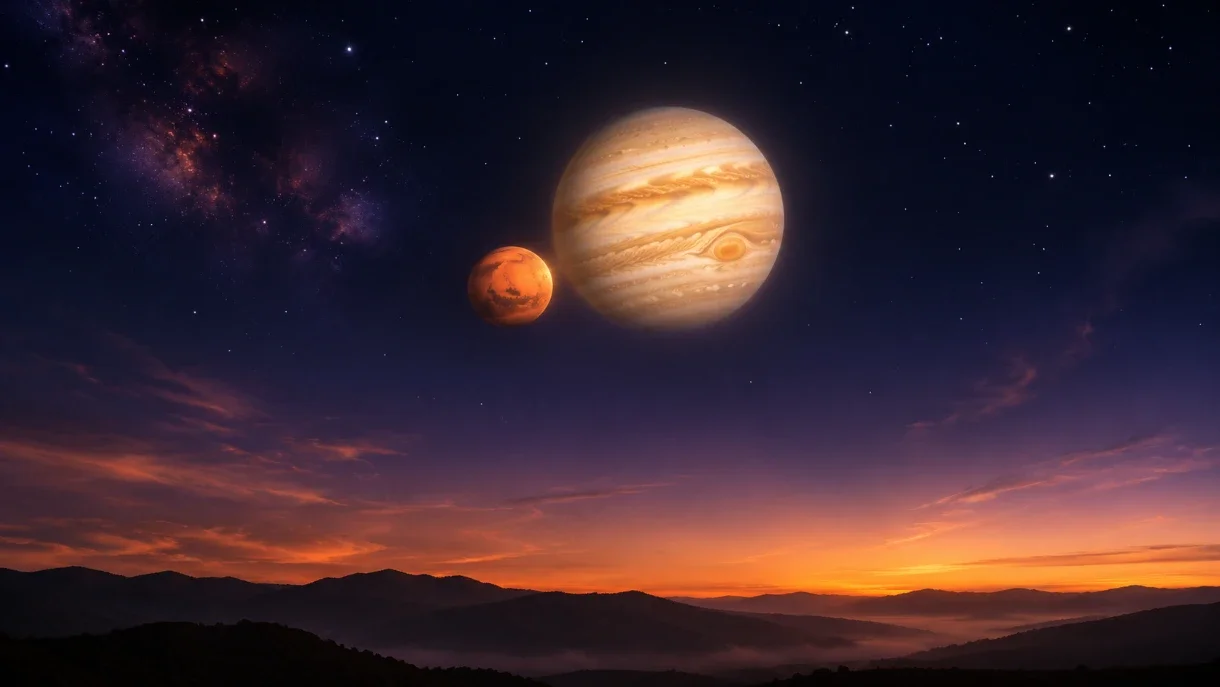
Mars and Jupiter meet on November 16, 2026, in a remarkable celestial encounter. In Vedic astrology, their conjunction in Magha Nakshatra—close to Ketu—adds a deeper story of courage, wisdom, leadership, and ancestral legacy. Explore the science, Jyotisha calculations, and what this transit may mean for your birth chart.
Two planets traditionally linked with love and communication are moving retrograde at the same time. Explore November 2026 through the lens of Vedic astrology, from Libra and Virgo to the deeper meaning of your birth chart.
Discover your November Power Score, the month's defining themes, and how the major planetary transits may be interpreted for your Vedic Ascendant (Lagna). Grab a coffee. This one's a long read.
The November 24, 2026 Full Moon brings a powerful combination of traditional Vedic symbolism: an exalted Moon in Taurus, Krittika Nakshatra, and the sacred observance of Kartik Purnima. Discover its spiritual significance, what makes this supermoon special, and how its meaning may differ according to your personal birth chart.